
ISO 27001 Automation: A Practical Cloud-Native Guide
September 28, 2026•CloudCops
Two weeks before a Stage 2 audit, the security lead opens a shared drive named Evidence_FINAL_v3 and finds three different role exports, a Confluence page nobody has updated since the last reorganization, and a folder of AWS console screenshots. One screenshot shows a firewall exception without an expiry date. Another proves log retention only for the account where someone remembered to run the report. The access review is technically complete, but nobody can explain which list was the authoritative one.
This is the point where ISO 27001 automation stops being a software preference and becomes an operating-model decision. The useful shift isn't collecting more screenshots. It's generating queryable evidence from the same Terraform, Kubernetes, GitOps, identity, and observability pipelines that run production. The difficult part is defining the boundary clearly. Some controls can be tested by machines. Others still depend on risk decisions, business context, ownership, and management approval.
The practical question is therefore not, “Which platform automates ISO 27001?” It's, “Which parts of the ISMS should the platform execute, which signals should it collect, and where must a human remain accountable?”
The Audit Screenshot Problem ISO 27001 Teams Know Too Well
The screenshot ritual usually begins innocently. An auditor asks for evidence that privileged access is reviewed, production changes are approved, and logs are retained. The team gathers exports from AWS IAM, Kubernetes, the SIEM, the ticketing system, and the identity provider. Someone renames the files, pastes links into a spreadsheet, and adds a note explaining why the timestamps don't quite line up.
By audit week, the evidence pack has become a reconstruction exercise. The security lead has to prove not only that a control existed, but that it operated within the relevant period, applied to the right scope, and produced an outcome that someone reviewed. A stale role list doesn't prove current access governance. A Terraform plan doesn't prove that the plan was applied. A green dashboard doesn't prove that the underlying collector had permission to inspect every account.
That distinction matters because ISO 27001 certification volumes have grown substantially. The ISO Survey 2024 reported 96,709 valid certificates covering 179,877 certified sites worldwide, compared with 36,362 certificates in the 2019 survey, roughly a 2.7x increase in five years (certification statistics and historical context). More sites, cloud accounts, teams, and recurring reviews make manual evidence collection harder to scale.
Practical rule: If an auditor can ask, “Show me the state before and after the change,” a single screenshot is probably weak evidence.
Automation replaces the ritual with a chain of evidence. An IAM query records current privileged identities. A CI job stores the policy evaluation that permitted a deployment. A GitOps controller reports drift. A SIEM preserves control-plane events under a defined retention policy. Each artifact has context, an owner, and a relationship to the control it supports.
That doesn't mean every Annex A requirement becomes code. Automation is strongest for repetitive, machine-verifiable work, while risk treatment, scope, policy approval, and management review remain governed activities. The rest of the operating model depends on separating those responsibilities before buying or building tooling.
Which ISO 27001 Controls Can Be Automated
A Kubernetes deployment can pass every pipeline check and still leave an audit gap if nobody can prove who approved the exception or whether the evidence covered the right production boundary. Classify controls by the evidence they require, then decide which parts belong in platform automation and which remain under ISMS governance.
A control is a strong automation candidate when its expected state can be expressed as a query, its data source is authoritative, and a failure has a defined response. Identity and technical configuration often meet those conditions.
For example, A.5.16 identity management can combine records from an identity provider, HR system, and IAM API. A.8.2 privileged access rights can test role assignments, group membership, and approval records. A.8.15 logging can verify SIEM ingestion and retention settings. A.8.9 configuration management can compare deployed resources with Terraform state, approved baselines, or policy-as-code rules.
The pipeline can produce the evidence. A person still owns the decision.
An automated access report may identify an administrator whose employment status changed. It cannot determine whether a temporary exception remains justified, whether the business owner accepts the risk, or whether the review covered the correct scope. Those decisions belong in the ISMS workflow, with an accountable owner and retained approval.
Use a control triage before selecting tools
For each candidate control, record four statements:
- Expected state: What must be true?
- Authoritative signal: Which system can prove it?
- Failure action: What happens when the state changes?
- Human decision: Which judgment cannot be delegated?
This separates automated execution from workflow assistance. A trigger that asks a manager to review access does not perform the control by itself. A dashboard displaying a policy document does not prove that the policy was approved, communicated, and applied.
| Control Theme | Annex A Example | Automation Level | Primary Evidence Source |
|---|---|---|---|
| Identity and access | A.5.16 identity management | High for provisioning, deprovisioning, and access queries | Identity provider, HR system, IAM APIs |
| Privileged access | A.8.2 privileged access rights | High for role and entitlement checks, medium for exceptions | Cloud IAM, Kubernetes RBAC, approval tickets |
| Logging | A.8.15 logging | High for collection, routing, and retention verification | SIEM, cloud control-plane logs |
| Configuration | A.8.9 configuration management | High for declared infrastructure and drift detection | Terraform, Terragrunt, cloud APIs |
| Policies | A.5.1 policies for information security | Low to medium | ISMS repository, approval workflow |
| Threat intelligence | A.5.7 threat intelligence | Medium for collection, low for interpretation | Threat feeds, incident records, risk register |
| Classification | A.5.12 classification of information | Low to medium | Data inventory, classification decisions, owner approvals |
Research places the achievable ceiling well below full hands-off compliance. One academic analysis identified 37 automatable controls, representing 27.8% of the total ISO 27001 security controls, and concluded that about 30% of ISO 27001 and NIST SP 800-53 security controls could be automated with existing tools (academic analysis of control automation). A separate analysis describes communications and operations and access-control domains as the most automatable, while governance-heavy policy and organizational security domains approach zero automation (control-domain automation analysis).
The practical output is a hybrid responsibility map. The platform proves what happened, when it happened, and which source produced the result. The control owner decides whether the result is acceptable. The ISMS manager maintains the relationship between risk, control scope, and retained evidence. Leadership approves decisions that change risk exposure.
For a broader mapping of cloud operations to ISO requirements, the ISO 27001 compliance guide for cloud teams provides useful context. Use it to frame the operating model, then define the system boundary, evidence sources, and approval points for your own environment.
Building the Cloud-Native Automation Pipeline
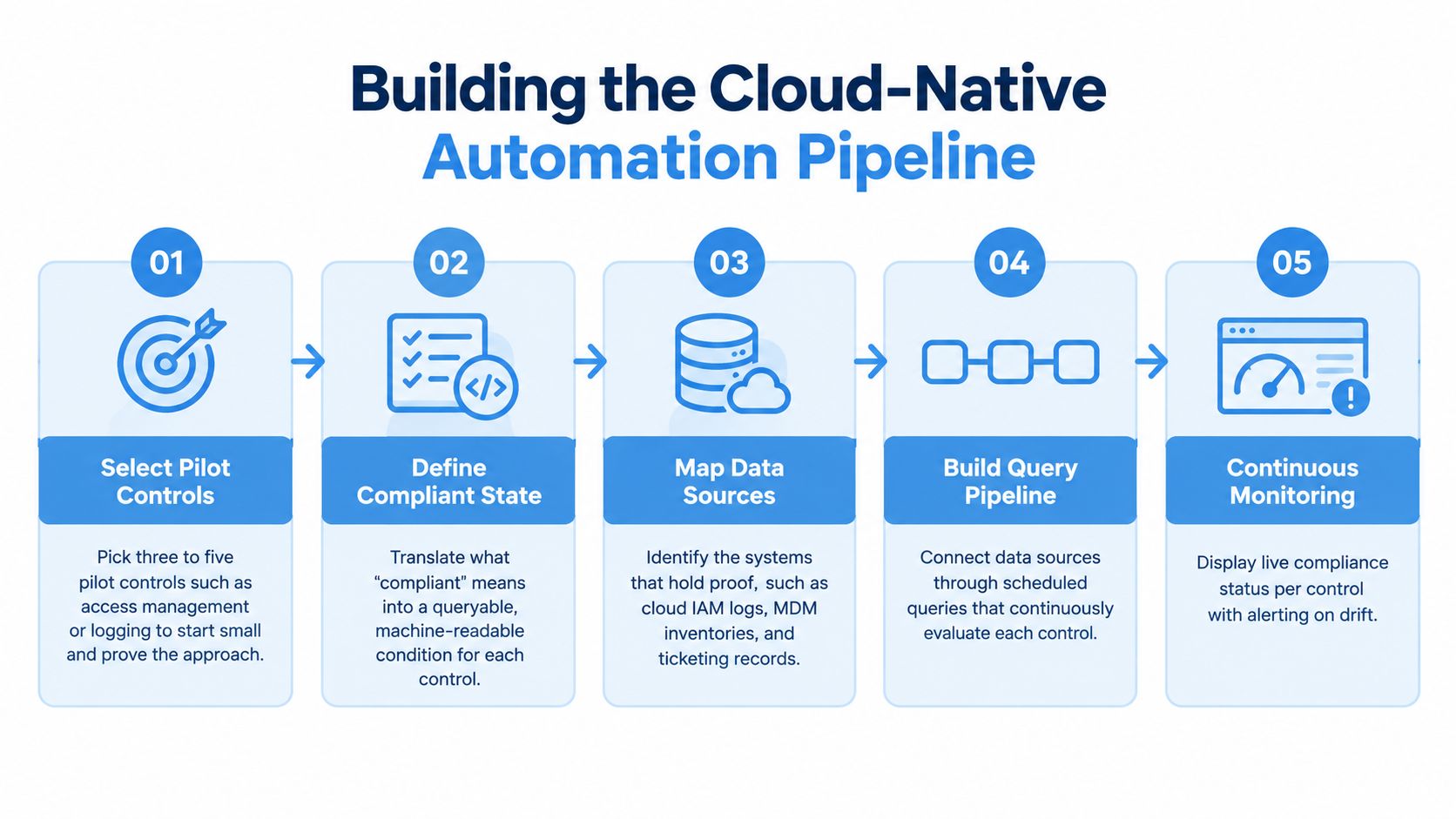
The first implementation mistake is opening a tool catalogue before defining evidence. Start with a small control set and describe the compliant state in language that an engineer can query.
Choose three to five pilot controls, ideally from access, logging, and configuration. For each one, create a control-to-evidence record containing the control statement, system boundary, expected state, query or test, evidence owner, failure route, retention requirement, and human approval point. If the team can't agree on those fields, a new platform won't resolve the ambiguity.
Define the state before writing the rule
“Access is reviewed regularly” is an audit intention, not a machine-readable condition. A better definition might state that every privileged production group has an owner, every member has a current employment record, every entitlement has an approval reference, and revoked identities no longer appear in the effective permission set.
The exact query depends on the environment, but the design principle is stable. A control should produce a reproducible answer, not a manually curated status label. Store the query, its version, the data sources it used, and the result that was generated.
Put preventative checks in infrastructure code
Terraform or Terragrunt should establish the baseline for IAM, network boundaries, encryption settings, and logging destinations. OPA or Conftest can evaluate plans in pull requests before infrastructure reaches an account. A failed rule should identify the resource, the violated condition, the repository commit, and the route for remediation.
For example, a policy can reject a storage resource without encryption, prevent a production role from using an unapproved wildcard permission, or require a logging destination for a control-plane service. The rule doesn't decide whether an exception is justified. It blocks the default path and forces an explicit, reviewable decision.
Reconcile runtime state with Git
Git approval proves that a change passed the delivery workflow. It doesn't prove that the running environment still matches the approved state. Argo CD or another GitOps controller can reconcile workloads, report drift, and preserve the relationship between a declared manifest and the cluster state.
That runtime signal should feed the evidence system rather than remain on an operations dashboard. A drift event needs a timestamp, affected object, observed state, declared state, owner, and remediation outcome. Teams adopting these patterns can use GitOps practices for controlled delivery as an engineering reference, then adapt the workflow to their audit scope.
Make observability part of the control path
Forward cloud control-plane events, Kubernetes audit records, authentication events, and relevant pipeline logs to a SIEM. Align retention with the evidence requirement for the logging control, and test that the collector can see the accounts, clusters, and regions in scope.
The pipeline should emit evidence at every stage:
- Plan evidence: Terraform or Terragrunt plan output (with sensitive values redacted or marked ephemeral, stored in encrypted, access-controlled, audited storage), policy results, and commit identity.
- Approval evidence: Pull request review, ticket reference, and exception decision.
- Deployment evidence: CI run, artifact digest, deploy identity, and GitOps reconciliation result.
- Runtime evidence: Configuration queries, drift alerts, and control-plane telemetry.
- Remediation evidence: Ticket status, owner, resolution, and validation result.
A separate cloud audit workflow can then replay the chain without relying on a console session. Research on cloud-based ISO 27001 and PCI DSS automation describes a model in which evidence collection is wired to IAM, configuration baselines, logging, and change-management signals, with reported reductions in manual audit workload of roughly 75% (cloud audit automation research). Treat that figure as a reported model outcome, not a guaranteed project result. Integration quality determines whether the automation produces complete proof or just another dashboard.
Designing the Audit Evidence Workflow
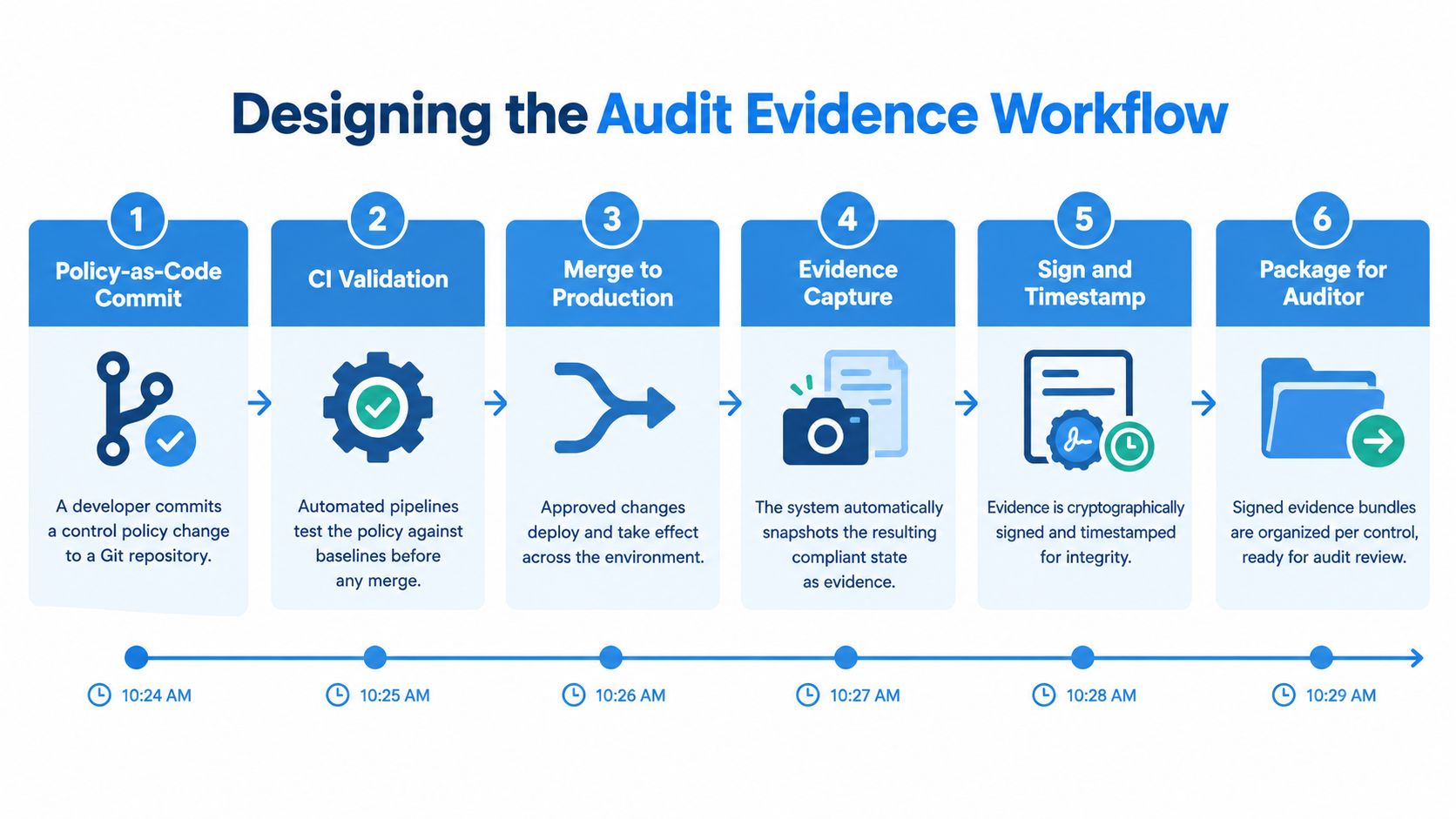
A defensible evidence workflow preserves the full path from control intent to observed result. Consider a policy change that requires every production deployment to carry an approved change reference.
A developer commits the policy to Git. CI evaluates the policy against representative manifests and infrastructure plans. Reviewers approve the pull request. The merge triggers deployment. The platform captures the test result, approval record, commit identifier, deployed version, and runtime observation. The evidence system then indexes those artifacts against the control and records any exception separately.
Preserve provenance, not just files
A useful evidence record answers five questions:
- What was tested?
- When was it tested?
- Which scope did the test cover?
- What result did the system produce?
- Who owned the response?
Hash and timestamp exported artifacts where appropriate, then keep the metadata that lets an auditor follow the chain. An OPA violation should connect to the pull request that resolved it. A Terraform drift finding should connect to the affected resource and remediation ticket. A Kubernetes audit event should retain the identity and action that changed the object.
Audit logging practices for cloud environments help operational teams avoid collecting logs without preserving useful context. Retention alone doesn't create evidence. The record must demonstrate how the signal relates to the control.
Package evidence around the auditor's questions
A practical bundle might contain:
- 00-scope-and-index: ISMS scope, control list, evidence index, and system boundaries.
- 01-access-control: identity extracts, privileged access tests, approvals, and revocation results.
- 02-configuration: baseline definitions, policy evaluations, drift results, and remediation records.
- 03-logging: collector configuration, SIEM queries, retention verification, and sample events.
- 04-change-management: pull requests, CI results, deployment records, and exception references.
- 05-human-governance: risk assessments, treatment plans, policy approvals, and management reviews.
The last folder is deliberately human-owned. A machine can show that an exception was opened and that a ticket reached approval status. It can't create the underlying risk acceptance rationale or demonstrate that management understood the residual risk.
For readers who need broader context on preparing audit material, the IT Cloud Global audit guide for Houston offers a useful perspective on organizing technical audit work around scope, records, and review.
The sequence also benefits from a visual walkthrough:
A strong package doesn't overwhelm the auditor with raw telemetry. It presents a control index, a concise test description, linked artifacts, exceptions, and a clear statement of what requires management interpretation. That structure makes continuous evidence consumable rather than merely abundant.
Choosing Your Automation Toolchain
There isn't one correct stack. The right choice depends on whether the team needs a small evidence collector, a tightly integrated platform workflow, or vendor-managed control mapping across many systems.
A very small team may begin with point tools such as Steampipe, cloud-native queries, Git repositories, and a carefully maintained spreadsheet. This pattern is inexpensive and transparent. It works when the environment is narrow and the team can maintain the queries, ownership records, and evidence index. It fails when the spreadsheet becomes the system of record or when collectors don't cover every account and service.
A mid-sized platform team usually gets more depth from an engineering-native stack. Terraform or OpenTofu defines infrastructure, OPA or Conftest enforces rules, Argo CD or Flux reconciles workloads, and a SIEM stores telemetry. This approach fits teams that already operate through pull requests and CI/CD. Its trade-off is ownership. Engineers must maintain policies, integrations, exception workflows, and evidence packaging as the platform changes.
Full GRC platforms such as Vanta or Drata can reduce the integration work required to connect cloud APIs, HR records, policies, and audit workflows. They're useful when the organization needs vendor-managed collectors, cross-framework mapping, control-gap scoring, and a central view for non-engineering stakeholders. They don't automatically resolve ambiguous control definitions or replace technical validation in Kubernetes and infrastructure pipelines.
| Toolchain Pattern | Typical Cost | Integration Depth | Cloud-Native Fit |
|---|---|---|---|
| Point tools and spreadsheets | Low to moderate, depending on tooling and internal effort | Narrow unless maintained in-house | Good for small, bounded environments |
| Policy-as-code and GitOps stack | Engineering time plus existing platform tooling | Deep inside CI, IaC, Kubernetes, and observability | Strong for platform-led compliance |
| Full GRC platform | Commercial subscription and implementation effort | Broad SaaS, HR, cloud, and workflow coverage | Variable, strongest when API collectors cover the stack |
| Hybrid model | Combined platform and engineering costs | Broad governance plus deep runtime evidence | Often practical for growing cloud teams |
The important cost is not only the subscription. It includes connector maintenance, cloud permissions, policy ownership, auditor support, exception handling, and the effort required to investigate false positives. Research on the market identifies a split between lightweight tools and heavier GRC platforms, with reported pricing ranging from roughly £3,000 per year to tens of thousands annually, before separate audit fees (automation cost and platform trade-offs). Those figures vary widely, so use them as market context rather than a budget assumption.
CloudCops GmbH is one option for teams that want engineering-led implementation. It maps Annex A requirements into Terraform, Kubernetes, GitOps, CI/CD, and policy-as-code workflows, with automated audit evidence built around the platform's actual delivery and observability systems. The useful test is whether the resulting controls remain understandable and maintainable by the team that operates them.
Common Pitfalls and Metrics That Matter
A green dashboard can hide a failed control. One collector may inspect a single AWS account while the certificate scope covers several. A Terraform policy may validate planned changes but miss console edits. An access workflow may send reminders while no one records the final approval. These gaps sit between platform automation and the human-governed ISMS, so they require different owners and tests.
As the earlier control-triage analysis showed, only a limited share of ISO 27001 controls can be machine-automated with current tooling (control automation benchmark). The practical risk is overcounting. A workflow trigger, dashboard widget, or evidence upload can support a control without performing the control itself. The platform may prove that a Kubernetes admission rule ran, for example, while a risk owner still decides whether an exception is acceptable, a supplier remains approved, or management review is complete.
Watch the failure modes
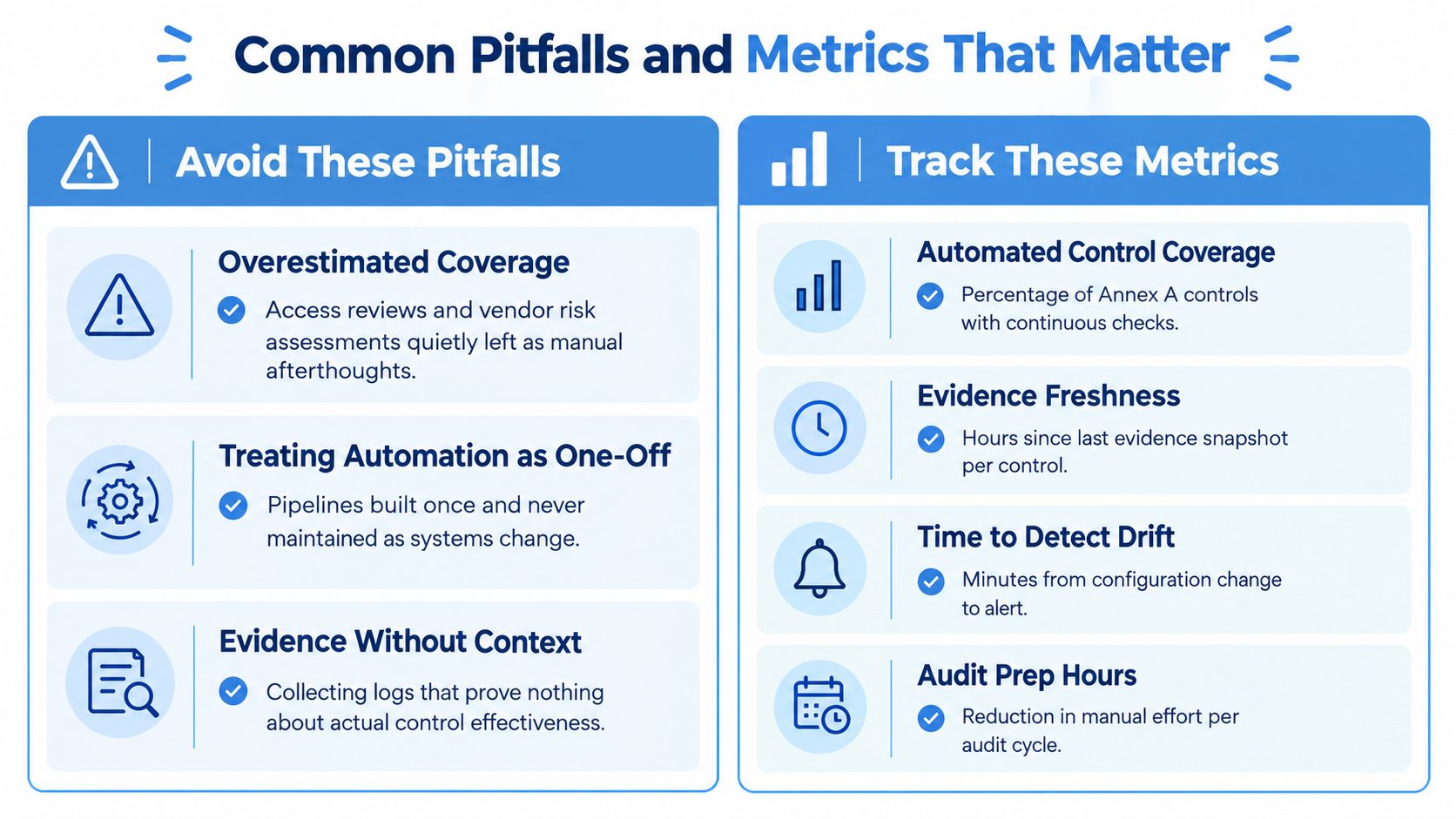
- Overestimated coverage: Teams automate access evidence but leave access decisions, vendor reviews, and classification judgments outside the operating rhythm.
- One-off policy migration: Engineers write OPA rules, pass an audit, then fail to update them as services, accounts, or deployment patterns change.
- Unmanaged exceptions: Temporary bypasses remain open without an expiry, owner, compensating control, or closure test.
- Untrusted signals: A dashboard stays green because a collector failed open, queried the wrong scope, or lacks permission to inspect the resource.
- Evidence without context: Logs exist, but nobody can connect an event to its control, change, approval, or remediation result.
Measure operating health
Track signals that show whether the operating model is reducing uncertainty:
- Mean time to remediate a control failure: How long does a failed test remain unresolved?
- Machine-verified evidence coverage: What share of in-scope controls has current, queryable evidence?
- Evidence freshness: How long since each control produced a validated snapshot?
- Open exception ratio: How many exceptions remain open, and how many passed their expiry?
- Unowned risk treatments: Which decisions lack a named accountable owner?
- Drift detection time: How quickly does an unauthorised configuration change create an alert?
Run a weekly readiness check. Confirm collector permissions, inspect failed tests, review expiring exceptions, sample evidence provenance, verify owners for human decisions, and replay one control from source signal to auditor package. This catches broken handoffs before an auditor does.
The metric that matters most is not the number of green controls. It is whether the team can explain every red control, exception, and missing signal without reconstructing the story from memory.
Automation should make that explanation routine. It does not remove ISO 27001 governance. It gives governance owners reliable facts while giving platform engineers a repeatable way to enforce the technical states they control.
CloudCops GmbH can map ISO 27001 Annex A controls into Terraform, Kubernetes, GitOps, policy-as-code, and CI/CD workflows that generate audit evidence from platform activity. Visit CloudCops GmbH to discuss control mapping, evidence pipelines, and ongoing platform support.
Ready to scale your cloud infrastructure?
Let's discuss how CloudCops can help you build secure, scalable, and modern DevOps workflows. Schedule a free discovery call today.
Continue Reading
Cloud Security Strategy: 2026 Playbook
Build a cloud security strategy for 2026 with core pillars, frameworks, policy-as-code, KPIs, and a roadmap for startups, SMBs, and enterprises.
Audit Logging Best Practices: 2026 Security Guide
Master audit logging best practices for cloud security. Our 2026 guide covers aggregation, integrity, compliance, & examples for AWS, Azure, GCP.
Mastering Infrastructure as Code Security in 2026
Secure your cloud with our 2026 guide to infrastructure as code security. Learn to mitigate risks, implement policy-as-code, and protect CI/CD pipelines.