
What Is Platform Engineering and Why It Matters Now
September 19, 2026•CloudCops

Platform engineering is the discipline of building and running an Internal Developer Platform that gives engineering teams self-service paths to production, and 83% of organizations have already adopted it in some form, with 20% fully adopted and only 17% reporting no plans to adopt (CloudBees survey data). If you're asking what is platform engineering, the practical answer is simple: it's the team and system that turns cloud complexity into a reliable, self-service product for developers.
That probably sounds familiar because many teams are living the same pattern right now. A developer needs a staging environment, opens a ticket, waits, gets half the access they need, then pings three people on Slack. Meanwhile, an SRE keeps restarting the same flaky pipeline and an engineering manager wonders why delivery still feels slower than it should.
This is the gap platform engineering is trying to close. Not with another portal nobody uses, and not by renaming the ops team. The job is to make the common path to shipping software fast, safe, and boring in the best possible way.
A Plain-English Definition of Platform Engineering
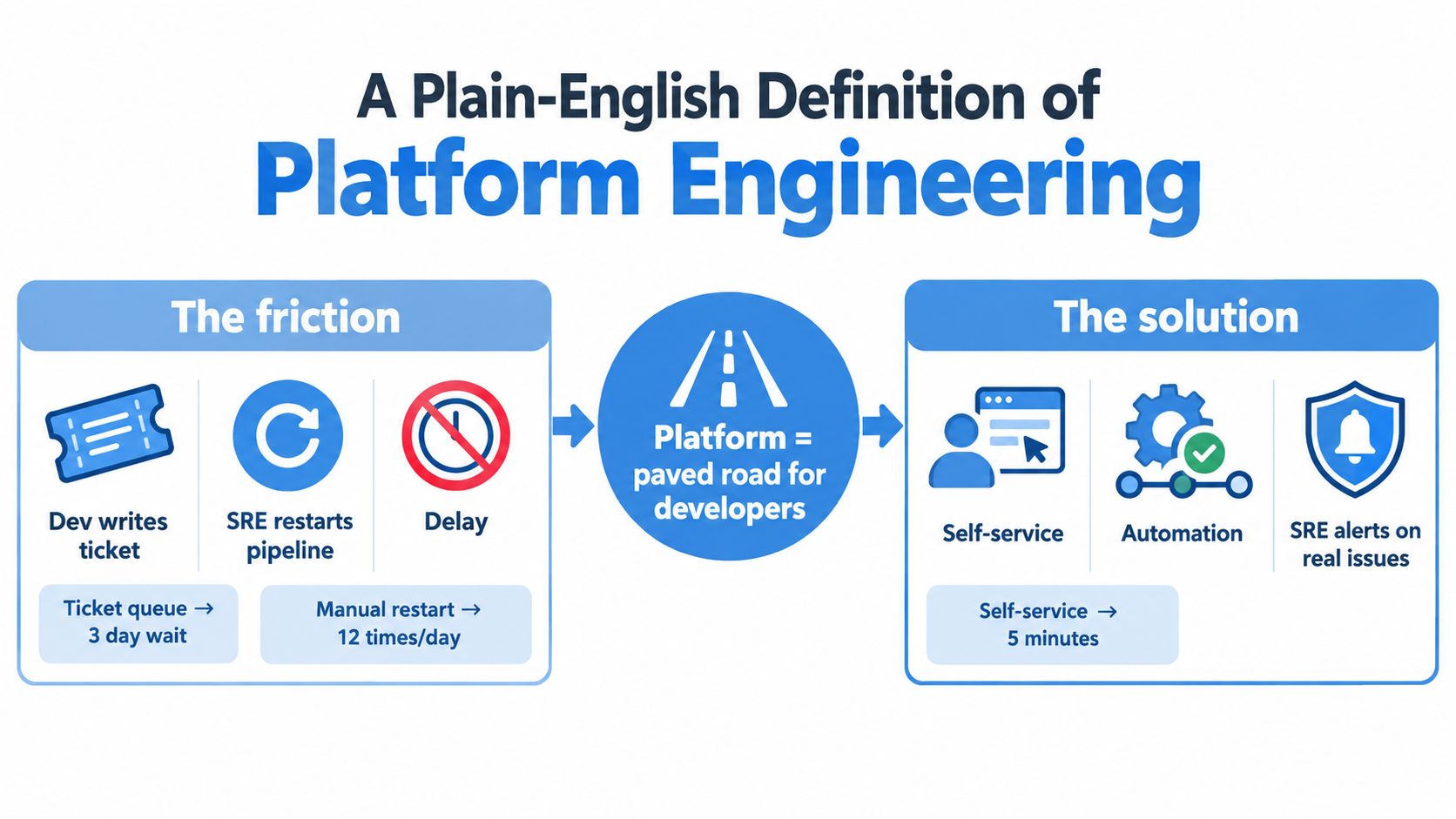
Monday morning. A developer is ready to ship a small service update, but the work stalls before a single user sees it. They need a repo template, a CI pipeline, cloud access, secrets, a deployment target, logs, dashboards, policy checks, and someone to approve the last missing permission. None of those steps is unusual. The problem is that each one lives in a different place, with a different owner, and a different way to ask for help.
Platform engineering exists to remove that friction at the system level.
In plain English, platform engineering is the practice of building and running an Internal Developer Platform, or IDP, that gives software teams a clear self-service path to do common delivery work safely. That path usually covers things such as creating services, deploying code, getting environments, viewing telemetry, handling secrets, and meeting security requirements without stitching the process together by hand every time.
City infrastructure as a model
City infrastructure is a useful model because it shows what platform teams own. They do not decide what every building should look like. They make sure roads, power, water, and signage are reliable enough that builders can focus on the building itself.
A software platform serves the same role. Application teams still own product code and product decisions. The platform team provides the shared delivery systems underneath: cluster access, deployment workflows, identity, secrets, observability, policy controls, and service templates. If those basics are consistent and easy to use, teams spend less time relearning infrastructure and more time shipping product changes.
A simple test helps here.
If developers need to memorize your infrastructure model before they can release software, you are still exposing internal plumbing. A platform starts when the common path becomes clear enough that teams can use it with confidence, without opening a trail of tickets or hunting down the one person who knows how the pieces fit together.
An IDP is a product for developers
This is the part many organizations miss. An internal developer platform is not just a portal, and it is not a pile of scripts with a nice name. Buying tools can help, but tools alone do not create a platform people use.
That adoption versus usage gap matters more than the definition itself. Plenty of companies can say they "have a platform" because they installed Backstage, standardized on Kubernetes, or published templates. Developers may still avoid the paved road if the workflow is slow, confusing, or missing key steps. In practice, platform engineering only works when the platform behaves like a real internal product with users, service expectations, support, and feedback loops.
A useful platform usually includes:
- Self-service workflows for routine tasks such as provisioning environments or deploying services
- Golden paths for common service types, with sensible defaults already in place
- Guardrails that enforce security, compliance, cost, and reliability rules in the flow of delivery
- Documentation and support that answer real tasks, not just describe the underlying tools
- Usage signals that show whether teams are choosing the platform instead of working around it
That last point is becoming more important in the AI era. Platforms are no longer serving only human developers clicking through workflows. They increasingly need to support automation, code-generating assistants, and machine-driven delivery tasks that require the same clear interfaces and guardrails. That is one reason some teams also look at adjacent systems such as an AI employee platform when they plan how internal workflows will operate a year or two from now.
The definition is useful only if it changes outcomes
A short definition is helpful, but it can also hide the job. The goal is not to assemble a modern-looking stack. The goal is to improve delivery performance in ways teams can feel and leaders can measure.
A mature platform reduces wait time, cuts down on handoffs, and makes the safe path the fast path. Those changes are what later show up in DORA outcomes such as deployment frequency, lead time for changes, change failure rate, and time to restore service. So the plain-English definition is this: platform engineering builds the shared delivery product that developers will use, and it is successful when that product improves software flow instead of adding one more layer to learn.
The term itself grew out of years of DevOps practice, internal tooling, and product thinking for developer experience, as noted earlier. The important shift was not the label. It was the realization that shared infrastructure works better when it is designed, operated, and measured like a product for internal users.
How Platform Engineering Differs from DevOps and SRE
Teams mix these terms together all the time, which is understandable because they overlap. But they are not the same thing.
DevOps is mainly a way of working. SRE is mainly a reliability practice. Platform engineering is the product-oriented function that builds the paved road they both benefit from. DevSecOps folds security into the lifecycle instead of treating it like a final checkpoint.
The quickest way to separate them
| Discipline | Scope | Owner / Team Shape | Primary Metrics | Mindset |
|---|---|---|---|---|
| Platform Engineering | Internal platform, self-service workflows, reusable delivery paths | Dedicated platform team | Adoption, usage, platform reliability, delivery flow, developer experience | Product thinking for internal users |
| DevOps | Collaboration across development and operations | Shared across engineering, not one team | Flow, feedback, automation, shared ownership | Cultural and operational |
| SRE | Reliability, availability, incident response, toil reduction | SRE team or embedded reliability engineers | SLOs, error budgets, incident metrics | Reliability engineering |
| DevSecOps | Security integrated into delivery workflows | Shared across platform, security, and app teams | Policy adherence, secure delivery, reduced late-stage security friction | Shift security into the path |
The common mistake is to say, “We have a DevOps team, so we're doing platform engineering.” Maybe. But maybe not.
If that team mostly handles tickets, manually provisions environments, and acts as a general cloud support desk, it hasn't become a platform team yet. The mandate has to change from service fulfillment to product design.
A practical ownership model
Here's a simple way to think about ownership:
- DevOps has no single owner. It's a behavior and operating model.
- SRE owns reliability outcomes and spends energy on service health, incident patterns, and toil.
- Platform engineering owns the internal platform and its interfaces.
- DevSecOps means security controls are built into the path rather than added after the fact.
That distinction matters when you set budgets and expectations. A platform team shouldn't be measured only by uptime of clusters. It should also be measured by whether teams can use the system without hand-holding.
Many companies don't fail at platform engineering because the tech is wrong. They fail because they rename an ops group and keep the same ticket-based incentives.
The overlap is real, but the job is different
Strong platform teams work closely with SREs. They often adopt DevOps values. They usually partner with security engineers. But their center of gravity is different.
They ask questions like: Which workflows deserve a golden path? Where do developers drop off? Which interfaces create confusion? Which abstractions reduce cognitive load without hiding too much? If you want a more role-specific comparison, this breakdown of platform engineer vs DevOps is a useful companion.
That last point about abstraction is important. A platform should simplify the common path, not erase operational reality so completely that developers can't understand the systems they run.
A Brief History from DevOps to Internal Platforms
A common scene played out in a lot of engineering orgs during the cloud boom. A product team got the keys to ship faster, then discovered the keys also came with Kubernetes YAML, Terraform state, CI failures, access rules, dashboards, alerts, and a pager.
That was the turning point.
DevOps had pushed the industry in the right direction. Closer ownership between development and operations removed handoffs and sped up delivery. But in many companies, self-service arrived before the path was safe and easy to use. Teams were told to move faster, while the road in front of them was still gravel.
Platform engineering grew out of that gap. The discipline took shape when companies realized that autonomy only works at scale if the common path is paved, guarded, and maintained like a shared road system. Otherwise every team builds its own driveway, and the organization pays for that duplication in slower releases, uneven reliability, and higher cognitive load.
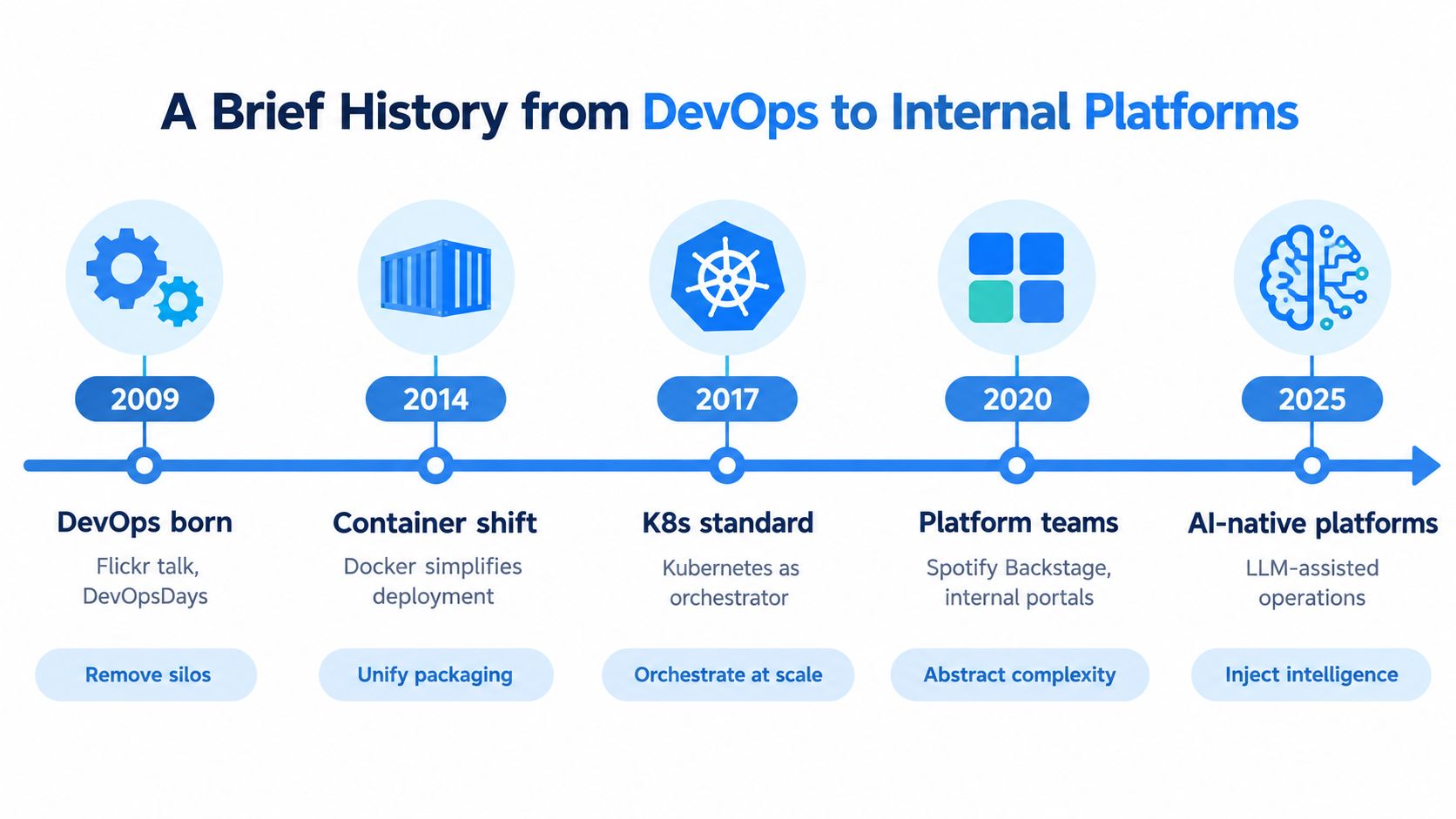
The practice came first. The label came later
Long before "platform engineering" became a standard title, teams were already building shared deployment paths, reusable infrastructure patterns, and paved roads for service delivery. The label became more visible once the community had a way to name the work and compare notes across companies.
One idea helped crystallize it. Team Topologies gave organizations a practical way to describe a platform team as a team that reduces cognitive load for stream-aligned teams. That framing mattered because it shifted the conversation from "who manages infra" to "how do we make delivery easier to use, safer, and more repeatable."
The output of that work is usually an internal developer platform. That phrase matters because it grounds the discipline in something testable. A platform is not a slide about standardization. It is the product developers use, or avoid.
That adoption-versus-usage gap is where many platform efforts stall. Leaders approve the budget, a team assembles a toolchain, and the platform technically exists. But developers keep bypassing it because the interface is confusing, the golden path is incomplete, or the platform adds another layer they have to learn before they can ship. A platform has not succeeded when it is available. It has succeeded when teams choose it because it saves time.
The AI shift is raising the stakes. As infrastructure, policies, and delivery workflows become easier to generate, the hard part moves even more toward curation, guardrails, and usability. More YAML is not the answer. Better defaults are. In that sense, the modern platform team is doing for AI-era delivery what good road engineers do for traffic. They are deciding where the lanes go, where the guardrails belong, and which routes should be fast by default.
You can also see the field maturing in how it talks about success. Recent academic work has examined platform engineering as an emerging discipline and noted that the evidence base is still developing, with much of the current knowledge coming from industry practice and case-based observation (multivocal review of platform engineering research).
That is a healthy place to be, as long as teams stay honest about outcomes. The useful question is no longer "did we stand up an internal platform?" It is "did the platform improve throughput, stability, and the developer experience enough to move DORA metrics in the right direction?"
A short video makes that shift easier to visualize in practice:
Core Components and Principles of a Modern Platform
A modern platform is easier to understand as a stack than as a shopping list.
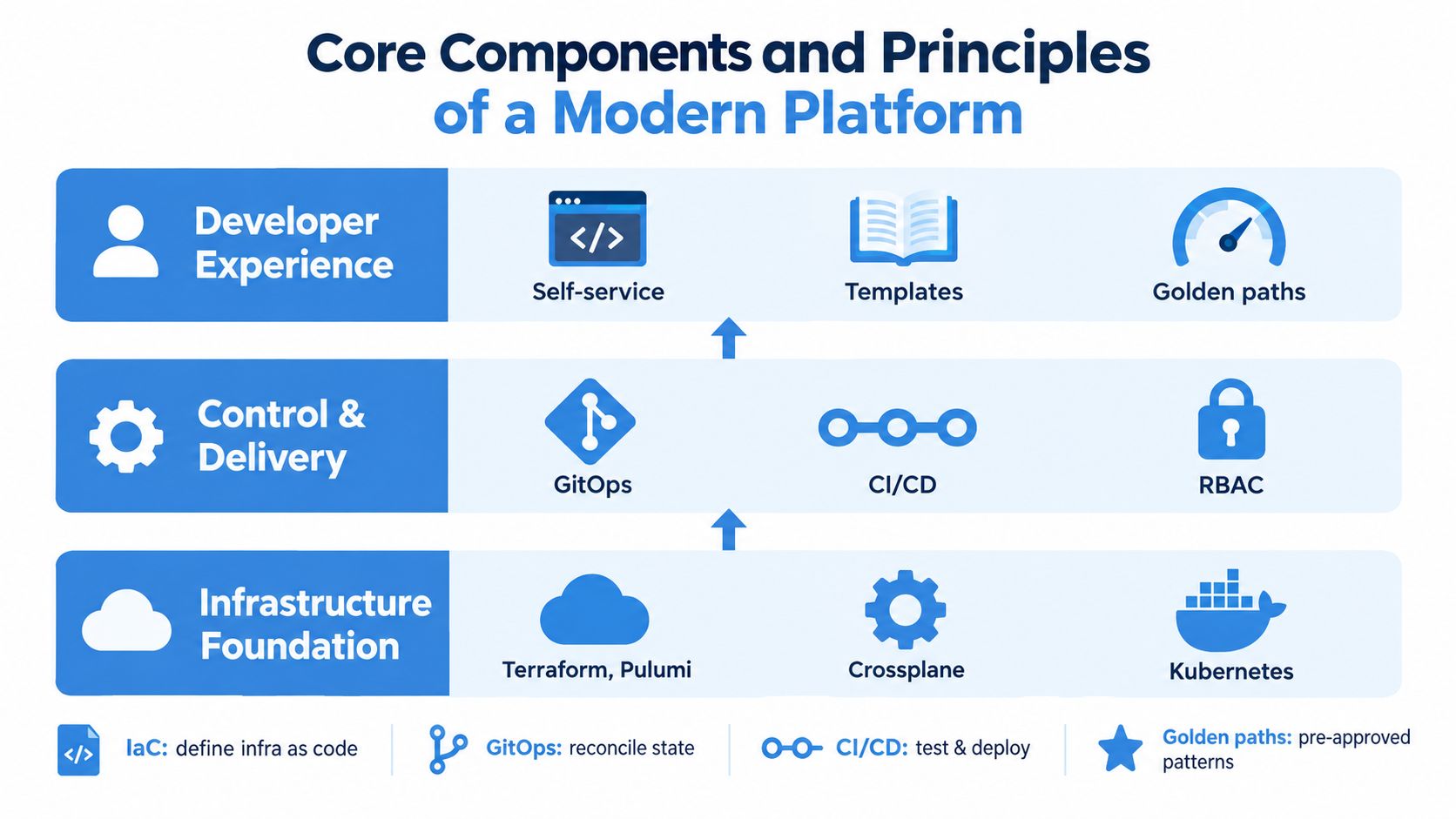
If you only list tools, everything sounds optional and interchangeable. The parts reinforce each other. Infrastructure definitions feed provisioning. Delivery systems push code through a standard route. Observability closes the loop. Security and policy shape what “safe self-service” means.
Foundation layer
At the bottom, you usually have Infrastructure as Code.
Tools like Terraform, OpenTofu, Pulumi, and Crossplane define the cloud resources, cluster patterns, networking, and supporting services the platform depends on. Consistency starts here. If every environment is assembled by hand, the platform never becomes trustworthy.
On top of that sits the runtime baseline, often Kubernetes for teams operating cloud-native systems. Not every company needs Kubernetes, but many platform teams use it because it gives them a common control plane for application delivery.
Control and delivery layer
The next layer is the system that turns intent into running software.
Common pieces include:
- GitOps controllers such as Argo CD or Flux, which reconcile declared state with what runs
- CI/CD pipelines that test, build, scan, and release code through repeatable workflows
- Identity and access controls that decide who can deploy what, where, and under which policies
- Secrets management so credentials don't spread through ad hoc scripts and chat messages
The platform starts feeling real to developers. Instead of “talk to ops,” the interface becomes “push code, choose a template, request an environment, and follow a known path.”
Recent CNCF and SlashData reporting based on responses from more than 400 professional developers found that platform engineering tools are now evaluated primarily across workflow automation, application delivery, and security/compliance management, which is a useful signal that the center of gravity has moved beyond provisioning alone (platform engineering maturity in 2026).
Experience and guardrails layer
At the top is the part people see.
That might be Backstage or another portal, but the portal is only useful if it exposes actual capabilities. Good platforms offer templates, service catalogs, documentation, approved deployment paths, and a clear way to request standard resources.
The best teams design this layer around reduced cognitive load:
- Golden paths for common work. A new API service shouldn't require reading five different repos.
- Embedded guardrails. Use OPA, Kyverno, or similar policy tooling so security and compliance checks happen in the path itself.
- Observability by default. Wire in OpenTelemetry, Prometheus, Grafana, Loki, or Tempo so teams don't bolt on visibility later.
- Documentation close to action. If the deploy template lives in one place and the instructions live somewhere else, adoption falls fast.
A platform should hide accidental complexity, not essential complexity. Developers still need to understand the behavior of their services, even if they don't have to handcraft every cluster rule.
Principles that matter more than the tool names
The tooling changes. The principles don't.
- Self-service beats ticket queues for repeatable work.
- Opinionated defaults beat endless flexibility for common service types.
- Product thinking beats internal IT thinking because developers are users, not requestors.
- Measured adoption beats assumed success because a platform nobody uses is just centralization with better branding.
That last point becomes even sharper when you look at business impact.
Business Benefits and DORA Metrics That Move
A CTO asks why the company should fund a platform team for another year. A staff engineer asks a simpler question: will this remove waiting, rework, and incident pain, or just add another internal product to learn?
That is the right test.
Platform engineering creates business value when it improves software delivery in ways leaders can see and developers can feel. The cleanest way to measure that is through DORA outcomes, because DORA focuses on delivery speed, stability, and recovery instead of counting tools, portals, or templates.
How platform capabilities map to delivery outcomes
| Platform Capability | DORA Metric Moved | Typical Directional Impact |
|---|---|---|
| Reusable service templates and paved paths | Deployment frequency | Teams release more often because they start from a known pattern instead of rebuilding the basics |
| Standard CI/CD workflows | Lead time for changes | Code reaches production faster because approval steps, tests, and handoffs are more predictable |
| Versioned config and controlled rollback paths | Mean time to recovery | Recovery gets faster because teams can revert to a known good state without improvising |
| Built-in policy checks and approved delivery flows | Change failure rate | Fewer releases fail because risky changes are caught earlier in the path |
| Default logs, metrics, and traces | Mean time to recovery | Incident diagnosis gets shorter because the first layer of visibility is already there |
| Self-service environments and infrastructure requests | Lead time for changes | Developers spend less time waiting on central teams for routine setup |
A good platform works like a well-designed airport. The traveler still needs to know where they are going, but signs, lanes, and security checks are built into the route. You do not make travel faster by removing all controls. You make it faster by making the safe path the normal path.
That trade-off matters. A platform with too much flexibility usually recreates the same inconsistency it was meant to reduce. A platform with too much control often pushes teams back to side scripts and unofficial workarounds. The useful middle ground is opinionated for common cases and expandable for the cases that need variation.
DORA is the scorecard, not the whole story
DORA tells you whether delivery is improving. It does not fully explain why developers choose the platform, or avoid it.
That adoption-vs-usage gap is where many platform programs stall. Leadership sees a portal launch and assumes the investment is working. Developers judge the platform by a stricter standard: does it save time this week? If the official path takes longer than the unofficial one, usage drops even if the platform looks complete on paper.
So measure both outcomes and behavior.
Look for signs such as:
- shorter wait time for common infrastructure requests
- fewer hand-built exceptions in service setup and deployment
- faster onboarding for new engineers joining a team
- lower support load on senior developers and central ops groups
- repeated voluntary use of the platform for everyday work
AI makes this more urgent, not less. As teams generate more code, configs, and automation with AI assistance, the volume of change rises. That raises the value of standard paths, policy checks, rollback safety, and default observability. In other words, AI can increase developer output, but platform engineering determines whether that extra output reaches production safely.
If you need a baseline for the delivery side of the model, this guide to DORA metrics and what they measure is a useful reference.
The business case is straightforward. Strong platforms reduce waiting, reduce avoidable mistakes, and reduce recovery time. The mature question is not "do we have a platform?" It is "are teams using it, and are delivery outcomes getting better because of it?"
A Practical Maturity Roadmap and the AI-Native Future
A familiar scene plays out in many companies. The platform team ships a portal, leadership sees a launch, and engineers keep doing the work through private scripts, copied Terraform, and Slack requests because those paths still feel faster.
That gap is the heart of platform engineering maturity. Adoption on an org chart is not the same as daily usage by developers. If the paved road adds clicks, waiting, or guesswork, teams leave it.
Recent reporting shows how wide that gap can get. One analysis points to a pattern where dedicated platform teams are common, while active developer usage still lags far behind, and many organizations still depend on mandated usage instead of voluntary pull (adoption versus usage analysis).
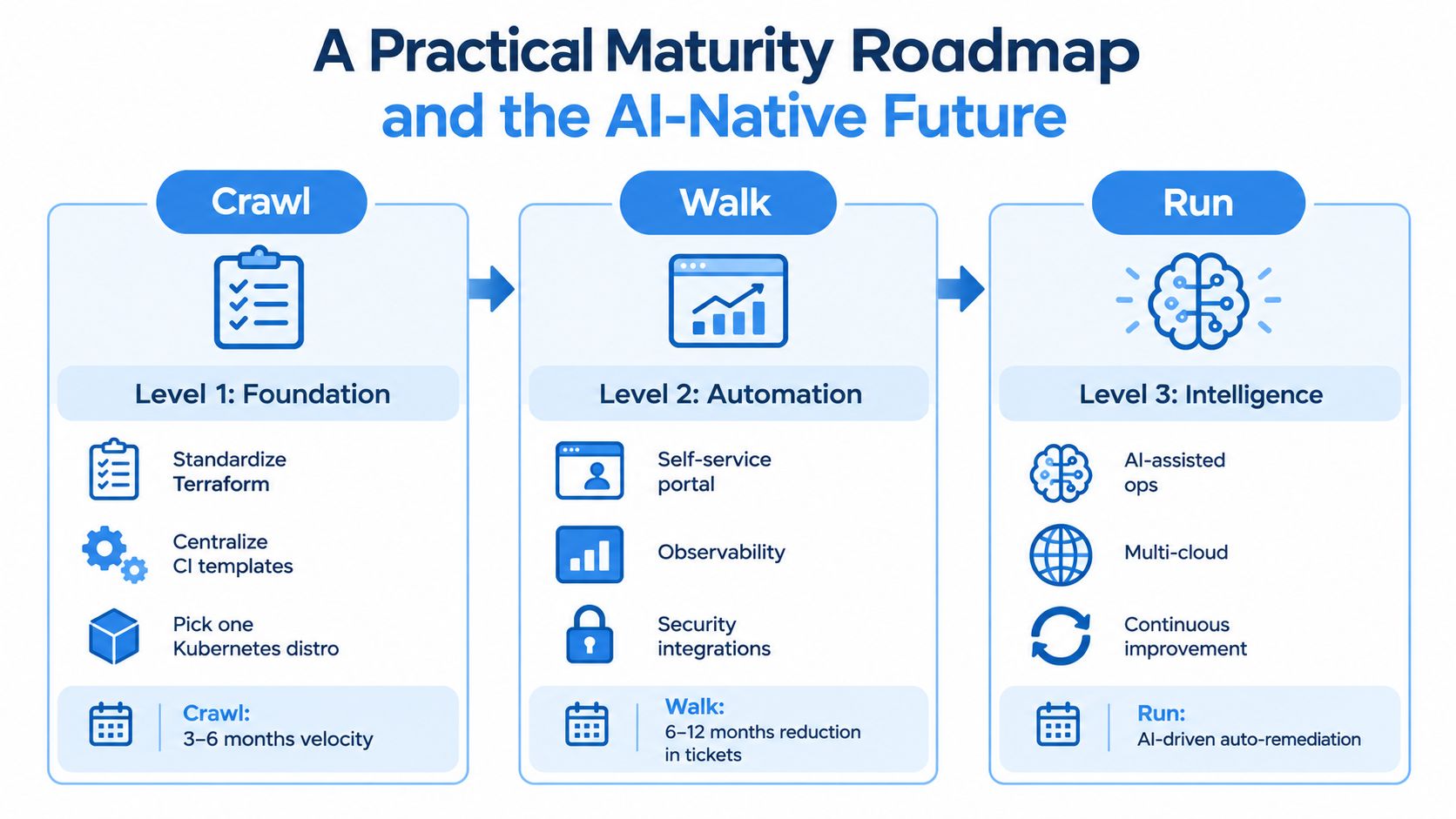
A useful roadmap is less like a software release plan and more like building roads in a growing city. You do not start with tunnels, flyovers, and smart traffic systems. You start by paving the route people already use every day, then you make that route faster, safer, and easier to trust.
Crawl
Start with one repeated pain that wastes engineering time every week.
For one company, that might be creating a standard service with CI, logging, and deployment wired in. For another, it might be provisioning a test environment without opening three tickets. The point is not breadth. The point is proving that the official path is easier than the workaround.
Good crawl-stage work often includes a small set of standard building blocks:
- one approved way to define infrastructure
- one CI pattern for the most common service type
- one deployment path for a standard application
- one place to ask for help and report friction
- one or two measures tied to delivery speed, such as time to first deploy or wait time for common requests
At this stage, a template repository and a few reliable automations can beat a large portal rollout. Developers trust platforms that save them an hour on Tuesday afternoon, not platforms that promise a grand future state.
Walk
The walk stage begins when teams ask for more platform paths because the first one worked.
Now it makes sense to add a self-service layer over stable capabilities. Teams often introduce GitOps with Argo CD or Flux, add OpenTelemetry by default, and use a portal such as Backstage to expose common workflows. The portal is the front desk. The actual service quality still depends on what happens behind the desk.
Golden paths need sharper boundaries. A good golden path should answer a simple question: if a team starts a new service today, what is the fastest safe route to production?
That usually includes:
- service creation with templates, metadata, CI setup, and observability defaults
- environment provisioning for standard workloads
- deployment and rollback through a known release path
- security and compliance checks built into the workflow
Measure behavior here, not just access. Track whether teams finish the workflows, how often they return, where they drop off, and whether delivery outcomes improve. If usage rises but lead time stays flat, the platform may be easier to click through without removing friction. If usage rises and DORA measures such as deployment frequency, lead time, or change failure rate improve, the platform is doing real work.
Run
A mature platform usually feels quiet.
Engineers can create, deploy, observe, and recover services through standard paths without needing a chain of approvals for routine work. Under the surface, the platform has stronger controls: policy checks, identity boundaries, secrets handling, cost visibility, and reliability expectations tied to service ownership. The experience feels simple because the hard parts were designed well.
Maturity here is not a bigger tool catalog. It is a tighter connection between platform behavior and business outcomes. Can a new team ship safely in days instead of weeks? Can incidents be contained faster because logs, traces, ownership, and rollback paths are already in place? Can platform engineers spend less time acting as ticket routers and more time improving shared systems?
Those are stronger signs of progress than a long architecture diagram.
The AI-native shift changes the platform's job
AI changes the volume and speed of engineering work. More code, more config, more generated pipelines, and more change requests enter the system.
That raises the value of platform engineering. If developers and AI agents can create artifacts faster, the platform has to make the safe path just as fast. Otherwise, teams produce more output that still gets stuck in review queues, policy gaps, or fragile release processes.
The latest edition of the State of Platform Engineering Vol. 4 frames this shift as a move from the cloud-native era into the AI-native era. In practice, that means platform teams may need to support more than human self-service.
Common additions include:
- AI-assisted workflows for routine setup, documentation, and configuration
- agent-facing interfaces that let automation invoke approved platform actions
- policy controls for both human and machine-initiated changes
- specialized paths for data-sensitive or GPU-backed workloads
A helpful way to frame it is this: the old platform mostly served developers through a UI and a set of APIs. The next platform serves developers and software agents together, with guardrails strong enough to keep speed from turning into noise.
What to do next
If your organization is early, resist maturity theater. Pick one painful workflow, make it faster, and prove it with usage and DORA movement.
If your organization is further along, test whether teams choose the platform when they have other options. Mandated adoption may improve standardization, but voluntary repeat usage is a better sign that the platform is acting like a product.
CloudCops GmbH is one example of a company working in this area, helping teams build cloud-native, cloud-agnostic internal platforms with IaC, GitOps, Kubernetes, observability, and policy controls. That kind of partner is useful when the goal is not assembling more tools, but improving delivery flow and governance together.
CloudCops GmbH helps teams design, build, and secure modern internal platforms with Kubernetes, GitOps, observability, and everything-as-code practices that support better delivery flow and stronger guardrails. If you're trying to turn platform engineering from a vague initiative into a usable product for developers, visit CloudCops GmbH to see how they approach platform engineering in real environments.
Ready to scale your cloud infrastructure?
Let's discuss how CloudCops can help you build secure, scalable, and modern DevOps workflows. Schedule a free discovery call today.
Continue Reading
Canary Deployment Strategy: A Practical Guide for 2026
Learn how a canary deployment strategy reduces blast radius and accelerates safe rollouts for startups and enterprises.

The 5-Layer GitOps Pipeline We Use for Every Enterprise Client
How we structure GitOps across infrastructure, platform, security, observability, and application layers — and why treating them as one flat repo doesn't scale.

How We Migrated Apache Kafka from VMs to Kubernetes (AKS)
Lessons from migrating a production Kafka cluster, 60+ Elixir microservices, and an entire Ansible-managed infrastructure to Azure Kubernetes Service — including the five things that nearly derailed us.