
How to Automate Software Deployment the Right Way
September 17, 2026•CloudCops
At 2:47 a.m., a regional bank deploys a patch to its core banking API. Builds finish in under five minutes, merges reach main daily, and the automated test suite is green. Twelve minutes later, transaction latency spikes, the fraud model rejects legitimate wire transfers, and the on-call engineer discovers that the rollback script points to a container tag that no longer exists.
The pipeline was fast. The release process wasn't safe.
That distinction matters when you automate software deployment. Automation can remove repetitive work, standardize execution, and support smaller releases, but it can also widen the blast radius when promotion rules, artifact traceability, rollback paths, and observability are weak. The strongest teams don't choose between speed and control. They build delivery systems where policy, evidence, and progressive exposure are part of the deployment itself.
The benchmark data supports that direction. The 2024 State of Software Delivery report from CircleCI recorded an average of 1.68 deploys per day, while describing multiple deploys per day as a pattern associated with top-performing teams. AWS guidance likewise places strong CI/CD performance across a range from multiple deployments each day to twice each week. The important point isn't a universal target. It's the operating model: small, observable changes with rapid recovery.
When Fast Deployments Become Risky Business
A successful build proves that code passed the checks you wrote. It doesn't prove that the release is safe for every dependency, data shape, traffic pattern, permission boundary, or production configuration.
In the bank scenario, the team optimized the visible part of delivery. Developers merged frequently, CI ran quickly, and tests completed without errors. The release still failed because the system lacked controls around promotion and recovery. Nobody had verified that the fraud model behaved correctly against production-like transactions, the rollback reference wasn't immutable, and the on-call path couldn't identify the last known-good artifact without searching across tools.
Practical rule: A deployment isn't successful because the new process started. It's successful when the service remains healthy and the team can prove what changed, why it changed, and how to restore the previous state.
Fast delivery increases the need for those controls. The DORA metrics guide defines deployment frequency, lead time for changes, change failure rate, and time to restore service as the core measures for delivery performance. These metrics create a useful control loop. Baseline current performance, automate repeatable steps, then check whether throughput improves without increasing remediation work.
The historical shift is clear. Teams have moved from occasional, manual releases toward daily and multiple-daily deployment patterns, and mature delivery systems treat that cadence as an operational capability rather than an exceptional event. A global 2023 survey reported that organizations had automated 56% of the end-to-end DevOps lifecycle, with that automation associated with a 61% improvement in software quality, a 57% reduction in deployment failures, and a 55% decrease in IT costs. The same report found that only 38% had a clear strategy for implementing DevOps automation, showing why tools alone don't solve the problem. These figures are documented in the Dynatrace report on DevOps automation.
A safe deployment system therefore needs more than a build job. It needs:
- Promotion rules that determine which artifact may enter each environment.
- Approval evidence that records identity, intent, and policy decisions.
- Progressive rollout controls that limit exposure when confidence is incomplete.
- Observability that connects production behavior to a specific release.
- Recovery paths that use immutable references and rehearsed procedures.
The rest of the design follows those principles, from pipeline stages and deployment patterns to approval gates, rollback strategy, governance, and release telemetry.
The Building Blocks of an Automated Deployment Pipeline
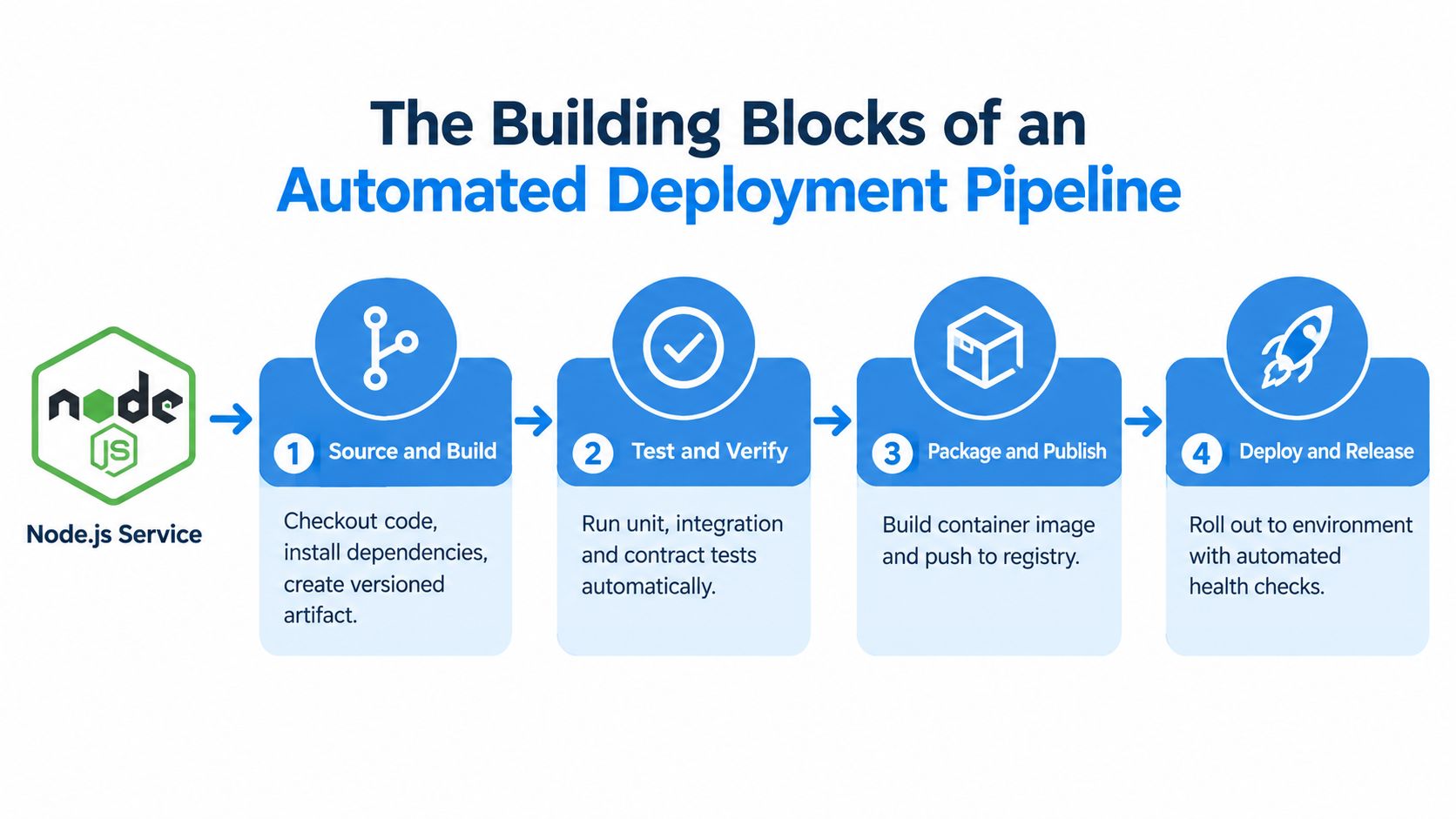
Use a Node.js service as the running example. The pipeline should create one deployable artifact, verify it, sign it, and promote that same artifact through environments. Rebuilding the application for staging and production creates two technically different releases, even when both came from the same commit.
Source and build
The first stage checks out a known commit, installs dependencies from a lockfile, and produces a reproducible artifact. Pin the Node.js runtime, package manager, base image, and build dependencies. Record the commit SHA and CI run identifier as metadata, not just as a human-readable version.
A GitHub Actions job might begin with source validation and a deterministic build:
- Checkout: Fetch the exact commit associated with the pull request or merge.
- Install: Use the lockfile and a pinned runtime.
- Build: Compile the service and create the container image.
- Record: Attach the commit SHA, build identifier, and dependency metadata.
Test and verify
Testing should reflect the ways the service can fail. Unit tests cover local behavior, integration tests check dependencies such as databases and queues, and consumer-driven contract tests protect API expectations between services. Security checks should include SAST, dependency analysis, secret scanning, and container image scanning.
A green unit suite can't validate a changed contract or an unsafe image. Required checks should block artifact publication when the result is unknown or fails.
Package and sign
Build the container image once and push it to a registry using an immutable digest. Generate an SBOM for the artifact, then sign the image with Cosign or another Sigstore-compatible workflow. A semantic version can help humans understand releases, but the deployment reference should remain tied to the digest and source commit.
The CD system should consume a signed image reference, not rerun the build. That separation makes the chain clear: CI creates evidence and an artifact, while CD promotes that artifact into a named target.
Release
The final stage renders an environment-aware deployment manifest. Application code stays unchanged, while environment configuration, replicas, resource limits, and external references are supplied through controlled configuration. Kubernetes manifests, Helm values, or Kustomize overlays should identify the exact image digest.
Teams working in regulated environments can use this CI/CD pipeline for regulated industries as additional context for separating delivery speed from evidence and control. A practical overview of the wider delivery model is also available in this guide to what CI/CD means in DevOps.
Store both the pipeline definition and deployment configuration in version control. Pipeline-as-code defines how validation and promotion execute. Pipeline-as-config defines targets, policies, and environment intent. If either lives only in a console, an administrator's manual change can escape review and make the next deployment impossible to reproduce.
Choosing the Right Pipeline Pattern for Your Team
The right pattern depends on where the source of truth lives, who initiates a change, and how easily the team can isolate failure. There isn't one universal architecture.
| Pipeline Pattern | Source of Truth | Trigger Model | Best Fit |
|---|---|---|---|
| Push-based CI/CD | Pipeline and deployment system | CI job invokes deployment | Legacy, hybrid, or highly customized estates |
| GitOps | Git repository containing desired state | Reconciler observes and applies state | Regulated or multi-cluster workloads |
| Trunk-based deployment | Main branch plus feature-flag state | Merge to main triggers delivery | Small SaaS product teams with strong testing |
Push-based CI/CD
Jenkins, GitHub Actions, and GitLab CI can invoke deployment jobs directly. This model is flexible and often the easiest bridge for a legacy estate, especially when existing scripts or vendor APIs must remain in place.
Its weakness is credential and state distribution. Deploy tokens may sit in several runners, scripts can encode hidden assumptions, and a successful job may alter runtime state without creating a clean desired-state diff. Tight secret scoping, short-lived identity, immutable artifacts, and centralized deployment evidence are essential.
GitOps
Argo CD or Flux continuously reconciles runtime state from a Git repository. The repository becomes the reviewable record of intended configuration, and a change produces a visible diff before the reconciler applies it.
That model supports clear promotion history and useful drift detection, but Git history alone isn't a complete audit trail. Force-pushes, unsigned commits, copied configuration between environments, and weak secret handling can undermine trust. Teams need protected branches, enforced commit signatures, no force-pushes or rebases on protected history, policy checks, and runtime observability. The CloudCops guide to GitOps provides useful background on the reconciliation model.
Trunk-based deployment
Trunk-based delivery keeps branches short-lived and moves validated changes through main, with feature flags controlling user exposure. It maximizes flow, but it depends on disciplined merge hygiene, reliable integration testing, and a flag lifecycle that removes temporary controls after release.
A practical heuristic is straightforward. Choose GitOps when production governance, multi-cluster consistency, and change traceability dominate. Choose trunk-based delivery for a small product team that can invest in testing and feature management. Use push-based CI/CD as a deliberate bridge where the estate still depends on imperative systems.
Many enterprises use a hybrid topology. CI builds, tests, signs, and deploys to ephemeral or staging environments, while GitOps governs production promotion. That division preserves fast feedback without giving a CI runner unrestricted production authority.
Environment Promotion and Approval Gates That Actually Hold
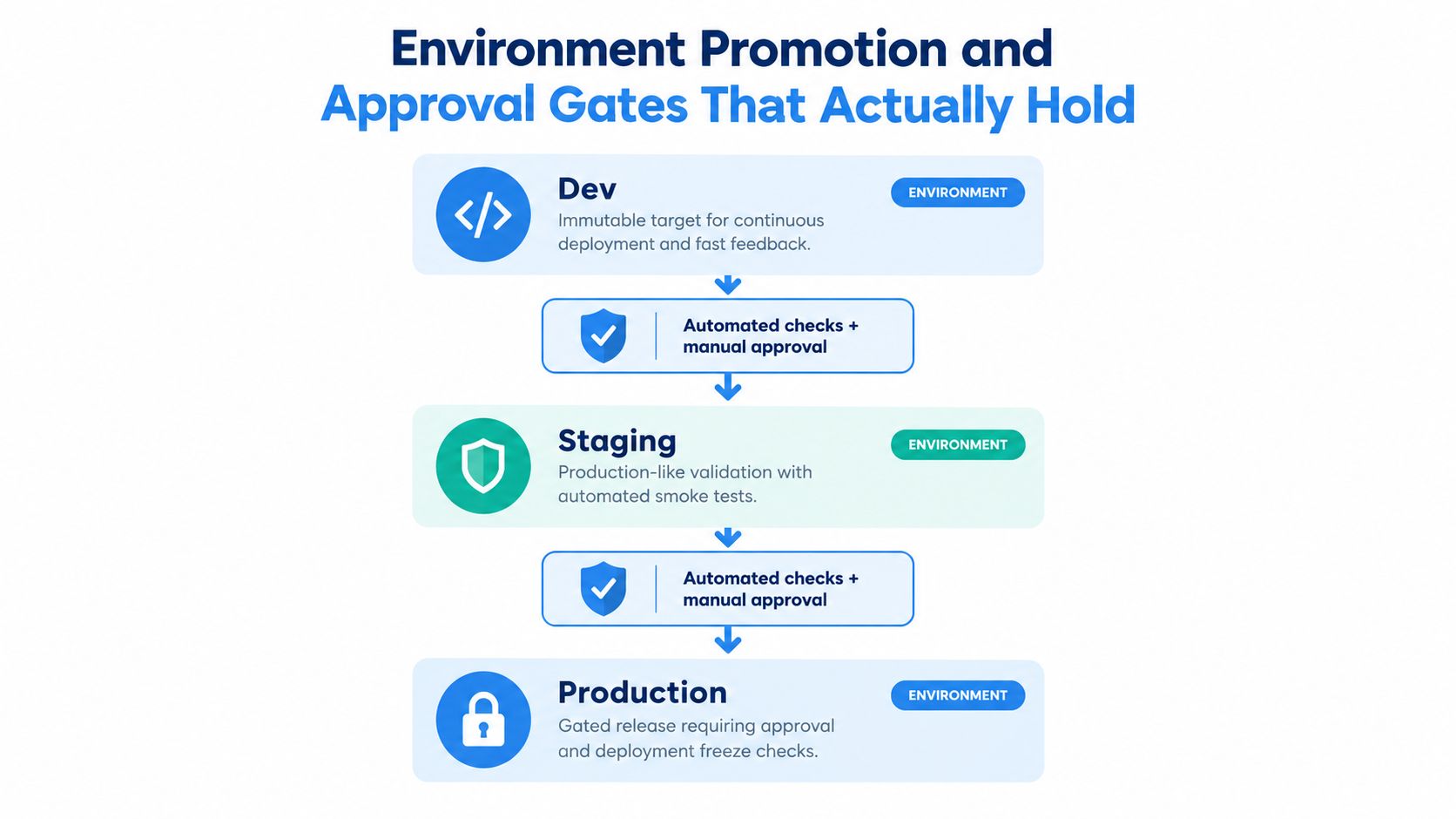
Treat environments as named, immutable targets, not as branches with informal meaning. A development target might map to a specific Kubernetes cluster and namespace. Staging should identify its production-like cluster or account, and production should map to an explicitly controlled target with its own identity boundary.
Branches describe collaboration. Environments describe runtime destinations. Mixing the two makes it difficult to answer a basic audit question: which artifact is running in which target, under which approved configuration?
Model promotion as a state transition
Promotion should update a versioned reference from one approved state to another. CI can publish the signed image and open a change to the staging configuration. Automated checks then validate deployment health, integration behavior, security posture, and configuration policy.
A useful flow looks like this:
- Development: Deploy the signed artifact to an isolated target and run fast feedback checks.
- Staging: Promote the same digest, apply environment-specific configuration, and run production-like smoke, integration, load, and security checks.
- Production: Permit promotion only when required checks pass and the release satisfies policy for its risk class.
Policy-as-code should make the decision, not a Slack message. OPA or Conftest can evaluate change windows, resource requirements, image provenance, and environment rules before promotion. Admission controllers can enforce the same policies at the cluster boundary, so a deployment can't bypass CI by calling the platform directly.
Keep human approval narrow and meaningful
A human gate still makes sense for regulated production releases, high-risk database changes, permission changes, and emergency exceptions. It shouldn't be a generic button that asks someone to approve a green screen without useful evidence.
Capture the approver identity, commit SHA, artifact digest, policy results, deployment target, and rollout outcome. Store those records with pipeline logs and release events. If a reviewer can't understand what will change and what evidence supports it, the gate is performing ceremony rather than governance.
The best approval flow has a default automated path for routine changes and an escalation path for higher-risk changes. That design reduces unnecessary waiting while preserving accountability where the consequences justify it.
Rollback and Progressive Delivery Strategies
Most rollout designs discuss how to send traffic to a new version. Fewer explain how to recover when the new version changes data, breaks a dependency, or produces a subtle business failure that basic health checks don't detect.
Rollback starts with artifact retention and compatibility. Keep the previous image digest available, record the active version in deployment events, and make database changes compatible with both the old and new application versions where possible. A rollback that restores code but cannot read the current schema isn't a recovery plan.
Blue-green deployment
Blue-green runs two equivalent environments and switches the load balancer or service route between them. It offers the clearest recovery path: point traffic back to the previous environment.
The trade-off is infrastructure cost and operational complexity. Running duplicate capacity can be expensive, and schema changes can create a state mismatch between blue and green. Blue-green fits high-risk services where rapid restoration matters more than keeping infrastructure minimal.
Canary delivery
Canary delivery shifts traffic progressively and evaluates real service behavior as exposure increases. Argo Rollouts or Flagger can work with Prometheus to analyze error rates, latency, saturation, and application-specific indicators, then pause or abort when the release violates defined conditions.
Canary reduces the blast radius, but it doesn't eliminate risk. A small traffic slice may not exercise a rare workflow, and metrics can lag behind a harmful business outcome. Define abort criteria before deployment and test that the controller can stop promotion.
Feature flags
Feature flags separate code deployment from user exposure. They work well when the risk lies in application logic, user experience, or a new integration rather than in the runtime platform. A flag can disable behavior without replacing the entire service.
Flags create their own governance burden. Owners, expiry conditions, access controls, and audit events must be explicit. An abandoned flag becomes another form of configuration drift.
| Strategy | Rollback Speed | Blast Radius | Cost | Best Fit |
|---|---|---|---|---|
| Blue-green | Fast traffic reversal | Broad if switched fully | Higher duplicate capacity | Services requiring a clear fallback |
| Canary | Fast abort after detection | Limited during staged exposure | Moderate routing and analysis overhead | Services with strong telemetry |
| Feature flags | Fast behavior disablement | Limited to flagged paths | Lower infrastructure overhead, higher flag-management work | Logic changes and controlled releases |
Choose based on recovery reality, not the deployment diagram. If the team can't detect failure, reverse traffic, restore compatible data behavior, and verify recovery, the strategy is incomplete.
Security and Observability Built Into the Pipeline
A pipeline without security and telemetry is a faster way to ship an incident. Passing tests don't establish artifact integrity, and a running container doesn't explain whether users can complete the workflows that matter.
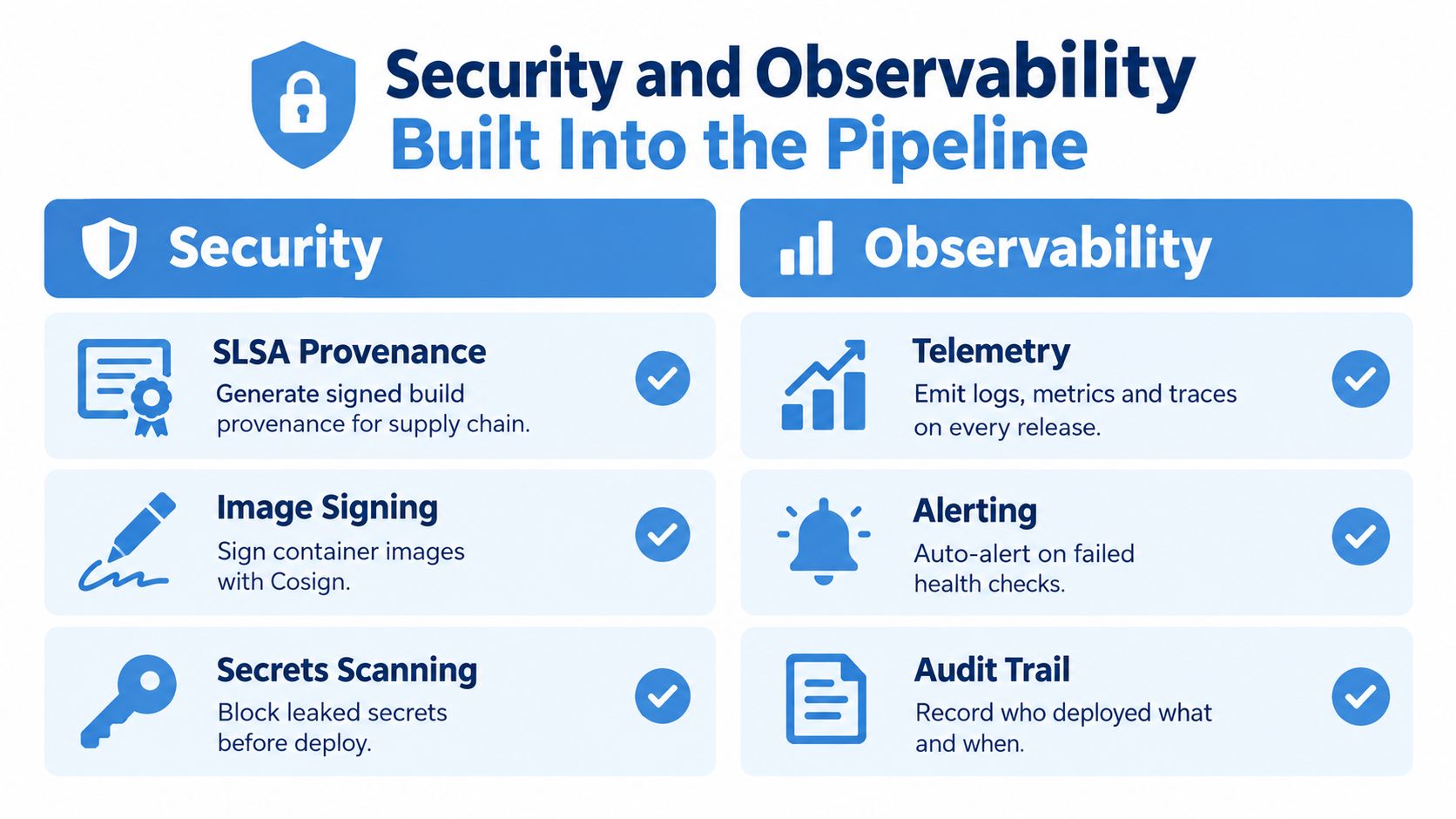
Supply chain controls should begin before deployment. Require signed commits where appropriate, generate SLSA provenance for builds, create an SBOM, and sign container images with Cosign. Admission policies should reject unsigned or untrusted artifacts at the runtime boundary. Secrets scanning belongs in the path before code reaches the artifact, while runtime credentials should use scoped, preferably short-lived identity rather than permanent tokens embedded in runners.
Make release health measurable
Deployment gates should use service indicators and objectives, not only process completion. Define the signals that represent healthy behavior for the service, then pause promotion when error rates, latency, saturation, or critical business flows move outside the accepted range. If the error budget is exhausted, the pipeline should stop increasing exposure until the owner reviews the condition.
Telemetry must connect the release to the runtime. Emit a structured deployment event containing the service, version, commit SHA, artifact digest, target environment, initiator, and rollout result. Use OpenTelemetry trace correlation so an on-call engineer can follow a failing request through the changed service and its dependencies.
Dashboard annotations make this operationally useful. A latency spike should show the release event beside the graph, not force the responder to compare timestamps across unrelated systems. Logs, metrics, traces, synthetic checks, and alert routing should all identify the deployment owner.
Auditability isn't a document generated after the incident. It is the chain of evidence produced while the release moves.
For teams shifting security checks earlier, this guide to shift-left security in DevOps offers relevant implementation context. The broader governance challenge is especially important in GitOps environments, where misleading history, copied configuration, and unprotected repository operations can create confidence without trustworthy evidence. Enforce protected history, signature verification, reconciliation alerts, and runtime audit records together.
A Practitioner's Checklist for Safer Automated Releases
Use the checklist as an operating control, not as a document that sits beside the pipeline. Each phase should produce evidence that another engineer can inspect during a review or incident.
Pre-commit
- Signed commits: Require commit signatures for repositories and branches where provenance matters.
- Review boundaries: Protect the default branch and require the checks appropriate to the change.
- Secret detection: Block exposed credentials before they enter the build context.
- Contract validation: Test API and event compatibility before consumers encounter the change.
Pipeline
- Reproducible builds: Pin runtimes, dependencies, base images, and build inputs.
- SBOM emission: Generate a software bill of materials for every deployable artifact.
- Security gates: Scan source, dependencies, and container images, then enforce policy rather than merely reporting findings.
- Immutable promotion: Promote a signed digest tied to the commit and build record. Don't rebuild per environment.
Release
- Environment-specific configuration: Keep target configuration versioned and apply it through controlled GitOps or an equivalent declarative mechanism.
- Approval policy: Route regulated or high-risk production changes through an approval that records identity and evidence.
- Progressive rollout: Use blue-green, canary, or feature flags according to the service's failure mode.
- Abort criteria: Define the signals that stop promotion before the release begins.
- Rollback readiness: Keep a known-good artifact reference and rehearse the recovery procedure quarterly.
Operate
- Audit retention: Ship deployment logs and approval records to a write-once or otherwise protected store.
- Release telemetry: Emit structured events and dashboard annotations for every deployment.
- Ownership alerts: Route SLO burn-rate alerts to the team responsible for the release.
- Recovery verification: Confirm that rollback restores both technical health and the affected user workflow.
Map the controls to the DORA framework. Deployment frequency reflects how reliably changes reach environments. Lead time for changes exposes pipeline and approval delay. Change failure rate shows whether canary aborts, validation, and rollback coverage work. Time to restore shows whether the team can recover without improvising.
The 2024 DORA report illustrates the distance between low and elite delivery performance. Low performers deploy roughly once every six months, have lead times from one to six months, change failure rates around 46% to 60%, and restore service in one week to one month. Elite teams deploy on demand, reach lead times under one day, keep change failure rates around 0% to 15%, and recover in under one hour. Those figures reinforce the practical target: compress lead time while making rollback and restoration routine.
Pick the three weakest controls on this checklist this quarter. Assign an owner to each, define the evidence that proves completion, and review the results in your next reliability retrospective. Trust in deployment automation grows through small, observable improvements, not through one large migration.
CloudCops GmbH designs CI/CD and GitOps platforms that automate build, test, promotion, and deployment while preserving version control, policy enforcement, and operational evidence. If you need help making automated releases safer across Kubernetes, AWS, Azure, or Google Cloud, visit CloudCops GmbH to discuss a platform engagement grounded in reproducible infrastructure and measurable delivery outcomes.
Ready to scale your cloud infrastructure?
Let's discuss how CloudCops can help you build secure, scalable, and modern DevOps workflows. Schedule a free discovery call today.
Continue Reading
Best CI CD Pipeline Tools for Agile Teams in 2026
Discover the best ci cd pipeline tools for your team in 2026. Compare features, integrations, and pricing to streamline your software delivery.
Canary Deployment Strategy: A Practical Guide for 2026
Learn how a canary deployment strategy reduces blast radius and accelerates safe rollouts for startups and enterprises.

Digital Transformation Consulting: A 2026 Field Guide
Digital transformation consulting explained: stages, methodologies, KPIs, engagement models, vendor criteria, and pitfalls for startups, SMBs, and enterprises.