
DevSecOps Maturity Model: Stages, Assessment, and Roadmap
September 15, 2026•CloudCops
A platform team can have SAST, SCA, container scanning, and secrets detection running in every CI job and still fail a serious security review. The dashboards are green because the scans completed, but production Kubernetes access reviews are missing, the release SBOM isn't signed, and nobody can show that critical findings have an agreed remediation path. The organization has tool coverage, not necessarily DevSecOps maturity.
That distinction matters for both a fintech startup and a regulated enterprise. Attackers and auditors rarely care whether a scanner is installed in isolation. They care whether someone owns the result, whether exceptions expire, whether production changes are traceable, and whether teams can fix important findings before release pressure wins. A useful devsecops maturity model exposes that operating gap by measuring security as a repeatable delivery capability.
The practical question is no longer, “Which scanners do we use?” It's, “How predictably does a security issue move from discovery to resolution across code, infrastructure, dependencies, clusters, and runtime?” This article uses that question to examine maturity stages, assessment methods, framework trade-offs, and a roadmap built around remediation throughput and cloud-native coverage.
The Hidden Gap Between Tools and Mature DevSecOps
A growing financial technology company had SAST, SCA, container scanning, and secret detection running in its CI pipeline. Pull requests displayed security results, dashboards showed recent activity, and the platform team could list every security product in use.
An audit exposed the operating gap. Production Kubernetes access reviews were incomplete, the release SBOM was unsigned, and nobody could show an agreed remediation path for serious findings. The scanners had run successfully. The control process had not.
That pattern appears when maturity is measured by integrations instead of delivery capacity. A scanner produces a result, the result creates a ticket, and the ticket enters a backlog. Without a service owner, severity policy, due date, exception process, and escalation path, detection creates visibility without producing accountable action.
Practical rule: A finding is operationally managed when a named team can explain who owns it, what happens next, and which artifact proves that action occurred.
The OWASP DevSecOps Maturity Model gives teams a structured way to compare current practices with stronger levels of integration. Its value is not the presence of another checklist. It helps assess whether security work is repeatable across code, dependencies, infrastructure, Kubernetes, and runtime operations.
A useful assessment scores workflow capacity beside control coverage. Can developers separate exploitable issues from noise? Can the platform team connect a Kubernetes namespace or infrastructure-as-code change to an accountable service? Can security verify that exceptions are approved, time-bound, and revisited? Can the team produce and sign an SBOM for each release, including software containing AI-generated code?
Earlier validation can also expose delivery constraints. Teams can use guidance on how to catch bottlenecks before release, since security and performance gates both create queues when ownership or remediation time is unclear. The same principle supports shift-left security in DevOps: move checks earlier only when teams have the context, authority, and capacity to resolve what they find.
Moving a scan earlier without improving triage moves the queue earlier.
What a DevSecOps Maturity Model Actually Measures
A maturity model measures whether security work moves through delivery, operations, and governance with predictable ownership. It assesses the flow of decisions and remediation, not the number of vendor tools in a pipeline. The OWASP DSOMM provides an independently maintained reference structure with four dimensions and sixteen sub-dimensions on a four-level scale, allowing teams to compare current practices with stronger forms of security integration.
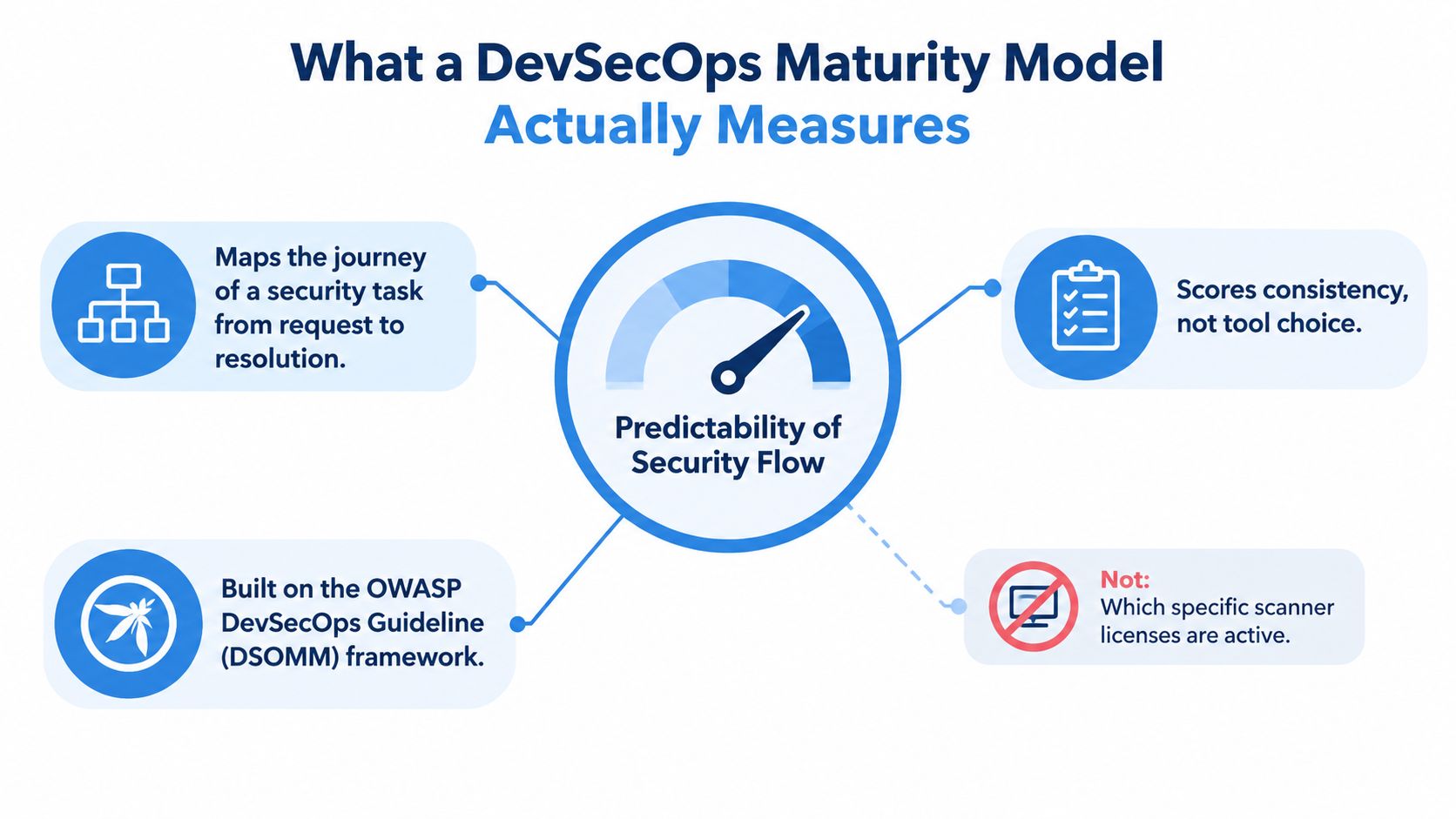
Its four dimensions give an assessment a practical spine:
- Static analysis findings: How teams ingest, classify, assign, and act on static analysis results.
- Pre-production security testing: How checks run before deployment and whether failures affect promotion.
- Runtime testing: How teams validate deployed systems and respond when behavior differs from the approved state.
- Operations and infrastructure knowledge transfer: How ownership, security knowledge, and operational feedback move between development, platform, and security teams.
Assess control coverage alongside workflow integration. A team can scan every repository and still lack a dependable owner map. Another may run fewer tools yet consistently stop risky releases, record exceptions, and show that approved fixes reach production through an auditable process.
Maturity therefore extends beyond a compliance checklist. Compliance asks whether a control exists and whether supporting evidence is available. Maturity also examines whether people perform the control consistently, automation limits variation, and the process remains usable during an incident or rushed release. That operating discipline supports operational resilience with DataLunix, especially when recovery, ownership, and evidence must work together.
A useful assessment also covers cloud-native delivery. Can the team connect a Kubernetes workload or infrastructure-as-code change to an accountable service? Can it produce and sign an SBOM for each release, including software containing AI-generated code? Can it separate exploitable findings from noise quickly enough to preserve remediation throughput?
For delivery leaders, four questions expose capacity:
- Can the organization detect the relevant risk?
- Can it prioritize the result using business and technical context?
- Can an accountable team remediate it within an agreed window?
- Can the organization prove what happened later?
DORA metrics overview can complement security measures. It does not replace vulnerability metrics, but it helps show whether new gates improve control or create an unmanaged delivery bottleneck.
The Maturity Stages From Ad Hoc to Continuously Optimized
Maturity stages are most useful when they describe observable behavior. A team shouldn't advance because it purchased a platform. It advances when security work becomes more predictable, measurable, and connected to accountable delivery teams.
OWASP DSOMM uses a four-level scale, while the practical operating roadmap below separates the highest state into an optimization stage. That distinction helps leadership describe the difference between advanced control enforcement and a system that continuously improves its own feedback loops. The Carnegie Mellon capability assessment similarly starts with “Performed Basic Practices,” describing ad hoc activity with minimal automation, documentation, or process maturity.
Level 1 means activity without dependable flow
At the first level, scans may exist, but findings often die in tickets. Teams perform security tasks when a release, incident, or audit creates pressure. Ownership is informal, exceptions live in chat or email, and evidence depends on someone reconstructing events from several systems.
The defining limitation isn't the absence of tools. It's the absence of a dependable remediation path.
Level 2 creates basic repeatability
At the next level, security checks run within CI, severity rules are documented, and teams use gates for clearly defined conditions. Exceptions receive an approver and an expiry date instead of becoming permanent bypasses. The organization can show that security work happens regularly, although triage may still be manual and policy coverage may vary between repositories.
Level 3 connects findings to service ownership
Standardization changes the operating model. Automated triage routes results to the right service team, namespaces have accountable owners, and every release produces an SBOM that can be associated with an artifact. Security checks use shared pipeline templates or reusable policy definitions, reducing differences between teams.
The strongest evidence at this stage is not a dashboard screenshot. It's a trace from finding to owner, decision, remediation, and release.
Level 4 enforces policy across delivery and runtime
Advanced teams express important rules as policy-as-code. Merge or promotion decisions can be blocked when a defined condition is met, Kubernetes runtime drift is detected, and remediation time is tracked by severity. Security and platform teams review failed policies as operational signals, not as isolated audit events.
Level 5 treats improvement as a feedback system
The optimization stage adds learning loops. Runtime findings influence threat models, AI-generated code receives deliberate review, and remediation throughput is compared over time. Teams examine whether the queue is shrinking, whether false positives consume capacity, and whether security controls cover the systems people deploy.
| Level | Characteristic Behaviors | Expected Evidence |
|---|---|---|
| Level 1 | Ad hoc scans, informal ownership, manual review, reactive fixes | Tickets, scattered approvals, incomplete pipeline records |
| Level 2 | CI checks, documented severity gates, tracked exceptions | Pipeline logs, gate rules, approved exceptions with expiry |
| Level 3 | Automated triage, service ownership, release SBOM generation | Owner mappings, SBOM artifacts, repeatable workflow records |
| Level 4 | Policy-as-code, runtime drift detection, severity-based remediation tracking | Policy repositories, cluster alerts, remediation reports |
| Level 5 | Feedback from runtime and delivery into design, threat modeling, and review | Trend analysis, updated threat models, improvement decisions |
The model is progressive, not purely technical. A team that jumps to automated blocking without ownership can increase failed builds and create bypass pressure. Mature sequencing builds the capacity to respond before tightening enforcement.
How to Run a DevSecOps Maturity Assessment
An assessment should start with a delivery boundary, not an enterprise-wide questionnaire. Select the value streams, repositories, clusters, and compliance boundaries that matter to a real product. Include the people who operate the pipeline and runtime, because security leaders often see policy while engineers see the exceptions that policy never captured.
Scope the system that delivers value
Document the path from code change to production. Include source control, CI, artifact storage, infrastructure provisioning, Kubernetes or other runtime platforms, identity controls, observability, and incident response. Mark where regulated data, privileged access, and third-party dependencies enter the flow.
Collect evidence from systems of record
Ask for pipeline definitions, failed-gate records, exception approvals, ownership mappings, SBOM artifacts, cluster policy results, and incident tickets. Don't accept “the tool supports it” as evidence. The question is whether the organization uses the capability consistently and can retrieve proof.
Score current and target states
Use a one-to-five internal score for planning, while keeping the framework's native scale visible. A score should describe behavior, not confidence. “Critical vulnerabilities are blocked” becomes meaningful only when the assessor can verify the rule, its scope, its exceptions, and the resulting pipeline records.
Useful measurements include:
- Scan coverage: The share of merged pull requests that receive the required security checks.
- Remediation throughput: The time between validated finding and completed fix, segmented by severity.
- Gate reliability: How often security policy causes a pipeline failure, and whether failures represent genuine policy decisions or noisy results.
- Exception discipline: Whether every bypass has an owner, rationale, approval, and expiry.
- Runtime accountability: Whether workloads, namespaces, infrastructure modules, and cloud accounts have named owners.
A simple weighted matrix can prioritize gaps by risk, delivery impact, regulatory relevance, and remediation effort. Weighting should reflect the organization's threat model, not a universal formula.
| Dimension | Current Level (1–5) | Target Level | Evidence / Artifact | Owner | Due Date |
|---|---|---|---|---|---|
| Static analysis findings | Pipeline records, triage rules | ||||
| Pre-production testing | Gate policy, test results | ||||
| Runtime testing | Runtime alerts, drift reports | ||||
| Operations and infrastructure knowledge transfer | Owner map, runbooks, incident records |
Use a compliance gap analysis to connect missing evidence to a control boundary, but don't let the audit view replace the engineering view. The best assessment shows both what a reviewer can verify and what a team can execute under release pressure.
Comparing the Leading Maturity Frameworks
No framework answers every assessment question. Choose based on the decision you need to make: rapid benchmarking, control traceability, or enterprise capability management. Then test whether the model reflects remediation throughput and cloud-native coverage, not only the presence of scanning tools.
OWASP DSOMM is a practical starting structure for product and platform teams. It measures four dimensions and sixteen sub-dimensions across four levels, giving teams a manageable way to compare practices and select a next improvement. Its accessible format helps teams establish a baseline quickly. It needs supplements for detailed evidence, Kubernetes admission controls, infrastructure-as-code workflows, and AI-assisted development risks.
The OWASP DevSecOps Verification Standard takes a control-oriented approach. It defines seven phases, thirty-nine controls, and four maturity levels. Each control ranges from absent, represented by 0, to measured and continuously improved, represented by 3. The DVS assessment structure fits regulated environments that require lifecycle traceability and evidence-based verification. The trade-off is assessment effort. A startup may find the control detail excessive for its first benchmark, while a regulated platform may need that precision.
The Carnegie Mellon SEI model treats maturity as repeatable capability. Its findings use four categories: Consistently Demonstrated, Occasionally Demonstrated, Insufficient Evidence Demonstrated, and Not Applicable. The SEI capability model suits enterprise programs that already manage process improvement through capabilities, value streams, and documented artifacts.
| Framework | Dimensions / Stages | Scoring Scale | Best-Fit Use Case |
|---|---|---|---|
| OWASP DSOMM | Four dimensions and sixteen sub-dimensions | Four levels | Product and platform benchmarking |
| OWASP DVS | Seven lifecycle phases and thirty-nine controls | Four levels, control values from 0 to 3 | Regulated control verification |
| Carnegie Mellon SEI | DevSecOps capabilities and value streams | Four findings levels | Enterprise capability assessment |
Use one framework as the spine. Add a separate cloud-native score for Kubernetes, IaC, SBOM production, runtime drift, and AI-generated code. Score workflow capacity alongside control coverage: how many findings the team validates, prioritizes, fixes, and verifies within the release cycle. Combining scorecards without reconciling definitions creates false precision. An explicit supplement makes gaps visible instead of hiding them inside an improvised aggregate score.
Maturity in Cloud-Native and AI-Assisted Pipelines
A conventional application score can look healthy while the platform remains exposed. A team may report a strong SCA result, yet ship a container without an SBOM, allow an unsigned image into a cluster, or permit GitOps configuration to drift from the approved repository. The score describes one control surface. It doesn't describe the entire delivery system.
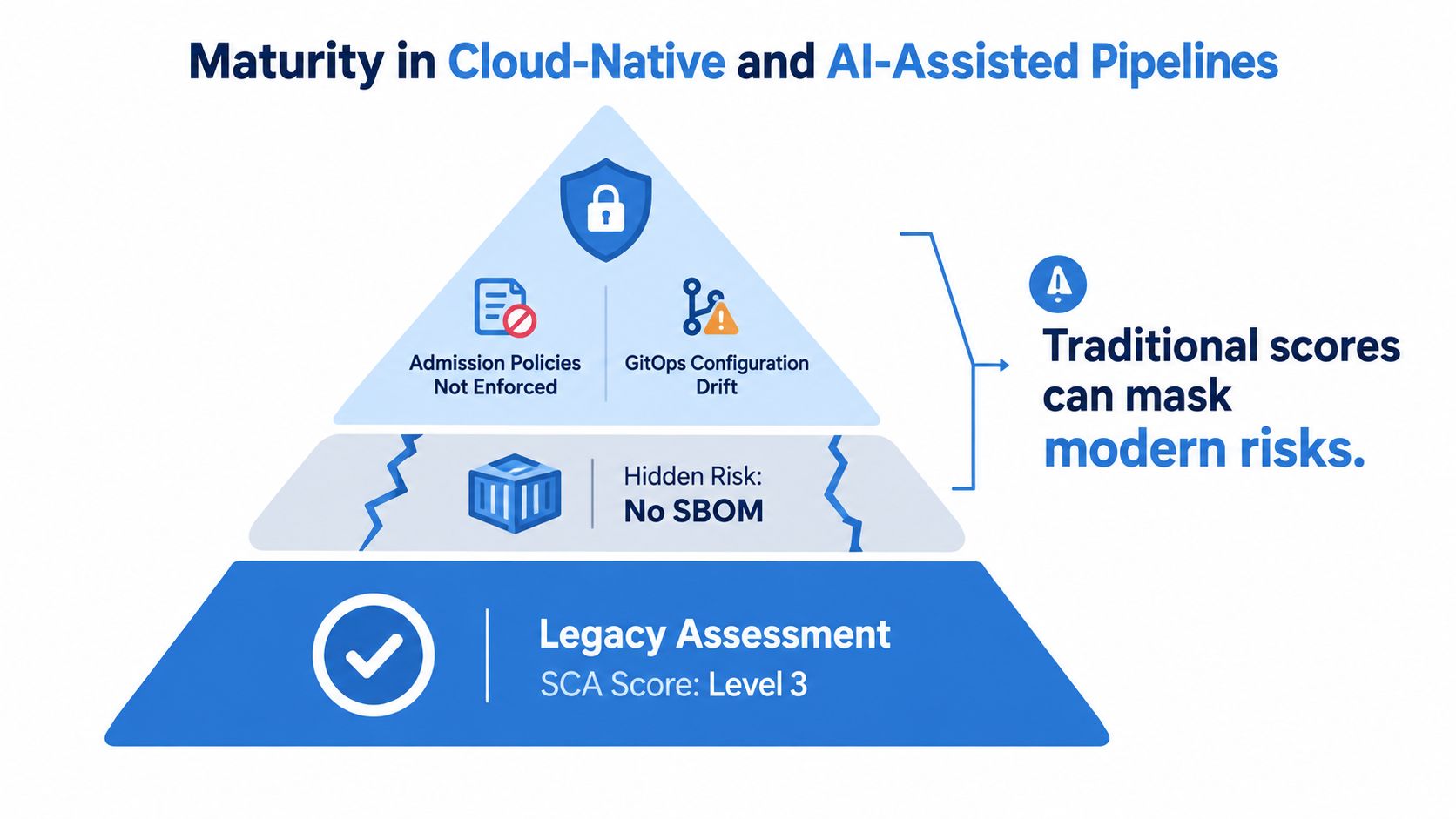
Map each maturity dimension to the artifacts engineers operate.
- Static analysis should include application code, Terraform or OpenTofu plans, Kubernetes manifests, Helm charts, and policy definitions.
- Pre-production testing should verify image contents, dependency provenance, SBOM generation, signatures, and release promotion rules.
- Runtime testing should cover admission policies, workload identity, cluster configuration, exposed services, and drift from declared GitOps state.
- Operations knowledge transfer should connect alerts and findings to repositories, namespaces, owners, runbooks, and incident records.
Tools such as Kyverno, OPA Gatekeeper, Argo CD, FluxCD, Trivy, Syft, Terraform plan checks, and signed artifact workflows can support these controls. They don't create maturity automatically. A rejected deployment with no owner or documented exception is still a workflow failure.
AI-assisted development adds another boundary. Treat generated code as an untrusted contribution, even when a developer reviews the final change. Apply the same secret detection, dependency analysis, license review, testing, and remediation ownership used for human-written commits. Teams may also need review prompts that identify missing context, unsafe assumptions, and generated code that bypasses established architectural patterns.
A mature score should fall when the assessment cannot explain what happens between a cloud-native finding and a production fix.
Track a cloud-native maturity delta as an internal planning measure: target maturity level minus current coverage across Kubernetes, IaC, SBOM, and AI-code controls. The value isn't the subtraction itself. It's the conversation it forces. A team that scores highly on application scanning but has weak cluster admission or supply-chain evidence has a visible modernization gap rather than an inflated maturity claim.
This short video provides another way to frame the relationship between delivery automation and security controls:
A Practical Roadmap to Move Up the Maturity Curve
Start with the work that blocks remediation, not with another scanner purchase. If critical findings have no owner, adding more detection increases queue volume. The first improvement should make the existing signal actionable.
The first quarter establishes guardrails
Create repository ownership, branch protection, signed commit requirements where appropriate, and pre-commit checks for secrets and unsafe configuration. Define severity policies and an exception workflow with an approver, rationale, and expiry. Use reusable CI templates so teams don't implement controls differently in every repository.
A CloudCops-style platform stack might combine Terraform, Terragrunt, or OpenTofu for reproducible infrastructure, Argo CD or FluxCD for GitOps, and OPA Gatekeeper for policy enforcement. Other combinations can work, but the assessment should measure the behavior these tools produce.
The next phase closes infrastructure and supply-chain gaps
Scan IaC plans before application deployment, enforce container image policies, generate an SBOM for each release, and attest the relationship between the SBOM and the artifact. Make the result useful to responders by linking package findings to deployed workloads and owners.
Later work strengthens runtime feedback
Add Kubernetes admission controls, configuration drift detection, runtime security telemetry, and incident playbooks. Measure whether findings move through the system faster, not whether the dashboard contains more results. Track DORA measures such as lead time, deployment frequency, change failure rate, and recovery time alongside security measures, because a gate that creates uncontrolled delivery friction isn't mature.
| Quarter | Priority Action | Tooling Example | Maturity Target | Key Metric |
|---|---|---|---|---|
| Initial quarter | Ownership, branch protection, secret checks, exception workflow | GitHub or GitLab controls, pre-commit hooks | Basic repeatability | Evidence of assigned findings and approved exceptions |
| Following quarter | IaC checks, image policy, SBOM generation | OpenTofu or Terraform checks, Trivy, Syft | Standardized controls | Builds with passing policy checks |
| Later quarter | Admission enforcement and GitOps drift control | OPA Gatekeeper, Kyverno, Argo CD, FluxCD | Advanced enforcement | Unauthorized changes detected and resolved |
| Optimization cycle | Runtime feedback, threat-model updates, AI-code review controls | OpenTelemetry, Prometheus, policy repositories | Continuous improvement | Remediation throughput over successive reviews |
The trade-off is predictable. Rapid scanning gains visibility and executive attention, but it also reveals the organization's capacity limit. If triage and ownership remain manual, teams may experience more noise before they experience better security. Build the remediation system at the same time as the detection system.
Turning Maturity Measurement Into Lasting Habits
A maturity assessment should work like an engineering review, with evidence, owners, and a next action. Re-score the same dimensions on a regular cadence, compare remediation throughput with the target, and change priorities when control coverage stalls. Carnegie Mellon SEI's maturity guidance is useful here because it emphasizes demonstrated capability and supporting artifacts rather than stated intent.
Keep the operating rhythm lightweight:
- Assign owners: Place assessment duties within platform, product, and security teams, with clear responsibility for Kubernetes, IaC, SBOM, and AI-generated code controls.
- Publish evidence: Share pipeline failures, exceptions, remediation queues, and runtime control status in one dashboard.
- Review trade-offs: Check whether new gates reduce risk or encourage bypasses, and record the decision.
- Tie progress to work: Convert each maturity gap into a backlog item with an owner, due point, and measurable result.
The useful score is the one that identifies the next constraint. It should show whether teams can remediate findings at the required pace while maintaining cloud-native control coverage.
This week, score two DSOMM dimensions against actual pipeline and runtime evidence. Commit to one improvement in the next sprint, such as assigning every production workload an owner or attaching a verifiable SBOM to releases in scope.
CloudCops GmbH helps teams design, build, and secure cloud-native platforms with Infrastructure as Code, Kubernetes, GitOps, CI/CD, observability, and policy-as-code. To turn a devsecops maturity model assessment into an actionable roadmap, visit CloudCops GmbH to discuss your platform goals.
Ready to scale your cloud infrastructure?
Let's discuss how CloudCops can help you build secure, scalable, and modern DevOps workflows. Schedule a free discovery call today.
Continue Reading
Multi-Cloud Strategy Explained for Modern Teams
Learn what a multi-cloud strategy is, when it pays off, and how to build one with governance, cost control, and GitOps. Practical roadmap inside.
Resilience Testing for Cloud Native Platforms: A Playbook
Plan, run, and measure resilience testing for cloud native platforms with safety practices, observability prerequisites, and CI/CD automation patterns.
OPA Gatekeeper Kubernetes How to Enforce Policies Fast
Learn OPA Gatekeeper Kubernetes step by step — install, write Rego policies, enforce constraints in CI/CD and troubleshoot with real examples.