
Multi-Cloud Strategy Explained for Modern Teams
September 14, 2026•CloudCops
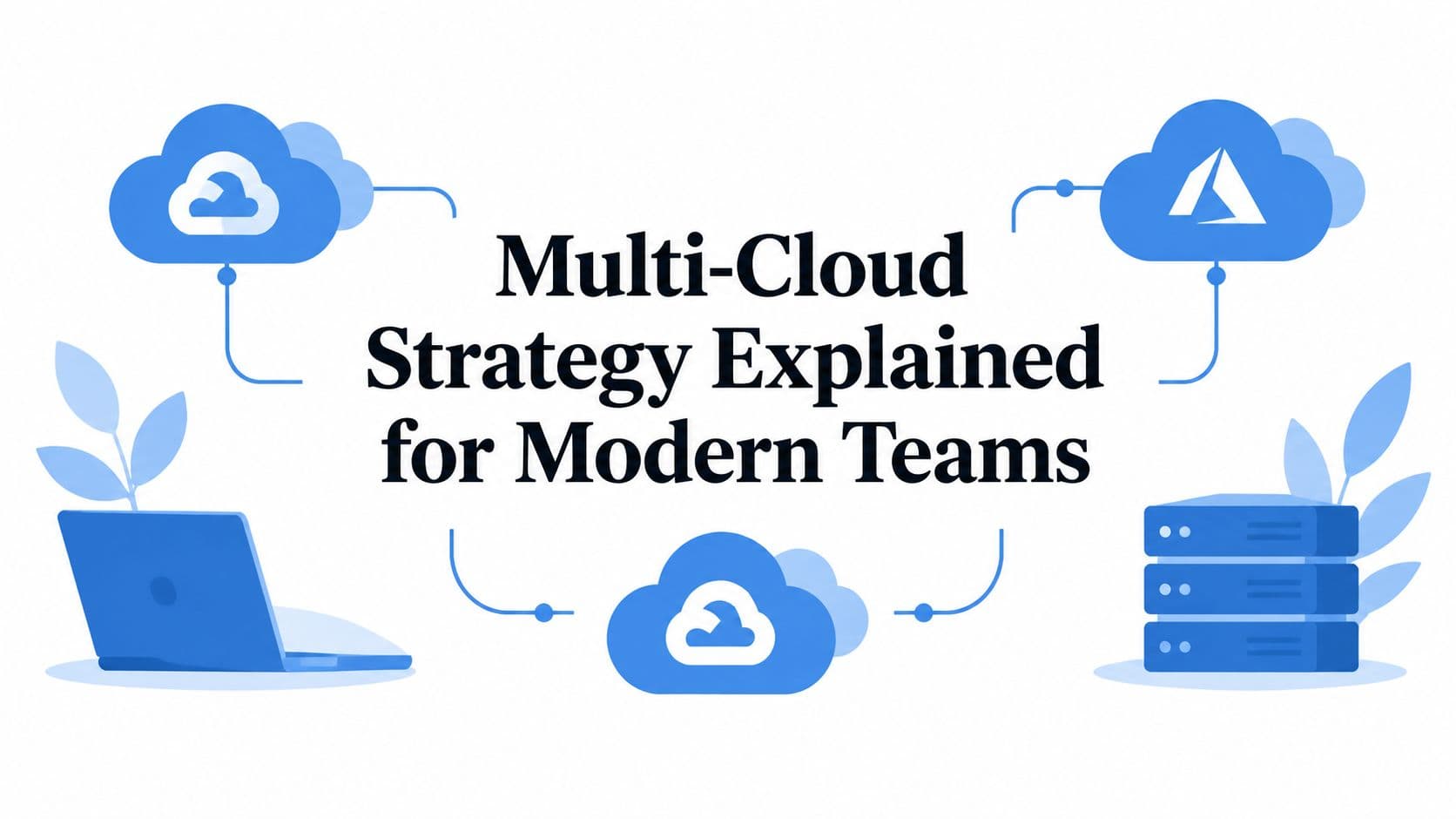
A product team usually doesn't choose multi-cloud because it wants more dashboards. The pressure arrives first: a key region can't satisfy data residency requirements, a managed service creates an uncomfortable dependency, a latency-sensitive workload performs better elsewhere, or a finance team discovers that one provider's pricing model no longer fits the application.
At that point, adding another cloud can either become disciplined workload placement or uncontrolled duplication. The difference is architectural intent. A sound multi-cloud strategy decides where each workload belongs, what must remain portable, and how engineers will operate every environment through the same versioned controls.
This guide follows the approach we use at CloudCops. It focuses on practical trade-offs, reproducible infrastructure, GitOps delivery, policy-as-code, and operational visibility. It also separates cases where multi-cloud is justified from cases where a well-designed single-cloud or multi-region architecture is the better answer.
Introduction: Why Multi-Cloud Strategy Matters Now
A startup may begin with one cloud because speed matters more than optionality. That choice is often correct. The team knows one provider's networking model, deployment services, identity system, and managed databases, so a single platform reduces cognitive load while the product finds traction.
The decision changes when the workload's constraints change. A European healthcare product may need stronger control over where sensitive data resides. A global application may need users served from regions that aren't equally suitable across providers. An analytics team may need a specialized platform, while the transactional system benefits from a different operational model. A regulated enterprise may also need recovery options that don't depend entirely on one provider's control plane.
Multi-cloud has moved from an emerging practice to a mainstream enterprise architecture. A 2026 survey of 524 enterprise cloud teams found that 89% of organizations with more than $5 million in annual cloud spend ran at least two cloud providers in production, compared with about 31% among organizations spending under $1 million annually. The same report connects broader adoption among larger spenders with vendor diversification, resilience, and matching workloads to specialized services.
That doesn't mean every organization should add a second provider. Multi-cloud introduces duplicated skills, networking complexity, identity challenges, data-transfer considerations, and more difficult incident response. If your application has no regulatory, resilience, performance, or service-placement reason to distribute workloads, a single cloud with strong infrastructure-as-code may be safer.
Practical rule: Choose multi-cloud for a concrete workload requirement, not because “cloud agnostic” sounds strategically prudent.
The useful question is not, “Which provider should own our platform?” It's, “Where should each workload run, and how will we operate it consistently?” The rest of this guide turns that question into patterns, controls, implementation steps, and architecture examples.
What a Multi-Cloud Strategy Really Means
Think of cloud providers as cities. Each city has different roads, utilities, regulations, and specialist services. A multi-cloud strategy lets a company operate in several cities, but it only works when the company standardizes the things that should remain consistent, such as identity, deployment workflows, observability, security controls, and service ownership.

Start with the terminology, because teams often call several different architectures “multi-cloud.”
- Single cloud: Applications and data run primarily with one public-cloud provider. Portability may exist in theory, but operations depend on one platform.
- Multi-region single cloud: The organization uses several regions from one provider. This improves geographic reach and can support regional recovery, but it doesn't remove provider-level dependency.
- Hybrid cloud: Public cloud services interact with private cloud or on-premises infrastructure. The defining concern is the relationship between public and private environments.
- Multi-cloud: The organization intentionally uses at least two public-cloud providers. It may also include private infrastructure, which makes the broader environment hybrid as well.
The important distinction is operational intent. Running an isolated analytics account in another provider isn't automatically a multi-cloud architecture. It becomes strategic when the team has explicit placement rules, shared controls, and an operating model for the distributed environment.
Workload placement is the central decision
A workload-specific approach might place a customer-facing API on one provider, a data-processing pipeline on another, and sensitive records in a controlled private environment. That doesn't require every service to run everywhere. Portability should be selective, based on business impact and the cost of moving a workload.
Active-active deployment means multiple environments serve production traffic at the same time. It can improve availability and user proximity, but it requires carefully designed data consistency, traffic management, and failure handling. Failover keeps one environment ready to accept traffic only when the primary environment becomes unavailable. It reduces steady-state duplication, but recovery depends on tested promotion and data-recovery procedures.
Standards reduce accidental coupling
Kubernetes can provide a common workload abstraction, but it doesn't erase provider differences. Cluster networking, load balancers, storage classes, identity integration, node lifecycle, and managed database services still vary. Teams should standardize interfaces where that creates value, while documenting provider-specific decisions instead of pretending they don't exist.
Useful building blocks include Terraform, OpenTofu, Terragrunt, Kubernetes, ArgoCD, FluxCD, OpenTelemetry, Prometheus, Grafana Loki, Grafana Tempo, and OPA Gatekeeper. These tools support a common delivery and control model, but engineers still need clear ownership and tested runbooks. For organizations reviewing external operational support, understanding the boundary between internal platform ownership and managed capabilities is essential.
Comparing Multi-Cloud Patterns and When to Use Each
There isn't one correct multi-cloud topology. The right pattern depends on the failure you're trying to prevent, the traffic path users need, the data model you can operate, and the team's tolerance for complexity.

A single cloud remains the simplest option. It provides one identity model, one primary networking stack, and fewer deployment variations. Its weakness is concentration. A provider outage, regional limitation, contractual constraint, or service-specific dependency can affect the whole application.
Multi-region deployment within one cloud addresses geographic resilience and user proximity without introducing a second provider. It's often the best first move when the main concern is regional availability. Active-active across clouds offers broader provider independence, but it also creates the hardest data and traffic problems. It only makes sense when the business impact of provider-level failure justifies the operational burden.
Failover is usually easier to control than active-active. The secondary cloud can remain scaled down or partially provisioned, while backups, infrastructure definitions, container images, and recovery procedures stay ready. The design is only credible if engineers regularly test promotion, DNS or traffic changes, secret availability, database recovery, and rollback.
Workload-specific clouds are often the most practical pattern. They let teams use a provider's strengths without forcing every application to become portable. The trade-off is that engineers must operate multiple platform conventions and secure the connections between them.
| Pattern | Resilience Level | Operational Complexity | Best For |
|---|---|---|---|
| Single cloud | Lower provider diversity, with resilience dependent on the chosen design | Low | Teams optimizing for delivery speed and simple operations |
| Multi-region single cloud | Stronger regional resilience within one provider | Moderate | Geographic distribution and regional recovery |
| Active-active across clouds | Highest provider diversity when traffic and data are designed correctly | High | Critical services needing simultaneous availability across providers |
| Failover | Strong disaster-recovery potential with less duplicated runtime capacity | Moderate to high | Recovery from provider or regional disruption |
| Workload-specific clouds | Depends on workload placement and recovery design | Moderate | Best-fit services, regulatory boundaries, and specialized platforms |
Latency deserves special attention. A synchronous request that crosses providers adds the network behavior of the slowest inter-cloud hop to the user-facing path. A technical review of multi-cloud networking recommends direct provider interconnects over open-internet paths for more consistent throughput and reduced jitter, while also emphasizing edge placement and cross-cloud orchestration.
The practical pattern is to keep latency-sensitive traffic on private interconnects, minimize synchronized data paths, and move non-critical coordination to asynchronous messaging. Regional caching and event-driven workflows can remove cross-cloud round trips from the critical path. Teams comparing terminology and architecture boundaries can also use this multi-cloud versus hybrid cloud guide before selecting a deployment model.
Governance, Security, Cost, and Observability Across Clouds
Distribution multiplies operational surfaces. A policy that exists only in an AWS account doesn't protect an equivalent workload in Azure or Google Cloud. A dashboard that sees Kubernetes metrics but not provider load balancers leaves responders without the context they need during an incident.
Flexera's 2026 State of the Cloud reporting says multi-cloud adoption rose by 2 percentage points year over year, while only 14% of surveyed organizations operated exclusively in a multi-cloud environment without private cloud. Earlier Flexera reporting found that 87% of enterprises had a multi-cloud strategy in 2023 and 72% used a hybrid approach combining public and private clouds. These figures from Flexera's State of the Cloud report describe why governance, security, and cost controls usually need to span more than public-cloud accounts.
Governance starts with one control model
Create a common control library and map each control to provider-specific implementations. The library should cover identity, encryption, network exposure, backup expectations, logging, retention, data residency, and approved service types. ISO 27001, SOC 2, and GDPR alignment becomes easier to audit when engineers can show the policy, its code implementation, its exception process, and the evidence generated by deployment pipelines.
OPA Gatekeeper can enforce Kubernetes admission policies, while cloud-native policy systems can cover provider resources outside the cluster. Keep exceptions explicit, time-bound, reviewed, and stored in Git. A control that exists only in a wiki is guidance, not enforcement.
Security and identity need a shared vocabulary
Use centralized identity where practical, but don't assume one provider's identity service should become the universal control plane. Define groups, roles, service identities, privileged actions, and break-glass procedures consistently. Then map those concepts into AWS IAM, Azure role assignments, Google Cloud IAM, Kubernetes RBAC, and external identity providers.
Cost allocation requires the same discipline. Standard tags and labels should identify team, product, environment, owner, data classification, and workload. Without those fields, finance can see invoices but not the engineering decisions behind them. Showback reports should connect spend to deployed resources and application ownership, not merely to cloud accounts.
Observability must follow the transaction
A common platform should collect traces, metrics, and logs using consistent resource attributes. OpenTelemetry can normalize telemetry collection, Prometheus can provide metrics, Grafana Loki can centralize logs, and Grafana Tempo can support distributed tracing. The aim isn't a decorative single pane of glass. It's the ability to follow a request across ingress, service, queue, database, and provider boundary.
Operational test: If an engineer can't identify the affected workload, cloud, region, deployment version, and dependency from one incident workflow, observability remains fragmented.
Use the same service names, environment labels, ownership metadata, alert severity model, and retention rules across clouds. For implementation detail, the multi-cloud security guide provides a useful reference point for consistent controls across distributed environments.

Building Your Multi-Cloud Foundation with IaC, GitOps, and Policy as Code
The foundation should be built in execution order, not assembled as a collection of fashionable tools. Start with infrastructure definitions, establish the repository as the source of truth, automate reconciliation, and enforce policy before production resources become difficult to change.

Define infrastructure before defining delivery
Use Terraform, OpenTofu, or both according to your governance and support requirements. Terragrunt can help structure shared configuration, environment inputs, and dependency relationships. Keep provider modules separate from workload modules when their lifecycles differ. A networking module should expose stable interfaces, while application teams consume those interfaces without copying provider-specific internals into every repository.
Every change should produce a reviewable plan. State storage, locking, secrets, provider credentials, and environment separation need deliberate design. Don't let engineers apply production changes from laptops when a pipeline can produce an auditable artifact.
Put Git at the center of reconciliation
A Git repository should hold infrastructure definitions, Kubernetes manifests, Helm values, policy bundles, and environment configuration. ArgoCD or FluxCD can continuously reconcile desired state with cluster state. This makes drift visible and gives teams a controlled path for rollback.
The deployment pipeline should validate formatting, test modules, scan images and dependencies, render manifests, evaluate policies, and require approval for sensitive changes. Engineers researching IaC practices should treat configuration drift prevention as a practical complement to this implementation model.
The sequence below works well for a first platform:
- Bootstrap the control plane: Establish identity, state management, repositories, runners, secrets handling, and audit logging.
- Provision shared foundations: Create networks, clusters, registries, ingress, storage, and baseline monitoring through IaC.
- Onboard one workload: Define its deployment, dependencies, ownership metadata, alerts, backup expectations, and recovery procedure.
- Add policy gates: Use OPA Gatekeeper and provider controls to reject unsafe configuration before it reaches production.
- Measure delivery and recovery: Track deployment frequency, cycle time, change failure rate, lead time, and recovery times. Use the results to improve the platform rather than adding abstractions without evidence.
Kubernetes improves workload consistency, but don't package every provider service behind a lowest-common-denominator abstraction. Keep managed services when they provide material value, and isolate those dependencies behind clear interfaces.
Zero-downtime releases depend on application design as much as deployment tooling. Use readiness checks, graceful termination, backward-compatible migrations, progressive delivery, and fast rollback paths. Code ownership matters too. The team that owns a workload should own its modules, manifests, alerts, and operational documentation.
Example Architectures for Startups, SMBs, and Regulated Enterprises
A venture-backed startup usually benefits from workload-specific placement, not fully duplicated production across providers. Keep the core product on the cloud where the team has the strongest operational capability, then isolate a workload with a clear reason to run elsewhere. That might be a data-processing component, a specialized machine-learning workflow, or a regional service with different residency needs.
Use Kubernetes only where it solves a real portability or operating-model problem. Terraform or OpenTofu should define both environments, while ArgoCD or FluxCD promotes application changes through Git. Keep telemetry names consistent from the first deployment. Early standardization is cheaper than normalizing several independently evolved platforms later.
An SMB modernizing legacy systems often needs a staged hybrid and multi-cloud model. The customer-facing application can move to a public cloud while a legacy database or integration system remains in a private environment. A second public cloud may provide disaster recovery or host a workload with a better fit, but the architecture should avoid turning every transaction into a cross-cloud synchronous call.
Use private interconnects for traffic that must cross environments. For less time-sensitive workflows, publish events through a durable messaging layer, process them asynchronously, and use regional caching where appropriate. This design reduces the chance that a temporary network problem becomes a customer-facing outage.
A regulated enterprise has a different starting point. Data classification and residency rules should determine placement before engineers compare provider services. Sensitive records may remain in a controlled environment, while stateless services, reporting workloads, or public-facing components run in selected public-cloud regions.
The enterprise needs more than duplicated infrastructure. It needs evidence. Store policy decisions, deployment approvals, access events, backup results, and recovery tests in an auditable system. Centralize traces and logs without moving data across boundaries that violate residency requirements. The multi-cloud architecture guide is a useful reference for cross-cloud connectivity, identity, traffic migration, and recovery planning.
Across all three contexts, the reliable pattern is the same: choose placement per workload, decouple cross-cloud dependencies where possible, and make every operational decision reproducible through code.
Choosing Your Path and Next Steps with CloudCops
A practical decision starts with the business constraint. Score each candidate workload against resilience requirements, regulatory boundaries, latency sensitivity, provider-specific capability, portability value, team expertise, and operational cost. If one cloud satisfies the requirement without unacceptable concentration risk, stay single-cloud. If the workload has a clear placement or recovery need, introduce multi-cloud narrowly.
Start with one pilot that can teach the operating model without putting the business's most sensitive transaction at risk. Define its infrastructure in Terraform or OpenTofu, deploy it through GitOps, enforce baseline policies, instrument it with consistent telemetry, and rehearse recovery. The output should be a working platform pattern, not merely a proof-of-concept diagram.
Expand only after the team can answer practical questions:
- Who owns the workload and its cloud resources?
- How does a change move from pull request to production?
- What happens when the provider, interconnect, registry, or identity system fails?
- Which team pays for the resources?
- Can the team restore the data and redeploy the service from versioned sources?
CloudCops GmbH can co-build this foundation with internal platform teams, provide mentoring, or support an ongoing CloudOps engagement. The useful deliverable is code your team understands and can operate, supported by clear standards for IaC, GitOps, policy, observability, and recovery.
CloudCops GmbH helps startups, SMBs, and regulated enterprises design and operate workload-specific multi-cloud platforms with Terraform, Kubernetes, GitOps, policy-as-code, and unified observability. Visit CloudCops GmbH to discuss a focused pilot or a broader platform engineering engagement.
Ready to scale your cloud infrastructure?
Let's discuss how CloudCops can help you build secure, scalable, and modern DevOps workflows. Schedule a free discovery call today.
Continue Reading
Azure Cost Management: Master Your Cloud Spend
Master Azure Cost Management with our 2026 guide. Learn to integrate cost controls into IaC, automate alerts, & implement FinOps best practices for your cloud.
10 Policy as Code Tools for DevOps Teams
Compare 10 policy as code tools for Kubernetes, Terraform, CI/CD, GitOps, and cloud compliance, with trade-offs and selection guidance.
Cloud Strategy Consulting for Business Growth and Efficiency
Explore how cloud strategy consulting drives growth, cuts costs, and ensures compliance with expert frameworks, metrics, and ready-to-use templates.