
Terraform Policy as Code: The Cloud Native Security Guide
September 18, 2026•CloudCops
Terraform policy as code is the practice of writing governance rules in code to automatically block non-compliant infrastructure changes before they're applied to a cloud environment. In 2026, policy-as-code adoption was reported at 48%, while Terraform remained the dominant IaC tool at 72% adoption (State of DevOps 2026).
A typical team discovers the problem during a pull request. The Terraform change looks harmless, the plan completes, and the reviewer approves it between meetings. Later, someone notices that a storage resource lacks the required encryption setting, a network rule is broader than intended, or a manually changed resource no longer matches the repository. The failure wasn't always a lack of security knowledge. It was a governance process built around human attention instead of repeatable controls.
Terraform policy as code closes that gap, but only when teams treat it as more than a plan-stage approval gate. The useful design covers authoring, planning, applying, drift, runtime state, exceptions, and policy maintenance. It also accounts for mixed stacks, where Terraform teams may already use OPA, Sentinel, Kubernetes admission policies, Checkov, TFSec, and cloud-native controls.
Why Traditional Compliance Fails in the Cloud Era
A traditional compliance gate often looks like this: an engineer submits a change, a security specialist reviews it, an auditor checks evidence later, and the organization hopes the deployed environment still reflects the approved design. That process can work for slow-moving infrastructure. It breaks down when several teams merge infrastructure changes continuously across multiple cloud accounts and environments.
The reviewer usually sees configuration and a generated plan, but the control itself may live in a spreadsheet, a ticketing system, or institutional memory. A rule such as “production data stores must use encryption and approved locations” becomes difficult to apply consistently when every module exposes different variables and every reviewer interprets the requirement differently.
Manual gates create the wrong trade-off
Teams facing a slow review queue have two predictable choices. They delay delivery until someone can inspect the change, or they approve changes with limited scrutiny to protect delivery speed. Neither option gives platform engineers reliable governance.
Manual checks also struggle with repetition. A reviewer may catch a public network rule in one pull request and miss the same pattern in another. A policy engine evaluates the same condition consistently, returns a machine-readable result, and can attach the failure to the exact resource or attribute that needs correction.
Practical rule: If a control matters often enough to repeat, it probably belongs in version-controlled policy rather than in a reviewer's memory.
Cloud modernization adds another complication. Teams frequently underestimate the operational and organizational burden of changing legacy platforms, which is why a resource on the real costs of cloud modernization can help stakeholders assess more than migration tooling alone. Governance must account for new delivery paths, ownership boundaries, inherited modules, and cloud resources changed outside Terraform.
Compliance must follow the resource
Terraform policy as code turns a written requirement into an executable control. The policy repository can be reviewed like application code, tested against representative inputs, and attached to the Terraform workflows where the decision is made.
That doesn't eliminate judgment. Some requirements need exceptions, compensating controls, or a human approval. Policy as code makes those decisions visible and repeatable. It also exposes a deeper weakness in many implementations: a policy can block the original deployment while failing to detect a later manual change, a provider-computed value, or a module update that introduces a new risk.
The operational target isn't merely “the plan passed.” It's the deployed infrastructure continues to satisfy the intended control.
Choosing Your Policy Engine for Terraform
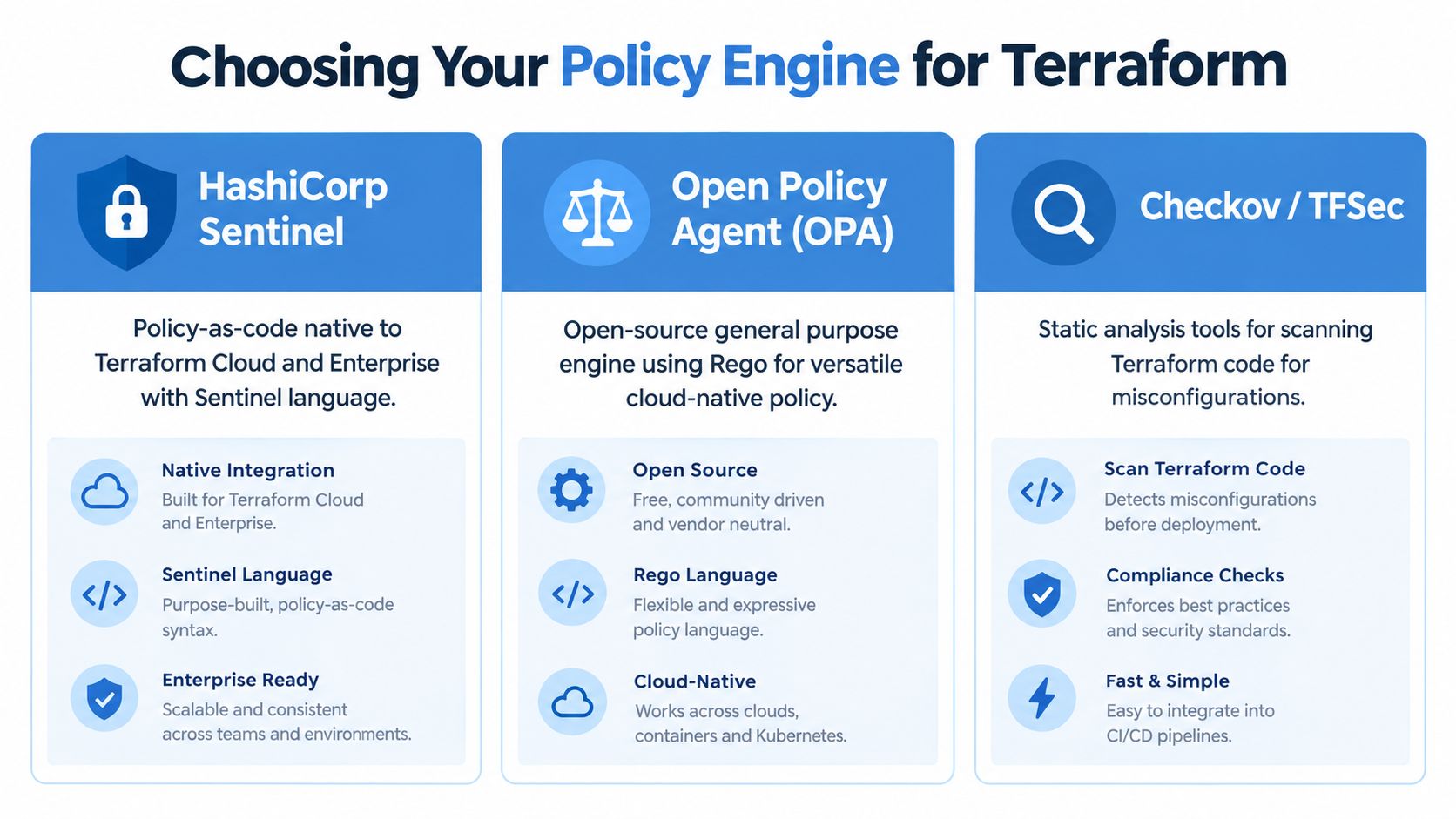
The right engine depends less on which tool has the longest feature list and more on where policy decisions must run. HashiCorp says Sentinel has been part of Terraform Cloud and Terraform Enterprise since their inception, while native OPA support in Terraform Cloud reached general availability on January 31, 2023, after a public beta launched during HashiConf Global 2022 (HashiCorp's OPA announcement).
Compare the architectural choices
Sentinel fits organizations that already run Terraform Cloud or Enterprise and want policy evaluation embedded in the run workflow. It offers close access to Terraform run context and centralized policy sets, but it creates platform coupling and requires teams to learn Sentinel's language.
OPA is the portable option. It evaluates structured data with Rego and can support decisions beyond Terraform, including Kubernetes and service authorization patterns. That portability helps mixed-tool organizations, although the team must own the plan conversion, query design, result handling, and enforcement wiring when OPA runs outside a platform that manages those details. Teams evaluating the broader ecosystem can use this Open Policy Agent reference to understand where OPA fits.
Terraform-native policy offers an HCL-based path for teams that want policy authoring closer to Terraform itself. HashiCorp describes Terraform policy as a framework that can enforce controls across lifecycle stages, including initialization, but newer capabilities should be evaluated against the organization's operational maturity and beta constraints.
Checkov and TFSec are useful static analysis tools. They're effective for catching recognizable misconfigurations in Terraform source, but source scanning isn't a substitute for evaluating a fully resolved plan or checking deployed state.
| Engine | Primary strength | Limitations | Best for |
|---|---|---|---|
| Sentinel | Embedded Terraform Cloud and Enterprise governance | Platform and language coupling | Centralized Terraform platform teams |
| OPA | Portable, general-purpose policy decisions | More integration work outside managed platforms | Mixed Terraform, Kubernetes, and cloud stacks |
| Terraform policy | HCL-based, Terraform-integrated workflow | Evolving capability and adoption model | Teams seeking native lifecycle context |
| Checkov or TFSec | Fast source-level misconfiguration detection | Limited resolved-state context | Developer feedback and complementary scanning |
A practical selection often uses more than one layer. Static scanners provide early feedback, while Sentinel, OPA, or Terraform-native policies enforce decisions against the workflow that can stop a run.
Mapping Enforcement Points Across the Workflow
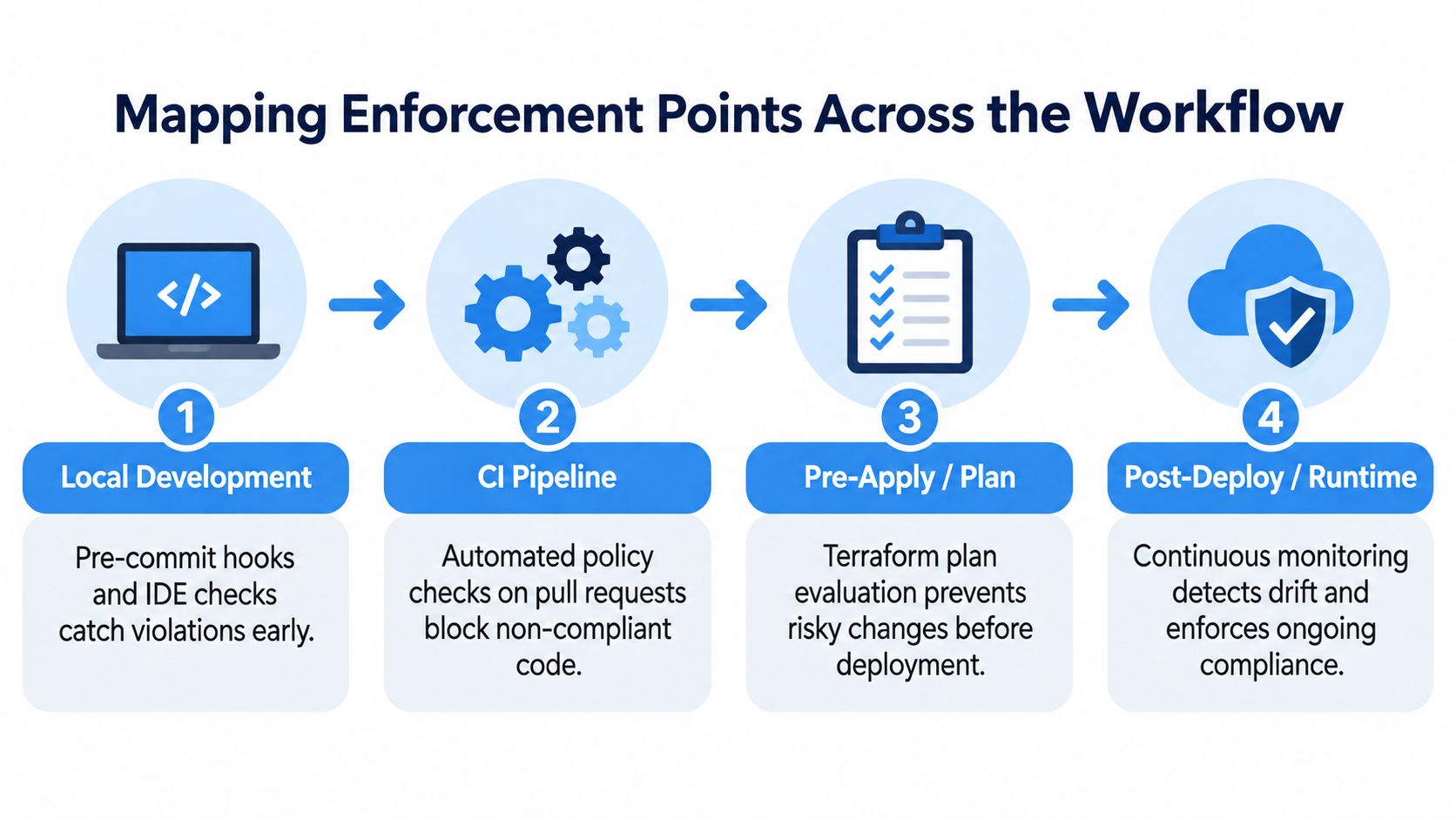
A Terraform change can pass source scanning and still create an unsafe result after variables, modules, data sources, and provider defaults are resolved. Effective enforcement therefore evaluates the Terraform plan JSON, not only raw HCL. The plan exposes the proposed resource graph and concrete changes before apply, as described in the Terraform policy workflow guidance.
Build the control chain
-
Local development catches obvious mistakes. Pre-commit hooks and editor integrations can flag missing tags, disallowed regions, or risky arguments before a pull request exists. Keep these checks fast and advisory enough that developers do not disable them after repeated noisy failures.
-
CI evaluates the proposed change. The pipeline initializes Terraform, creates a saved plan, converts it to JSON, and evaluates the result with the selected engine. A deny decision must return a non-zero status or create an explicitly failed check. A warning that still permits the merge is notification, not enforcement.
-
The Terraform platform makes the final pre-apply decision. Terraform Cloud or Enterprise can manage policy sets through version control, APIs, or provider workflows. HashiCorp's policy comparison explains how mandatory policy failures can stop runs unless an allowed override is used.
-
Post-deployment controls test the running environment. State refreshes, cloud configuration monitoring, drift detection, and scheduled policy evaluation identify manual edits, provider-computed values, and changes made through another control plane. This Day 2 layer closes the gap left by plan-only checks.
Why initialization matters
Initialization is often treated as setup instead of governance. That leaves an early control point unprotected. The HCP Terraform changelog describes Terraform policy evaluation, including an HCL-based policy-as-code framework that can enforce controls at lifecycle stages such as initialization.
An initialization policy can govern which modules and providers enter the workflow before they influence a plan. Plan checks remain necessary, but they occur too late if the pipeline has already accepted an unapproved dependency or generated input from an untrusted source.
Mixed-policy stacks also require an explicit ownership model. One engine may handle Terraform workflow decisions, while another evaluates Kubernetes or cloud configuration after deployment. Document which stage owns each control and route failures to the team that can remediate them. Guidance on automating security policies across workflows supports this operational approach.
Practical Examples and Common Governance Patterns
The strongest policies describe a concrete failure and identify the smallest useful input needed to prevent it. They don't try to encode every sentence from a compliance framework into one large rule.
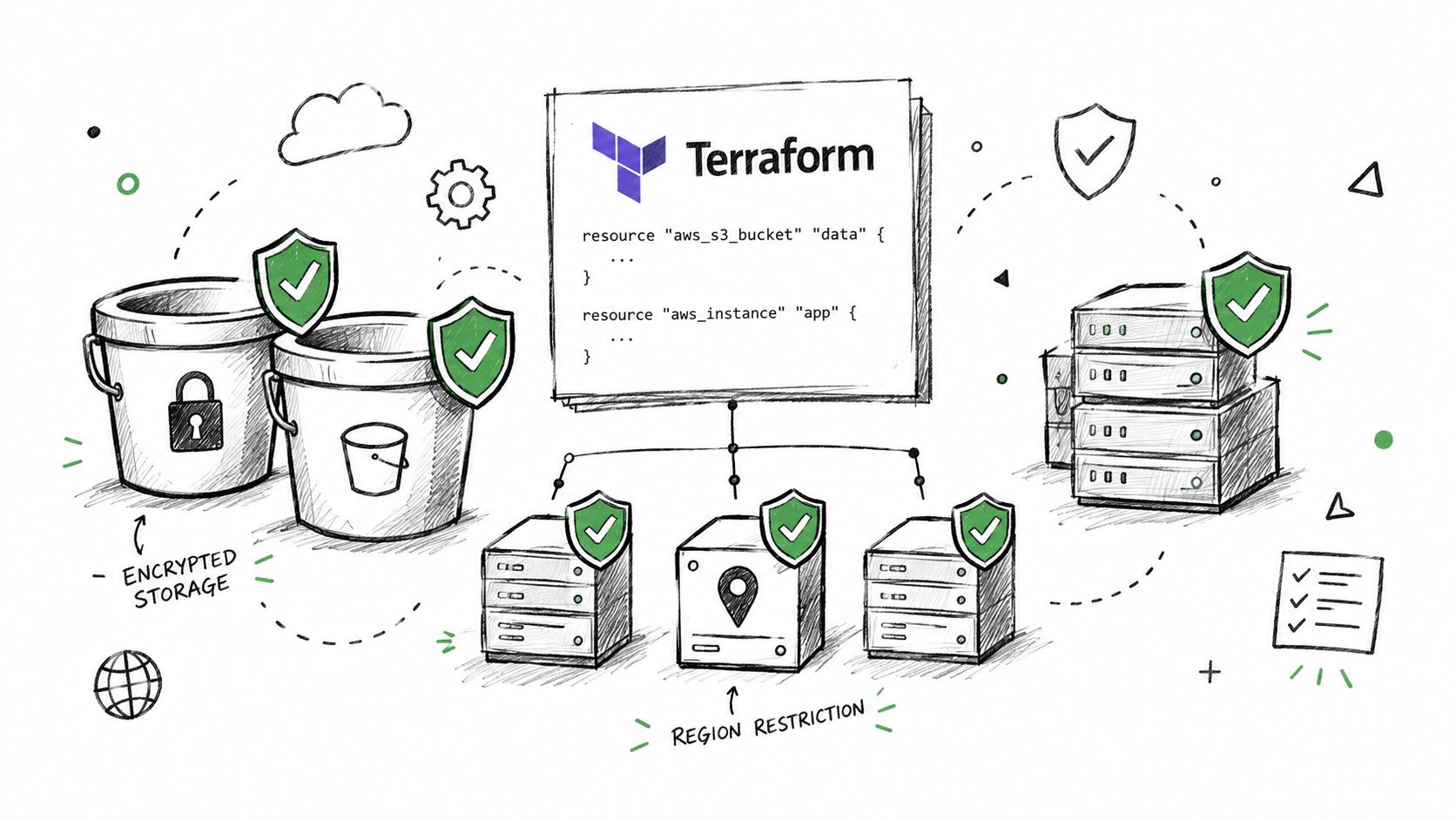
Consider a storage module that creates a bucket and its access policy. A source scanner may identify an obvious public setting, but a plan policy can inspect the resolved resource changes and deny the deployment when public access conflicts with the environment's classification. The message should identify the bucket, the failed requirement, and the approved remediation, not merely return “policy failed.”
Patterns that work
-
Encryption requirements: Require encryption settings for storage and database resources where the organization classifies the data as sensitive. Keep provider-specific rules separate from the business requirement so updates remain manageable.
-
Network boundaries: Reject overly broad ingress rules, especially when a resource exposes administrative or application ports to the public internet. The policy should inspect the actual rule after interpolation, not rely on a variable name that a module author can bypass.
-
Tags and ownership: Require ownership, environment, and cost-allocation metadata on resources that support tags. Treat exceptions as explicit metadata with an accountable owner, rather than allowing an untracked bypass.
-
Location controls: Restrict deployment to approved regions when residency, latency, or operational support requires it. Apply the control consistently across modules and providers where the same business rule applies.
The difficult case is drift. An engineer changes a firewall rule in the cloud console, the Terraform repository remains unchanged, and the next plan may eventually reveal the difference. A continuous control should detect the out-of-band change independently, classify the violation, and route remediation to the responsible team.
A passing plan proves that one proposed transition met the rule. It doesn't prove that the environment will remain compliant.
Policy failures also need ownership. Security may define the intent, platform engineering may maintain the implementation, and service teams may own remediation. Without that division, every failure becomes a platform escalation and developers start treating governance as an obstacle instead of a shared contract.
Testing and Integrating Policies into CI Pipelines
An untested policy is production code with an unknown blast radius. Build its test suite around allowed and denied resources, missing attributes, unknown values, module variations, and approved exceptions. OPA policies typically use Rego tests against representative Terraform plan JSON. Sentinel policies need fixtures that match the Terraform data available during evaluation.
Test the decision, not only the syntax
Each test should answer three questions:
- Does the rule deny the unsafe resource?
- Does it allow a compliant resource?
- Does it behave predictably when Terraform marks a value as unknown?
Unknown values require an explicit decision. A plan may not contain the final provider-computed value. Treating unknown as safe can create a bypass, while rejecting every unknown can block legitimate changes. The appropriate behavior depends on the control, but document it and cover it with tests.
CI must generate the same input used by enforcement. A typical OPA pipeline runs terraform plan -out=tfplan.binary, converts the result with terraform show -json tfplan.binary, then evaluates that JSON with Rego. The job should fail on a deny result, retain the evaluation output, and stop any apply job after a failed check. This plan JSON workflow also gives reviewers a concrete record of which proposed resources triggered the decision.
Test more than the pull request path. Scheduled evaluations against current state can catch drift that never appears in a repository change, while separate checks can assess resources created outside Terraform. Keep those results distinct from plan checks so teams can tell whether they are reviewing an unsafe change or an already noncompliant environment.
Roll out without surprising every team
Start new rules in audit or advisory mode where the platform supports it. Collect violations, distinguish genuine defects from missing context, and publish remediation guidance before mandatory enforcement.
Engine migration needs the same care. Do not translate Sentinel or Rego mechanically and assume equivalent behavior. Compare input schemas, unknown-value semantics, exception handling, test coverage, and enforcement levels. Run both decisions during a controlled transition, then retire the old rule after the replacement produces equivalent outcomes.
The target is a small set of trusted controls that developers understand, operators can maintain, and remediation owners can act on.
Aligning Policy with SOC2, ISO, and GDPR Requirements
Compliance frameworks describe control objectives, not Terraform expressions. SOC 2, ISO 27001, and GDPR may require organizations to protect information, control access, manage risk, and demonstrate accountability, but a single Terraform policy rarely proves an entire requirement.
The practical approach is to map each technical policy to a control statement, an owner, an enforcement point, and evidence. For example, a rule requiring encryption on a storage resource can support a broader protection objective. It doesn't prove key rotation, access review, incident response, or data classification by itself.
Build an evidence chain
A useful compliance record connects:
- Requirement: The internal or external control objective.
- Policy: The machine-readable rule that checks the infrastructure.
- Evaluation: The pass or fail result for a specific run or state check.
- Remediation: The change that resolved the violation.
- Exception: The approved reason, scope, owner, and expiry condition.
This structure makes audits less dependent on screenshots and retrospective explanations. It also reveals where policy-as-code is insufficient. A Terraform plan can show an intended configuration, but it may not prove that a user's access remained appropriate after deployment or that a data-processing activity complied with privacy obligations.
Keep privacy requirements contextual
GDPR-related controls often depend on data flows, processing purpose, residency, retention, and access relationships. A region restriction may support a residency requirement, but it can't establish the full legal basis for processing. Similarly, an ISO 27001-aligned infrastructure rule contributes evidence to an information-security control, but the management system still needs risk treatment, ownership, review, and continual improvement.
The compliance as code guidance helps frame this distinction. Automation supplies repeatable evidence and consistent technical enforcement, while governance teams retain responsibility for interpreting requirements and validating the wider control environment.
Policy repositories should therefore include control mappings and plain-language explanations. Auditors need traceability, developers need actionable failures, and platform engineers need a clear boundary between an enforceable infrastructure condition and a requirement that needs human or process evidence.
Recommended Toolchain and Runbook for Platform Teams
A platform team needs a toolchain that separates feedback, enforcement, and observation. Use source scanning for fast developer feedback, plan-based policy for deployment decisions, and post-deployment monitoring for drift and runtime state.

A workable operating model
- Author: The control owner writes the requirement, scope, exception behavior, and remediation message.
- Review: A platform engineer and a security or compliance representative review the rule and its fixtures.
- Test: CI runs policy unit tests and evaluates sample plans, including safe, unsafe, and unknown-value cases.
- Release: The team introduces the rule in advisory mode where possible, monitors failures, then applies the agreed enforcement level.
- Operate: Owners review violations, drift findings, and exception records on a regular cadence.
Keep policies in a dedicated repository or a clearly governed policy directory. Version policy bundles, pin execution dependencies, and require pull-request review. Avoid embedding every organization-wide rule inside individual Terraform modules. Module-level validation still has a place for input correctness, but central policy is better for controls that must apply across teams.
The runbook should define what happens when a policy fails. The developer should see the violated resource, the reason, the remediation, and the approved exception path. The operator should know whether to remediate through Terraform, revoke an out-of-band change, or escalate a state inconsistency.
Teams comparing audit and governance tooling may also consult this SOC 2 software roundup to distinguish evidence management from infrastructure enforcement. They solve related problems, but they aren't interchangeable.
CloudCops GmbH is one example of a consulting partner that co-builds everything-as-code platforms, including Terraform workflows, OPA-driven governance, CI/CD, and cloud-native controls across AWS, Azure, and Google Cloud. The important design choice remains ownership. A tool or partner can accelerate implementation, but the organization must maintain policy intent and exceptions.
Frequently Asked Questions About Policy as Code
Does policy as code slow Terraform down?
Policy evaluation adds work, but the effect depends on plan size, rule complexity, dependency lookups, and evaluation frequency. Keep local checks lightweight. Run deeper checks in CI or on the Terraform platform, and cache stable inputs when the engine supports it. A slow suite often points to inefficient queries or overly broad scope. Removing governance usually treats the symptom instead of the cause.
Should every policy be mandatory?
No. Use advisory enforcement for guidance and cleanup, soft enforcement when an approved exception may be valid, and hard enforcement for controls that cannot be bypassed. Mandatory failures can stop a run unless an explicit override is available, so define the exception path with the rule, including its owner, evidence, expiry, and review process.
How do mixed-tool teams avoid duplicate rules?
Give every control one system of record. OPA can own portable decisions across Terraform and Kubernetes, Sentinel can govern Terraform Cloud runs, and Checkov or TFSec can provide source-level feedback. Repeating a check is reasonable when the tools provide different timing or context. The messages, remediation guidance, and exception process still need one clear owner, or developers will receive conflicting failures.
What should happen after deployment?
Run drift detection and post-apply validation. Plan-time approval cannot catch an out-of-band change made later, a module update that introduces a violation, or a resource that no longer matches the approved configuration. Day 2 controls should report the affected resource, identify its owner, and distinguish a Terraform remediation from a state inconsistency or an authorized exception.
The policy layer should remain connected to operations rather than ending at apply. Start with a small control set, assign an owner to every failure, and add post-deployment observation before expanding coverage. This approach also makes mixed-policy stacks easier to manage because each engine has a defined role and escalation path.
CloudCops GmbH can help design Terraform policy as code, connect OPA or native Terraform controls to CI/CD, and add drift-aware governance across AWS, Azure, and Google Cloud. Visit CloudCops GmbH to discuss a co-built platform and runbook aligned with your infrastructure and compliance requirements.
Ready to scale your cloud infrastructure?
Let's discuss how CloudCops can help you build secure, scalable, and modern DevOps workflows. Schedule a free discovery call today.
Continue Reading
Terraform Best Practices for Multi-Cloud Teams in 2026
Practical terraform best practices for AWS, Azure, and GCP teams covering state, modules, CI/CD, policy-as-code, drift, and cost controls.
Terraform vs OpenTofu: How to Choose in 2026
Terraform vs OpenTofu in 2026: a practitioner-led comparison of compatibility, state, licensing, governance, migration friction, and CI/CD fit for real teams.
Multi-Cloud Architecture: A Practitioner's Guide for 2026
Learn to design, build, and operate a resilient multi-cloud architecture. Our guide covers patterns, principles, and a checklist to avoid common pitfalls.