
Terraform vs Pulumi Which IaC Tool Fits Your Stack
September 22, 2026•CloudCops
Your platform team has already standardized on Terraform, but the next generation of engineers wants to write infrastructure in TypeScript or Python. The application teams are asking for reusable abstractions, unit tests, and familiar IDE refactoring. Procurement is asking what Terraform's licensing change means for long-term standardization. Meanwhile, the infrastructure estate still depends on a broad provider ecosystem, predictable plans, and workflows nobody wants to interrupt.
That's the Terraform vs Pulumi decision in 2026. It isn't a contest between a “traditional” tool and a “modern” one. It's a choice about how your organization designs platforms, shares infrastructure knowledge, governs changes, and absorbs operational risk. Teams that treat the decision as a feature checklist often underestimate migration effort. Teams that treat it as an operating-model decision usually make a more durable choice.
Introduction Why Terraform vs Pulumi Matters Now
A platform team choosing an IaC standard rarely chooses only a command-line tool. It chooses how developers request infrastructure, how reviewers understand changes, how security teams enforce controls, and how operators recover when state or providers behave unexpectedly. That standard may shape the team's workflow for years, so a technically attractive feature can still be the wrong organizational fit.
Terraform remains the incumbent. HashiCorp released it in July 2014, while Pulumi arrived in June 2018, giving Terraform a much earlier start in the Infrastructure as Code market. Terraform reached version 1.0 in 2021, after years of production use and enterprise standardization. Independent commentary also describes an ecosystem with more than 3,000 providers, which helps explain why Terraform remains embedded across heterogeneous cloud and SaaS estates. These historical details are documented in Apptio's Terraform and Pulumi comparison.
Pulumi addresses a different pressure. Platform engineers can use TypeScript, Python, Go, C#, Java, and YAML instead of learning a dedicated configuration language. That makes infrastructure feel closer to application engineering, especially where teams need typed abstractions, reusable libraries, and tests that run within existing language toolchains.
The stakes become sharper when a team is already operating Terraform at scale. Replacing it means retraining engineers, reviewing provider coverage, translating state, changing policy controls, and rebuilding operational habits. Staying with it can mean accepting HCL constraints, external testing patterns, and licensing considerations that may matter to procurement or regulated buyers.
This guide focuses on that decision rather than declaring a universal winner. The practical question is whether your organization values Terraform's ecosystem and established operating model more than Pulumi's programming-language ergonomics. Readers assessing the wider Infrastructure as Code operating model should evaluate both the tool and the platform practices around it.
| Decision factor | Terraform | Pulumi | Usually fits best when |
|---|---|---|---|
| Configuration model | Declarative HCL | General-purpose languages and YAML | Teams prefer either constrained configuration or software-engineering patterns |
| Ecosystem | Mature provider and module ecosystem | Growing provider and package ecosystem | Provider breadth or abstraction flexibility is the primary constraint |
| Testing | External testing patterns are common | Native language testing patterns | The team wants infrastructure tests beside application tests |
| Existing estate | Strong choice for established Terraform workflows | Strong choice for greenfield or selective modernization | Migration cost is lower than the benefit of a new operating model |
| Governance | Mature policy and CI/CD patterns | Code-native policy options | Controls must fit existing platform standards or developer workflows |
| Strategic risk | Incumbency with licensing and ecosystem questions | Apache 2.0 SDK and a smaller ecosystem | Procurement and portability carry significant weight |
How Terraform and Pulumi Work Under the Hood
Terraform and Pulumi both let teams describe infrastructure as code, calculate changes, and reconcile cloud resources with an intended state. Their similarity ends at the outcome. The tools use different execution models and create different relationships between infrastructure authors and the platform team.
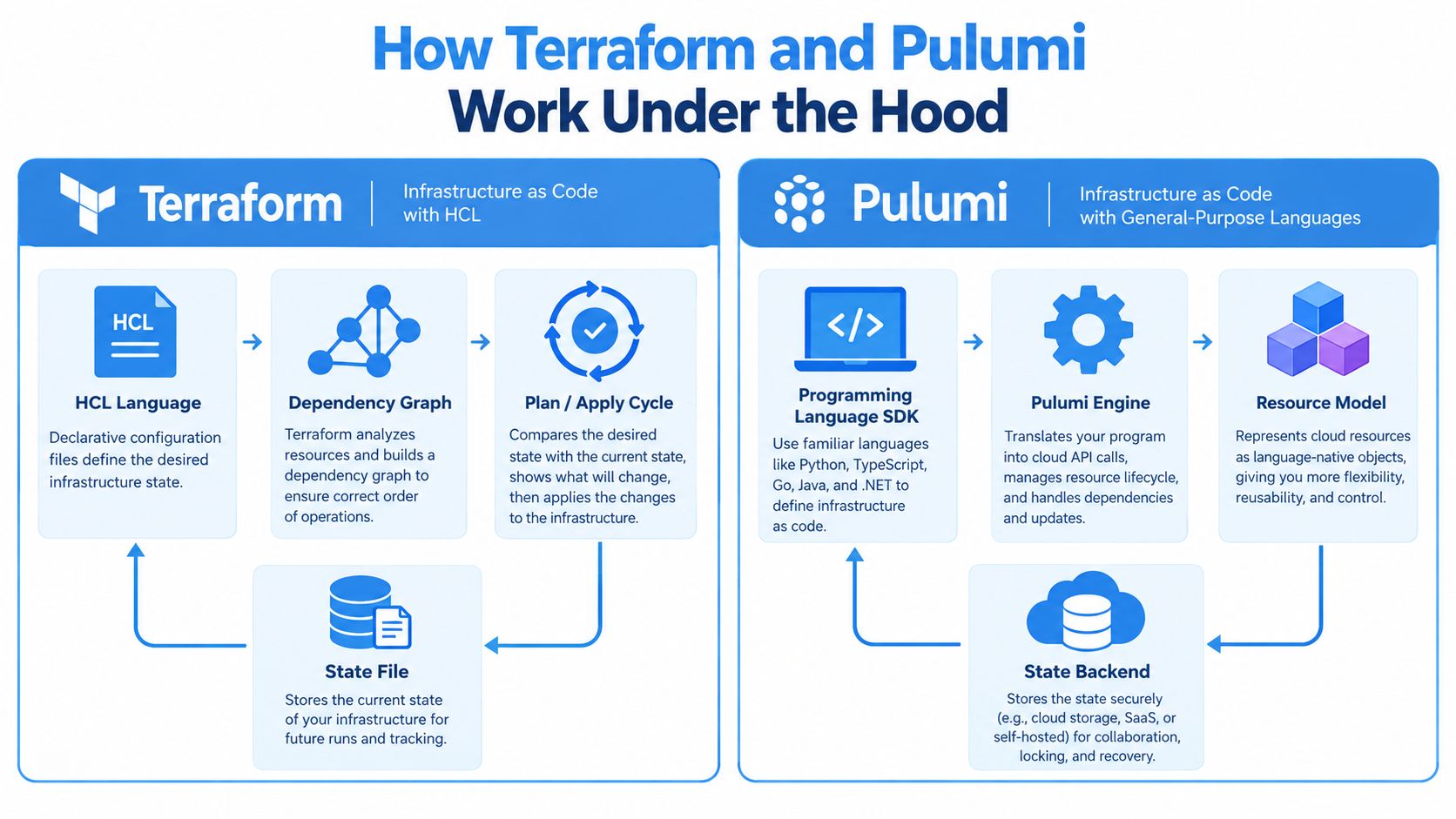
Terraform starts with HCL, a declarative language designed for resource configuration. Engineers describe providers, resources, variables, outputs, and dependencies. Terraform builds a dependency graph, generates a plan, and applies the approved actions. The state file records the relationship between configuration and real resources, allowing later plans to identify changes and drift.
That model creates a useful boundary. Terraform configuration is less like an application and more like a structured contract. The limited language can frustrate engineers who want complex control flow, but it also gives reviewers a consistent vocabulary for infrastructure changes. A platform team can enforce conventions without asking every contributor to understand a full programming runtime.
Pulumi uses a language host and SDK model. The author writes infrastructure in a supported general-purpose language, and Pulumi's engine evaluates the program to produce a resource graph. The engine then compares the desired resource model with stored state and performs the required operations. The result still resembles declarative reconciliation, but the path to that result includes language execution, package management, and runtime behavior.
The practical difference is the boundary
Terraform makes infrastructure the primary abstraction. Pulumi makes the programming language part of the abstraction. That distinction affects code review, debugging, testing, dependency management, and hiring.
A Terraform engineer generally investigates provider behavior, graph dependencies, plan output, and state. A Pulumi engineer may investigate those same concerns plus language exceptions, package versions, runtime configuration, and asynchronous outputs. Neither model removes complexity. Each places complexity in a different layer.
Teams hiring or growing a platform function should assess those layers explicitly. A specialist partner such as GENTY recruitment infrastructure engineers can help identify whether the organization needs HCL-focused operators, cloud-native programmers, or engineers comfortable with both models.
State is the other foundational distinction. Terraform commonly uses a state file with a remote backend and locking strategy. Pulumi uses a state backend and resource model, with managed and self-managed approaches available. In either tool, state access, encryption, backups, recovery procedures, and ownership matter more than the local syntax.
For Terraform teams, remote state file design should be treated as an operational control, not an implementation detail. The same principle applies to Pulumi stacks. A tool can generate a clean preview and still cause serious damage if the team lacks disciplined state ownership and recovery procedures.
Detailed Comparison Across Languages State and Packaging
The core comparison becomes clearer when each tool is judged against the work platform teams perform. Language choice matters, but so do state recovery, abstraction boundaries, testing, provider coverage, and the ability to onboard engineers without creating a second engineering culture.
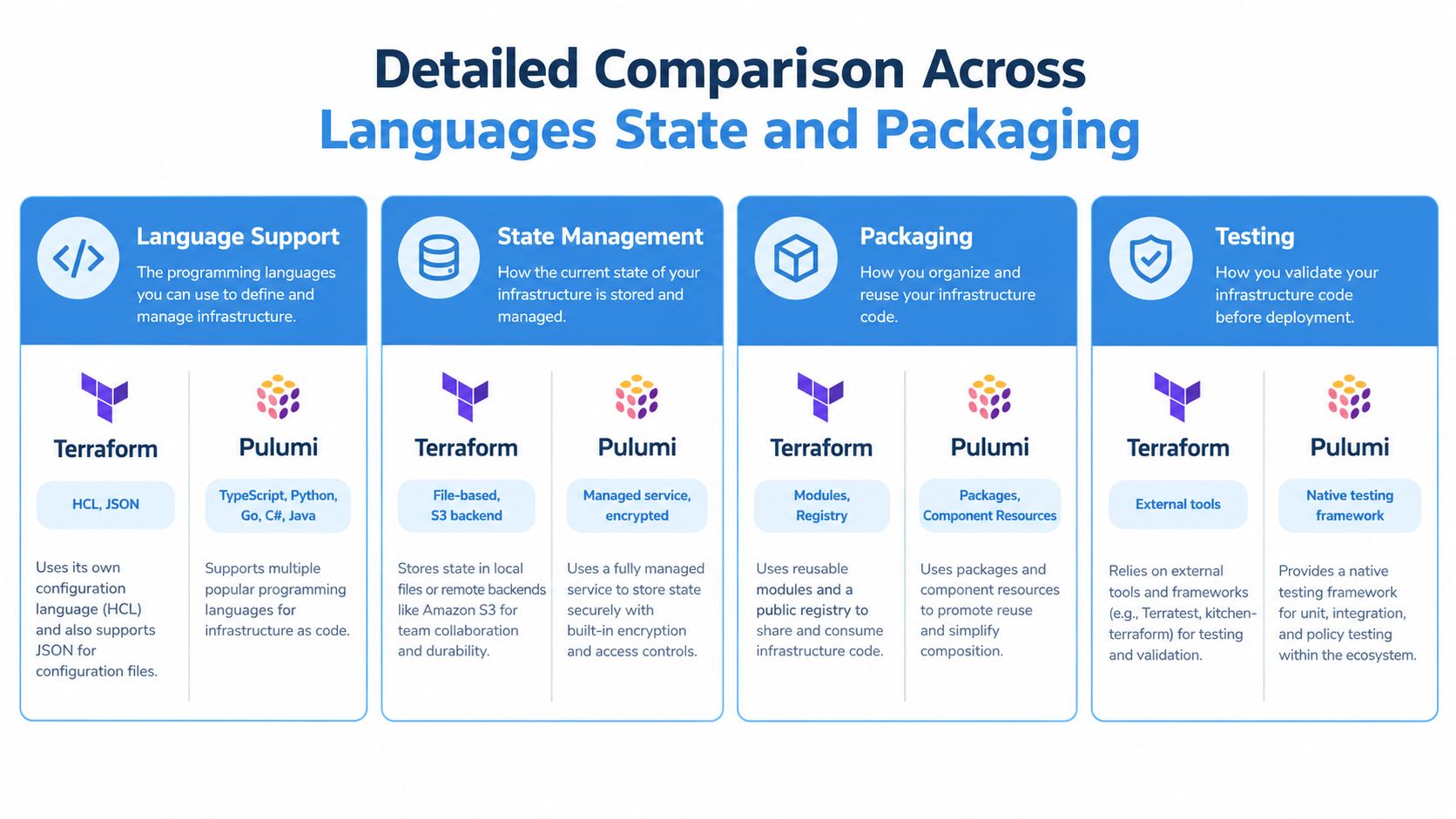
Pulumi's comparison model supports TypeScript, Python, Go, C#, Java, and YAML, while Terraform centers on HCL. The practical effect is significant. Pulumi can use compile-time type checking, unit-test frameworks, IDE refactoring, loops, and functions from the selected language. Terraform can express reusable logic through variables, expressions, modules, and DSL constructs, but teams commonly use external testing patterns such as Terratest. These differences are discussed in the 2026 language-focused Terraform and Pulumi analysis.
Language verdict: Pulumi fits teams that want infrastructure to behave like a tested software library. Terraform fits teams that value a constrained, purpose-built configuration model.
Language and developer experience
HCL is approachable once the team understands Terraform's resource model, expressions, modules, and lifecycle behavior. It's also deliberately narrow. That narrowness can make configuration predictable, but complicated conditional infrastructure often becomes difficult to read and debug.
Pulumi's language support reduces the need to invent DSL workarounds. Engineers can create classes, functions, packages, and test fixtures using familiar tools. The trade-off is that a Pulumi project inherits language-runtime concerns. Dependency pinning, virtual environments, package supply chains, and language-specific conventions become part of infrastructure operations.
The best choice depends on who writes the code. A platform team staffed by application engineers may gain speed from Pulumi. An operations-heavy team supporting many contributors may prefer Terraform's uniform syntax and large body of established examples.
State and secrets
Both tools require careful state design. State can contain sensitive values or references, and a failed deployment can leave the recorded model out of sync with the provider. Remote storage, access control, encryption, locking, backups, and break-glass procedures should be designed before production adoption.
Pulumi's managed service experience can reduce the amount of backend plumbing a team owns, while self-managed options support organizations with strict control requirements. Terraform's backend model gives teams a familiar pattern for storing state in infrastructure they already operate. Neither choice eliminates the need to define who can read state, who can approve changes, and how operators recover a damaged stack.
Secrets deserve the same treatment. Store them through the tool's supported secret mechanisms or an established secrets manager, keep them out of source control, and verify that plan or preview output doesn't expose values.
Modules and packages
Terraform modules are a mature organizational mechanism. Teams can publish network, Kubernetes, identity, or database modules through internal registries and establish versioning conventions around them. The risk is that poorly designed modules hide too much behavior or expose so many variables that they become difficult to operate.
Pulumi packages and component resources allow teams to build higher-level abstractions in a general-purpose language. This can produce cleaner interfaces for application teams, particularly when a platform product needs to expose a small set of safe primitives. It can also create an internal library that only a few language specialists understand.
Testing and multi-cloud coverage
Terraform teams often combine validation, plan checks, policy-as-code, integration tests, and external frameworks. Pulumi can place unit tests and mocks within the language ecosystem, which makes test-first infrastructure easier for teams already using those frameworks.
Multi-cloud support is less about whether either tool can target major clouds and more about the services your estate uses. Terraform's earlier market presence gives it broader provider and module coverage in many environments. Pulumi's compatibility with Terraform providers helps, but compatibility doesn't guarantee identical documentation, lifecycle behavior, or community support.
| Criteria | Terraform | Pulumi | Best fit |
|---|---|---|---|
| Language model | HCL with declarative configuration | TypeScript, Python, Go, C#, Java, and YAML | Terraform for constrained configuration, Pulumi for language-native engineering |
| State model | State file with configurable remote backends | Stack state with managed or self-managed backends | Depends on ownership, recovery, and compliance requirements |
| Reuse | Modules and registries | Packages and component resources | Terraform for established module estates, Pulumi for code-native abstractions |
| Testing | Validation plus external testing tools | Native language testing plus integration approaches | Pulumi when unit-test-first workflows are central |
| Provider strategy | Mature provider ecosystem | Pulumi providers and compatibility with Terraform providers | Terraform when service coverage is the deciding factor |
| Debugging | HCL, graph, provider, and state behavior | Language runtime, SDK, engine, provider, and state behavior | Match the tool to the team's debugging skills |
Ecosystem CI/CD and Security for Regulated Teams
A regulated platform team cannot run infrastructure as code from an engineer's laptop and call the process controlled. Pull requests need protected approvals, plans must be reproducible, production access requires separation of duties, and every applied change needs evidence that maps back to internal controls. Terraform and Pulumi can both fit this model. The surrounding platform, not the syntax alone, determines whether those controls hold under pressure.
Terraform usually creates less operational change for organizations with an existing Terraform estate. Repository conventions, CI runners, module registries, policy checks, and incident procedures may already be established. Pulumi can support the same approval and deployment gates, but its platform design must account for language-runtime builds, package provenance, preview behavior, and policy integration.
The ecosystem difference matters for teams managing a long tail of cloud, SaaS, networking, and security services. Terraform's earlier release and broad provider base reduce the chance that an unusual service or lifecycle edge case becomes an internal engineering project. Pulumi's code-native model can make reusable abstractions easier for software-focused teams to build, but code patterns do not replace provider coverage or operational knowledge.
CI/CD and GitOps boundaries
Both tools can run in pull-request pipelines through GitHub Actions, GitLab CI, or Jenkins. A production-ready workflow separates preview from apply, protects credentials, locks state, and stores an immutable record of the approved change. The pipeline also needs clear ownership for failed previews, provider upgrades, and state recovery.
GitOps adds a separate ownership question. Argo CD and Flux CD primarily deliver workloads, while Terraform and Pulumi generally provision cloud and platform resources. The operating model should assign ownership for clusters, identities, networks, managed services, and in-cluster objects before automation is deployed. If a GitOps controller and an IaC pipeline can both modify the same resource, reconciliation conflicts and unexplained drift follow.
Policy controls can combine OPA, provider validation, static analysis, and tool-specific policy systems. Test the declared configuration and the resulting resource intent. These controls are part of the operating model, so Terraform policy-as-code practices remain relevant even if the team later evaluates another IaC engine.
Licensing and auditability
HashiCorp changed Terraform and its core product suite from the Mozilla Public License 2.0 to the Business Source License 1.1 in August 2023. That change contributed to industry reevaluation and the rise of OpenTofu. Pulumi's SDK remains Apache 2.0, according to Encore's analysis of the Terraform and Pulumi landscape.
Survey reporting cited by CloudBizStack's comparison describes Terraform as dominant in current usage. One report estimated roughly 60% of IaC users currently use it, while just over 20% planned to use it in the future. Another survey summary reported 71% usage for Terraform and 1% for Pulumi. These results come from different surveys and are not one market measurement, but they show Terraform's adoption advantage.
Regulated buyers should review more than the headline license. Confirm component ownership, release governance, provider coverage, audit-evidence export, procurement fit, and whether a future move to OpenTofu or another engine can be executed without rebuilding the operating model.
Operational Costs Performance and Hidden Trade Offs
The cheapest IaC tool is the one your team can operate safely without creating a second platform. Subscription pricing is only one part of the calculation. Backend hosting, CI runtime, secrets integration, policy maintenance, incident response, training, code review, and migration effort can dominate the total cost.
Terraform often minimizes transition cost when engineers, repositories, modules, and pipelines already use Terraform. The team can reuse operational knowledge and provider patterns. Pulumi may reduce authoring friction for developers who already work in TypeScript, Python, Go, C#, or Java, but that benefit can be offset if platform engineers must introduce runtime management, package governance, and new troubleshooting practices.
Performance is workload-dependent
Benchmark-style reporting doesn't identify a consistent winner. One community summary reported terraform plan at about 12 seconds for 500 resources versus about 9 seconds for Pulumi, and about 55 seconds versus 40 seconds for 2,000 resources. A separate comparative study reported Pulumi's mean latency across AWS, Azure, and GCP at roughly 95% to 96% of Terraform's, suggesting near parity rather than a universal advantage. The results and their limitations are summarized in this comparative performance report.
Those results should guide testing, not replace it. Provider API latency, refresh behavior, dependency graphs, parallelism, state size, language startup, and CI runner capacity can all affect the observed result. Measure representative plans and applies in your own estate before making performance a selection criterion.
Operational rule: Optimize the workflow before optimizing the command. A slightly faster preview doesn't compensate for unclear ownership, weak policy checks, or slow incident recovery.
Hidden costs that actually matter
Terraform's hidden cost is often HCL complexity. Teams can build elegant modules, but advanced expressions, nested structures, and provider-specific behavior can make failures difficult to diagnose. Pulumi's hidden cost is broader. A language runtime gives engineers more power, while also introducing package updates, dependency vulnerabilities, build reproducibility, and language-specific failure modes.
State backend design also carries cost. A managed backend may reduce maintenance work but introduce procurement and tenancy questions. Self-managed storage can satisfy control requirements but leaves the organization responsible for access, locking, encryption, backup, and recovery.
The right financial model includes:
- Migration effort: Estimate translation, state import, test rewriting, pipeline changes, and retraining qualitatively before committing.
- Review capacity: Consider whether reviewers can understand the chosen language and detect unsafe infrastructure behavior.
- Provider gaps: Validate the services that matter most, including edge resources and operational features.
- Incident ownership: Define who handles state repair, provider regressions, failed applies, and emergency changes.
- Governance maintenance: Include policy libraries, exceptions, evidence collection, and drift response in the operating budget.
Real World Use Cases and Migration Patterns That Work
A greenfield startup and a regulated enterprise shouldn't receive the same Terraform vs Pulumi recommendation. Their constraints differ before the first resource is created. One may optimize for developer throughput and shared application skills, while the other may optimize for provider coverage, audit continuity, and low migration risk.
Greenfield product teams
A venture-backed startup building a cloud-native product may benefit from Pulumi when application engineers will own substantial infrastructure code. TypeScript or Python can make it easier to share libraries, validate inputs, and express environment-specific behavior without forcing the team to learn HCL first.
That advantage disappears if the team lacks platform discipline. General-purpose code can encode unsafe defaults, create hidden side effects, or make reviews harder for engineers who aren't fluent in the language. A small startup should establish component boundaries, dependency pinning, preview checks, secret handling, and ownership before the infrastructure becomes business-critical.
Terraform remains a sensible greenfield choice when the team expects broad cloud and SaaS integration, wants a large pool of hiring experience, or plans to use established modules from the beginning.
Established Terraform estates
A Terraform estate shouldn't be rewritten just because Pulumi offers a more comfortable programming model. The first question is whether the existing problems come from HCL or from poor module design, weak testing, unclear ownership, and uncontrolled pipelines. Pulumi won't repair those operating-model issues automatically.
A safer migration pattern is incremental coexistence:
- Map ownership first. Identify which teams own state, modules, providers, policies, and production approvals.
- Select a bounded workload. Choose a new service or isolated platform capability with clear resource ownership.
- Define the interface. Expose outputs and inputs through a stable contract rather than sharing internal state casually.
- Rebuild controls before production. Recreate preview, approval, policy, secrets, drift, and rollback workflows.
- Compare operational outcomes. Evaluate review quality, onboarding, incident handling, and maintenance, not just code length.
- Keep existing Terraform where it works. Coexistence is often safer than a forced rewrite.
This approach reflects an underexplained reality documented in Pulumi's Terraform comparison guidance. The hard decision isn't which syntax looks better. It's whether code reuse, shared abstractions, and unit-test-first workflows outweigh retraining, governance changes, migration cost, and ecosystem lock-in.
Regulated and multi-cloud organizations
A regulated enterprise should begin with procurement, auditability, provider coverage, and exit options. If Terraform already controls critical infrastructure, preserving the current platform may be the responsible choice while the team evaluates Pulumi or OpenTofu for bounded greenfield work.
If open governance and licensing portability are essential, Pulumi or OpenTofu may deserve a formal pilot. The pilot should include the organization's real controls and provider requirements, not a simplified demonstration stack.
Choosing Between Terraform and Pulumi for Your Team
The right choice follows your operating model, not a feature checklist. Choose Terraform when provider breadth, established modules, existing operational knowledge, and low migration risk outweigh the benefits of a general-purpose language. That is usually the practical decision for a large Terraform estate, particularly when the platform team already has mature remote state, policy, CI/CD, and incident procedures.
Choose Pulumi when application engineers will contribute directly to infrastructure, reusable software abstractions matter, and native testing or IDE workflows support delivery. It also merits evaluation when the organization wants Apache 2.0 SDK licensing and can operate a smaller ecosystem with language-runtime governance. Those benefits require clear ownership for dependencies, runtime upgrades, and shared abstractions.
Choose OpenTofu when licensing and open governance are strategic requirements. Verify provider compatibility, enterprise support, and migration procedures before committing. The market is fragmenting rather than converging: Terraform retains incumbent adoption, OpenTofu is attracting greenfield evaluation, and Pulumi is growing among developer-centric teams.
Before standardizing, score each candidate against five questions:
- Who writes infrastructure? Platform specialists, application developers, or both?
- What must the tool provision? Major cloud resources only, or a broad SaaS and multi-cloud estate?
- What governance already exists? State recovery, policy, approvals, drift detection, and audit evidence?
- What does procurement require? License terms, vendor concentration, open governance, and portability?
- What would failure look like? A slow migration, provider gap, insecure abstraction, or operational split?
The recommendation should come from these answers, not from a benchmark or a polished demo. Run a bounded pilot with production-like controls, then measure review quality, onboarding effort, incident handling, and maintenance alongside deployment results.
CloudCops GmbH helps teams design and operate governed, everything-as-code platforms across Terraform, Terragrunt, OpenTofu, policy-as-code, GitOps, and multi-cloud environments. Visit CloudCops GmbH to discuss an IaC assessment, migration plan, or co-built platform workflow suited to your team's operating model.
Ready to scale your cloud infrastructure?
Let's discuss how CloudCops can help you build secure, scalable, and modern DevOps workflows. Schedule a free discovery call today.
Continue Reading
Automation in DevOps: What It Actually Means in 2026
Learn what automation in DevOps really delivers in 2026, from IaC and GitOps to DORA metrics, with a practical roadmap and pitfalls to avoid.
Puppet vs Ansible A DevOps Leader's Guide to Automation
Puppet vs Ansible showdown. A deep technical comparison of architecture, scalability, security, and use cases to help you choose the right DevOps tool.
Terraform Policy as Code: The Cloud Native Security Guide
Master terraform policy as code. Learn how to enforce governance with Sentinel, OPA, and Terraform Cloud across your infrastructure lifecycle.