
Monorepo vs Multi Repo: A Practical Decision Guide
September 23, 2026•CloudCops
The popular advice is simple: choose a monorepo for collaboration and a multi-repo setup for independence. That framing is too shallow for teams operating real production systems. The harder problem isn't average speed. It's delivery variance, the long tail of changes that waits behind dependency conflicts, overloaded CI, unclear ownership, or a cross-service refactor nobody planned to coordinate.
A repository model should make difficult work predictable. Google's internal repository, which contained about 2 billion lines of code, 9 million unique source files, and roughly 86 terabytes of data by 2015, remains a foundational example of a monorepo operating at global scale, as documented in this history of the monorepo model. But scale alone doesn't make a monorepo correct, just as service boundaries don't automatically make a multi-repo organization autonomous.
The practical decision comes down to four questions: how many teams share the system, how intensely their code is coupled, where compliance boundaries sit, and how much AI-assisted code generation your engineers use. The right answer optimizes for predictable delivery, not a headline claim about which repository model is faster.
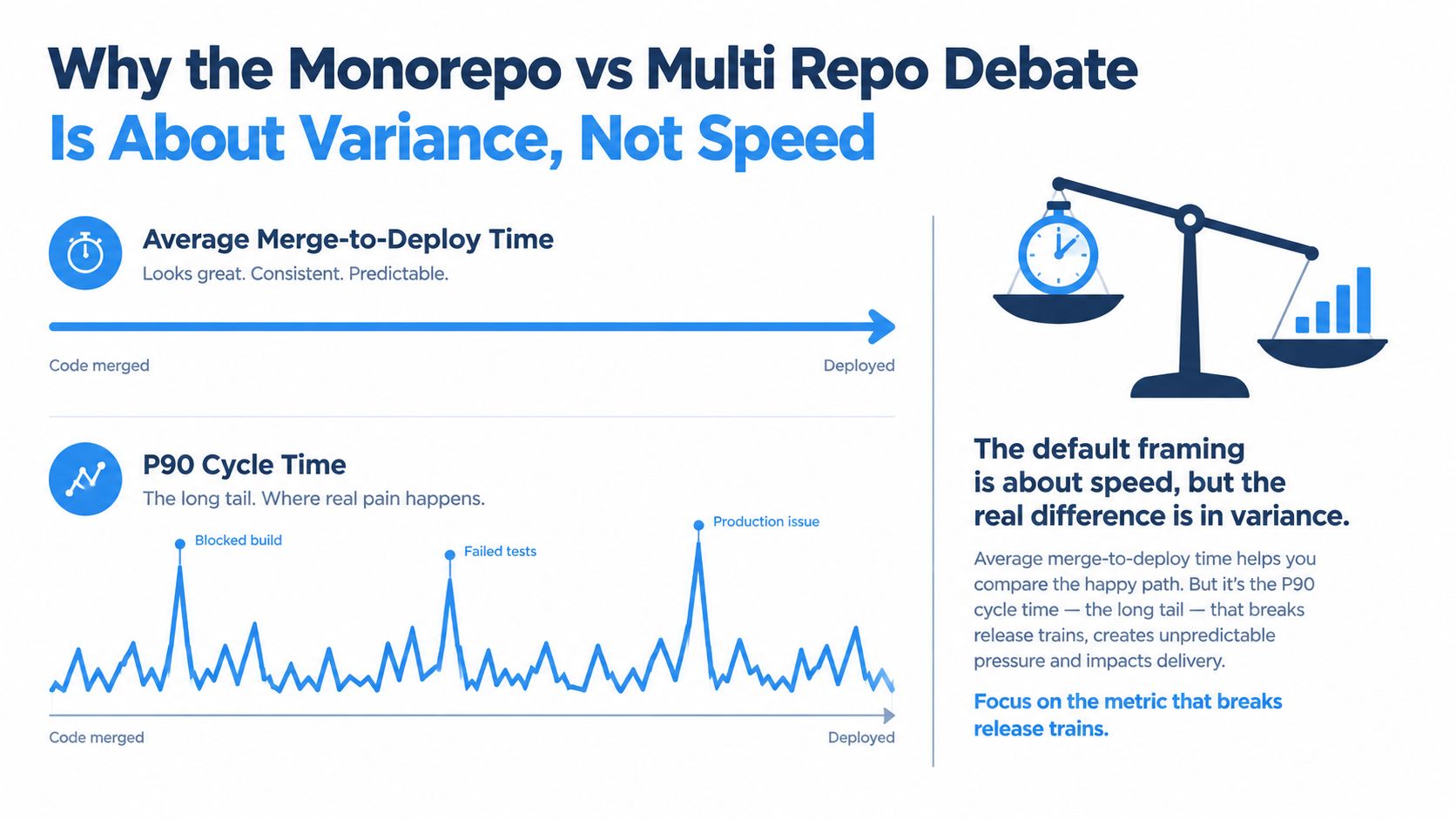
Why the Monorepo vs Multi Repo Debate Is About Variance, Not Speed
Repository strategy should be judged by its worst delivery delays, not only by the typical change. Median merge-to-deploy time describes a normal path. P90 exposes the slow tail, where dependency conflicts, CI queues, permission reviews, and broad refactors turn an ordinary change into a release blocker.
Consider a shared dependency upgrade used by four teams. In a monorepo, one incompatible change can trigger failures across the same build graph. The teams may need to coordinate fixes, wait for affected tests, and compete for CI capacity before any of them can ship. Strong ownership rules and affected-target builds can contain that risk, but they do not remove the shared failure domain.
A multi-repo setup separates those delivery paths. The teams may spend more time publishing versions, updating contracts, and coordinating releases, yet a stalled upgrade usually remains within the repositories that depend on it. That isolation reduces blast radius while increasing the work required to keep interfaces aligned.
AI-assisted code generation makes the variance question sharper. Generated changes can arrive quickly, but they may touch shared libraries, create inconsistent patterns, or expand the review surface. A monorepo makes those interactions visible and supports atomic fixes. Separate repositories limit the blast radius, but teams must manage duplicated generated code and drift between implementations.
As detailed in the benchmark breakdown below, the tail distribution is wider for monorepos. That finding does not make multi-repo universally faster. It shows why teams should measure blocked work and high-percentile cycle time alongside average throughput.
Practical rule: choose the model that limits the number of teams affected by your worst dependency and CI failures.
Evaluate team count, coupling intensity, compliance boundaries, and AI-generated change volume together. Small groups with shared libraries may prefer atomic refactors. Regulated organizations may accept duplicated release work to preserve least-privilege access and auditable ownership.
What Each Model Actually Means in Practice
A monorepo is one version-controlled root containing multiple applications, services, libraries, and infrastructure components. A practical layout might look like this:
apps/
  web/
  mobile/
services/
  billing/
  identity/
libs/
  design-system/
  data-access/
infra/
  terraform/
  kubernetes/
tooling/
  ci/
  scripts/
package.json
The root usually contains shared formatting, testing, dependency, and build conventions. Each package or service still has its own manifest, ownership rule, test target, and deployable artefact. A monorepo doesn't require one application, one language, or one release process. It requires one repository boundary and a build graph that understands the relationships inside it.
A multi-repo, often called a polyrepo, places each service or library in its own repository:
web-app/
billing-service/
identity-service/
design-system/
terraform-platform/
kubernetes-config/
A thin platform repository may provide reusable CI templates, policy as code, deployment definitions, and conventions. Teams own their repositories independently, and a release typically references versioned packages, container images, or infrastructure modules rather than one shared commit.
| Dimension | Monorepo | Multi Repo |
|---|---|---|
| Repository boundary | One root for applications, services, libraries, and infrastructure | Separate repository for each service, library, or platform component |
| Shared tooling | Usually maintained at the root and consumed consistently | Distributed through templates, packages, or copied configuration |
| Package boundary | A directory or workspace inside the repository | The repository itself, or a published package within it |
| Change request | One pull request can update several packages atomically | Cross-service changes usually require coordinated pull requests |
| CODEOWNERS scope | Commonly path-based, package-level ownership | Commonly repository-level ownership and permissions |
| Release artefact | Can be produced from a shared commit while deploying selected targets | Usually versioned per repository, service, or package |
| Coordination model | Central visibility with internal autonomy enforced by tooling | Repository autonomy with coordination enforced by contracts and automation |
The vocabulary matters because “monorepo” is sometimes used to describe a folder collection without a real dependency graph, while “multi-repo” can include advanced federation tooling. A hybrid model may keep separate repositories for governance and access control, then use a meta-repository to lock versions and orchestrate pipelines.
Comparing the Technical Tradeoffs That Matter
The useful comparison isn't a list of universal advantages. It's a set of tradeoffs that flip when language, team structure, build graph, and release cadence change.
| Criterion | Monorepo Strength | Multi Repo Strength | When It Flips |
|---|---|---|---|
| Build and test | Affected-only execution can avoid unrelated work when the dependency graph is accurate | Each repository can build a focused service with fewer graph-wide concerns | The monorepo needs mature graph tooling; multi-repo becomes harder when integration tests span many services |
| CI | Shared conventions, remote caching, and fan-out can standardize delivery | Pipelines are easy to reason about for isolated services | Monorepo CI needs careful sharding and cache governance; multi-repo coordination grows with service count |
| Dependency management | One lockfile and visible upgrade impact simplify coordinated changes | Per-service manifests limit upgrade blast radius | Central upgrades become risky in a tightly coupled graph; independent manifests create drift |
| Branching | Trunk-based development supports atomic refactors and shared feature flags | Separate main branches support independent release policies | Monorepo teams need strong ownership rules; multi-repo teams need contract and compatibility discipline |
| Access control | CODEOWNERS and path rules can protect package boundaries | Repository-level IAM maps cleanly to strong isolation | Path permissions may be insufficient for sensitive assets; many repositories increase administration |
| Release artefacts | One commit can establish compatible versions across components | Services can publish and deploy on their own schedules | Atomic releases are valuable for tightly coupled systems; isolated releases win for bounded contexts |
Build performance is the first serious fault line. Nx and Turborepo can calculate affected tasks and reuse cached results, while Bazel supports hermetic builds and distributed execution for demanding graphs. Those systems don't remove complexity. They move it into dependency declarations, cache keys, execution rules, and platform maintenance.
Multi-repo pipelines start with a smaller local problem. One service checks out, builds, tests, and publishes. The complexity appears when a change crosses repositories, because engineers must coordinate versions, integration environments, compatibility windows, and rollback paths.
Dependency management creates a similar inversion. A monorepo makes shared library upgrades visible and can update consumers in one change request. A multi-repo setup protects unaffected services from an upgrade, but stale versions and inconsistent security patches can persist unless Renovate or Dependabot keeps the graph moving.
Access control is less philosophical than operational. A sensitive service may fit naturally into a repository with dedicated IAM, audit history, and release approvals. A monorepo can still enforce package-level ownership, but the organization must verify that path-based controls match the compliance boundary rather than assuming they do.
Mobile teams face the same question under different constraints, including platform-specific projects, shared modules, and release coordination. The practical guidance in how mobile teams manage code is useful because it treats repository structure as part of the wider development workflow, not as an isolated Git preference.
What the Cycle-Time Benchmark Data Really Shows
Cycle-time averages conceal the delivery risk that matters during coordinated releases. Faros analyzed 320 scrum teams over a full year and reported this distribution:
| Repository model | Median PR cycle time | Mean PR cycle time | P90 PR cycle time |
|---|---|---|---|
| Monorepo | 19 hours | 3.6 days | 8.6 days |
| Polyrepo | 2 hours | 2.8 days | 5.5 days |
The Faros benchmark analysis shows a wider monorepo tail in this dataset. The median difference is substantial, while the mean difference is smaller. That pattern points to a concentrated failure mode: some changes encounter shared ownership, dependency analysis, review queues, or integration work that typical pull requests avoid.
A separate monorepo build-tool benchmark compares cache-restoration performance across Nx, Turborepo, Lerna, Lage, and Moon — a different dimension from PR cycle time, but useful when evaluating CI tooling. Treat both datasets as comparison points, not universal rules. Repository size, language mix, CI design, review policy, deployment model, and team topology can shift the result.
P90 is a useful operating signal because release coordination is constrained by the slowest changes, not the typical ones. Long-running pull requests create stale branches, hold up dependent work, and force teams to sequence releases manually. Remote caching and affected-only execution reduce repeated computation, but they do not correct broad CODEOWNERS scopes or an inaccurate dependency graph.
Segment the P90 by package, team, change type, and queue state before changing repository structure. A tail concentrated in integration-heavy packages calls for test isolation or staged environments. A tail concentrated in one team may indicate ownership overload or review bottlenecks, so narrow approval scopes and rebalance maintainers. Cross-cutting refactors need dependency-aware tooling and explicit rollout plans. In a multi-repo setup, delays clustered around synchronized releases point toward compatibility contracts and automated dependency updates.
AI-assisted code generation makes this segmentation more important. Generated changes can span many packages, increase review volume, and expose hidden dependency edges. Measure their queue and integration behavior separately instead of assuming faster authoring produces faster delivery.
Define the metric consistently. Document whether cycle time starts at the first commit, pull request opening, approval, merge, or deployment. The guide to calculating cycle time provides a practical reference for aligning that definition.
Choosing by Org Size, Compliance, and Release Cadence
Repository structure should follow the organization's coordination problem. The same engineering team can reasonably choose a monorepo for one product and multi-repo for another if the ownership and compliance boundaries differ.
A small startup with 15 engineers often benefits from a monorepo because shared tooling, common libraries, and atomic refactors outweigh the cost of a modest dependency graph. Engineers can find the code they need without negotiating repository access, and the platform team doesn't have to maintain a large catalogue of duplicated pipeline definitions.
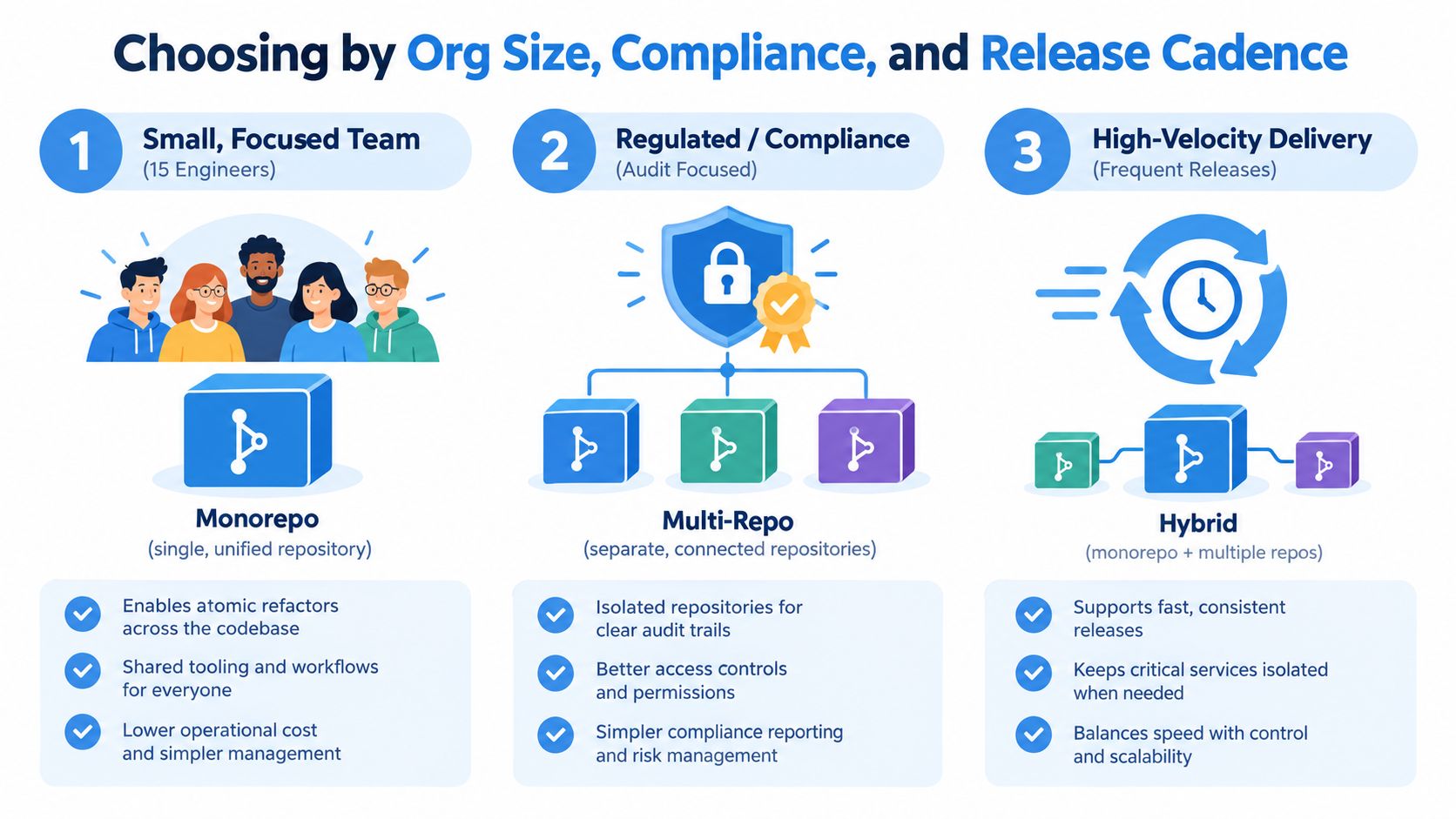
A scale-up with 200 engineers and several product surfaces needs sharper boundaries. A monorepo can still work, but only if package ownership, dependency direction, partial clones, sparse-checkout, and affected-only CI are treated as platform capabilities. If teams release on different schedules and operate distinct bounded contexts, multi-repo may reduce coordination pressure.
A regulated enterprise usually evaluates repository shape through evidence and access. Work involving SOC 2, HIPAA, or FedRAMP obligations may fit multi-repo boundaries when auditors need clear ownership, isolated approval flows, and service-specific access. A monorepo can support those controls, but the organization must prove that path permissions, audit records, build policies, and deployment gates provide the required separation.
The more sensitive the boundary, the less acceptable “we can probably enforce that with conventions” becomes.
Release cadence breaks ties. Teams deploying frequently tend to value atomic refactors and a unified build graph, provided their CI can isolate affected targets. Organizations running monthly release trains may prefer independent repositories because service owners can prepare, approve, and archive release artefacts without carrying every other team's change set.
Hybrid designs are often the honest answer. A platform repository can manage shared GitOps policies while application repositories remain independently deployable. Teams evaluating this model can use what platform engineering means in practice as context for separating developer workflows from the repository boundary itself.
Tooling and Patterns That Make Each Model Work
Tools don't rescue a confused ownership model, but they can prevent predictable failure modes.
For a monorepo, start with an explicit project graph. Nx is useful when teams need project boundaries, affected commands, generators, and cache-aware task orchestration. Turborepo suits teams that want a focused task runner for workspace packages and cached execution. Both require accurate inputs and outputs. A cache that ignores environment variables, generated files, or lockfile changes can return a fast but incorrect result.
Bazel addresses a different scale problem. Its hermetic build rules and distributed execution model help large organizations make builds reproducible across machines. The cost is operational: engineers must maintain rules, toolchains, remote execution, cache permissions, and debugging workflows. Without that investment, Bazel can become a second platform that only a small group understands.
For JavaScript and TypeScript workspaces, pnpm workspaces can provide consistent package linking and dependency installation. Changesets adds a controlled way to version and publish packages when teams need independent release artefacts inside one repository. These tools work best when package boundaries are enforced rather than treated as folder suggestions.
Multi-repo organizations need different guardrails. Git submodules can pin a shared library or infrastructure component, but pointer drift and awkward update workflows make them a poor substitute for dependency automation. Sparse-checkout and partial clones reduce the local working set when repositories contain many unrelated paths, although they don't solve cross-repository release coordination.
Each repository should own its CODEOWNERS rules, checks, and deployment policy. Renovate or Dependabot can open coordinated upgrade changes, while shared CI templates reduce configuration drift. A meta-repository can lock compatible versions across services without collapsing every source file into one root.
The failure mode determines the tool. Use graph-aware caching for unnecessary rebuilds, hermetic rules for reproducibility, package versioning for independent publication, and repository-level controls where access isolation matters.
Migrating Between Monorepo and Multi Repo Without Breaking Things
A repository migration is a delivery-system change, not a Git move. Treat it as a phased program over 12 weeks, with rollback paths and measurable checkpoints rather than a weekend cutover.
During the first phase, inventory ownership boundaries and record every cross-repository dependency. Assign each dependency to an owning team and service-level agreement. This reveals whether the proposed monorepo will expose useful relationships or merely combine unrelated systems under one expensive approval surface.
The next phase introduces compatibility tooling before changing the visible structure. Sparse-checkout, partial clones, submodules, or pnpm workspaces can let engineers experience the target workflow while the original repositories remain authoritative.
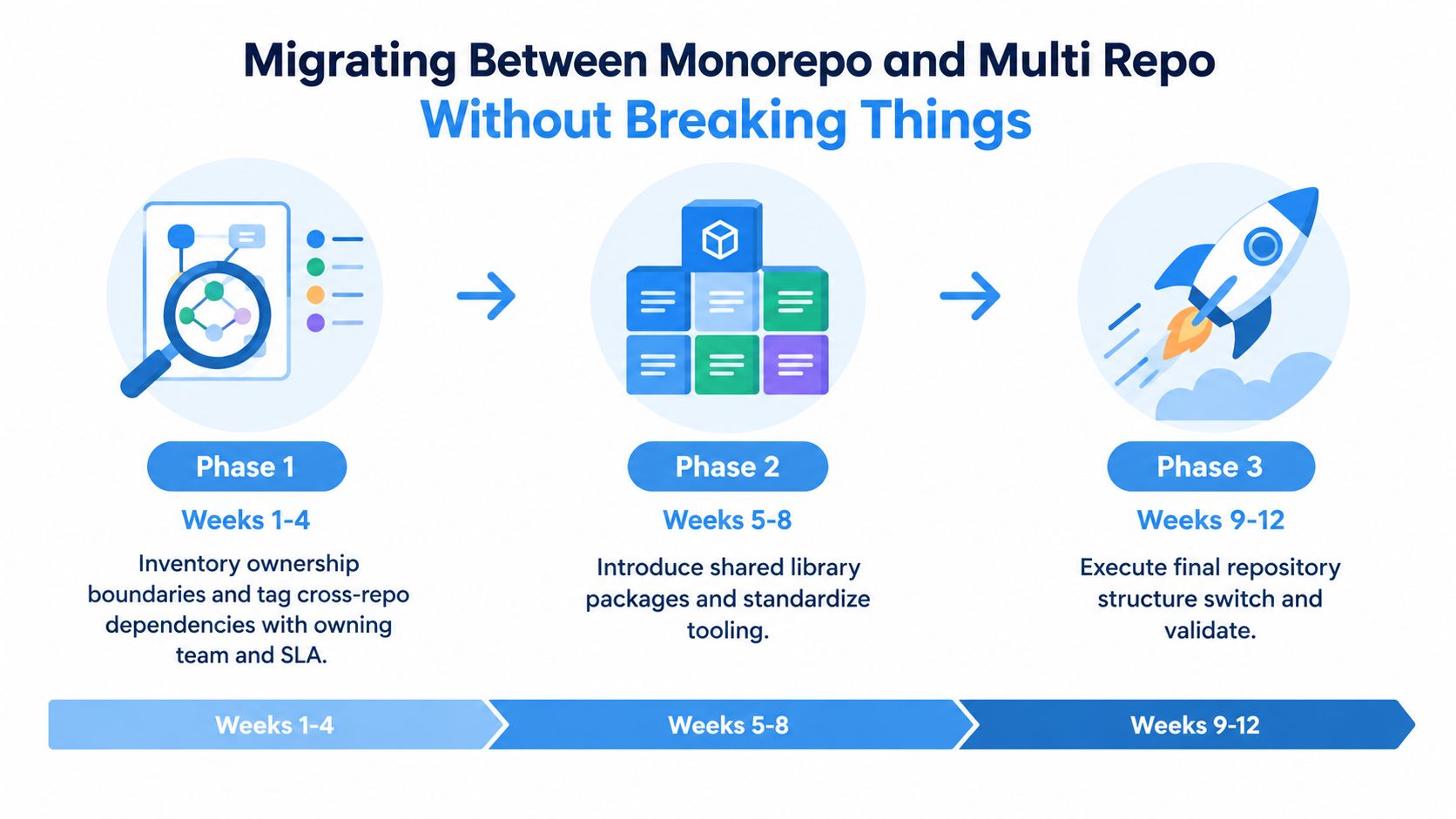
A pilot squad should then exercise the new path against real changes. In a multi-repo to monorepo migration, CI can validate the original repositories and the consolidated layout while a merge bot reconciles changes. In the reverse direction, the pilot can publish versioned packages or container images from the shared tree before teams adopt separate repositories.
The final phase changes the default CI path and keeps legacy pipelines warm long enough to support rollback. Decommission old repositories only after ownership, release, and observability records remain stable.
Three issues repeatedly create avoidable damage:
- Unscoped CODEOWNERS changes: A broad rewrite can give the wrong teams approval authority without warning.
- Broken SemVer ranges: Moving packages can invalidate consumer constraints or publish incompatible artefacts.
- Cache invalidation storms: A new path layout can make every task look changed, overwhelming CI on the first day.
A GitOps example is straightforward. Keep environment declarations and deployment policy in a controlled platform repository, publish application artefacts from the selected source model, and let Argo CD or Flux reconcile environments from versioned references. That preserves deployment traceability while the source repository structure changes.
A Decision Framework and Recommended Practices
Score the choice against the system you operate, not the architecture diagram you hope to build.
| Criterion | Weight | Lean Monorepo | Lean Multi Repo |
|---|---|---|---|
| Team count under 50 | High | Shared context and tooling are easier to maintain | Useful when teams already have strong service boundaries |
| Release cadence under daily | High | Atomic changes and unified automation support frequent delivery | Independent pipelines help when services truly release separately |
| Regulated workload | Very high | Possible with strict path controls and audited policy | Repository-level access and evidence boundaries are often simpler |
| Shared library surface area | High | Direct refactors and one dependency view are strong advantages | Versioned contracts reduce accidental blast radius |
| AI-assisted code generation intensity | High | Unified context can improve cross-package understanding | Requires indexing, federation, and permission-aware context tooling |
AI changes the decision because coding assistants and agents need context. A curated monorepo index can expose contracts, conventions, ownership, and dependency relationships without forcing engineers to broker context between repositories. That doesn't mean a monorepo automatically makes generated code correct. Poor boundaries, stale documentation, and excessive permissions can make a large repository noisy and unsafe.
A federated or virtual-monorepo approach can preserve multi-repo governance while giving AI tools a connected view. This emerging pattern is discussed in commentary on monorepos, multi-repos, and AI-assisted development, which is useful context for organizations balancing least privilege against shared engineering context.
For teams choosing a monorepo, adopt trunk-based branching, package-level CODEOWNERS, and affected commands in CI from the beginning. For multi-repo teams, standardize templates, dependency automation, compatibility testing, and release metadata. A platform group can formalize those capabilities through an internal developer platform, regardless of where source code lives.
Optimize for the engineer debugging production at 2 a.m., not the architect drawing the boundary at a whiteboard.
CloudCops GmbH helps teams design repository, CI/CD, GitOps, Kubernetes, and infrastructure workflows that match their delivery and compliance constraints. If you're deciding between monorepo, multi-repo, or a hybrid model, visit CloudCops GmbH to discuss the target architecture and an implementation path that keeps delivery predictable.
Ready to scale your cloud infrastructure?
Let's discuss how CloudCops can help you build secure, scalable, and modern DevOps workflows. Schedule a free discovery call today.
Continue Reading
Terraform Best Practices for Multi-Cloud Teams in 2026
Practical terraform best practices for AWS, Azure, and GCP teams covering state, modules, CI/CD, policy-as-code, drift, and cost controls.
Service Discovery: Mastering Resilient Microservices
Explore service discovery: client-side vs. server-side, Kubernetes, security, and blueprints for resilient microservices.

Cloud-Native Traffic Management: Guide 2026
Master cloud-native traffic management with this 2026 guide. Explore patterns, Istio & Envoy tools, and playbooks for resilient Kubernetes systems.