
8 Types of Forced Migration Explained
September 21, 2026•CloudCops
Forced migration includes refugee movements, internal displacement, statelessness-related displacement, deportation, trafficking, development-induced displacement, disaster-induced displacement, and conflict- or climate-driven displacement. By the end of 2024, UNHCR reported 123.2 million forcibly displaced people worldwide — among them 42.7 million refugees, 73.5 million internally displaced persons, and 8.4 million asylum-seekers (these categories use different counting methods, so they do not sum neatly to the headline total), which is why the topic can't be understood through a single label alone.
People often use forced migration as if it means one thing. It doesn't. It's an umbrella term that covers different kinds of movement, different causes, and different legal situations.
That distinction matters in practice. One person may flee armed conflict but remain inside their country, which points to internal displacement. Another may cross a border and ask for protection, which places them in the asylum system. A third may lose access to nationality documents and fall into a protection gap shaped by statelessness. The cause, the border question, and the legal status aren't interchangeable.
A useful way to sort the types of forced migration is to ask four questions:
- What caused the movement: conflict, persecution, disaster, coercion, exploitation, state action, or development pressure?
- Did the person cross an international border: yes or no?
- What legal or protection category applies: refugee, asylum-seeker, internally displaced person, trafficked person, deportee, or someone affected by statelessness?
- Which response system is available: asylum law, domestic protection, anti-trafficking measures, return monitoring, emergency relief, or resettlement and long-term inclusion?
That lens also explains why categories overlap. The same conflict can produce both refugees and internally displaced people. A flood may trigger disaster displacement, then expose people to trafficking risks. Statelessness may not itself be a movement category, but it can make escape, return, and legal protection much harder.
1. Refugees
Refugees are people who leave their country and need international protection. The border crossing is the key first distinction. If a person stays inside their own country, they aren't a refugee in the legal sense, even if the danger they face is severe.
The modern legal foundation is the 1951 Refugee Convention and current UNHCR displacement trends. That framework still matters because many refugee situations last for years rather than weeks. UNHCR reported that by mid-2024, 66% of refugees and other people in need of international protection under its mandate had been displaced for more than five years, and 25 million people were in protracted displacement situations.
What usually causes refugee movement
Refugee movements are commonly linked to persecution, armed conflict, violence, and state collapse. A grounded example is a family that flees militia attacks, crosses into a neighboring country, and seeks protection because going home would expose them to serious harm.
That legal status changes the response. Refugees may need admission at the border, access to asylum procedures or recognition, documentation, shelter, schooling, health care, and eventually return, local integration, or resettlement.
Practical rule: If a person fled danger and crossed into another country, refugee protection may apply. If they didn't cross a border, look first at internal displacement.
Refugee status also has limits. Not every person displaced by hardship, environmental stress, or insecurity will fit the refugee definition, even when the movement clearly wasn't voluntary. That's why other categories in this list matter.
2. Asylum-Seekers
An asylum-seeker is someone who has asked another country for protection but whose claim hasn't been finally decided. This is a legal process category, not a judgment that the claim is weak or strong.
UNHCR explains that refugees, asylum-seekers, and internally displaced persons are separated by both legal status and border crossing, and it also warns that forced-displacement datasets use different source conventions across categories, which means totals aren't directly additive without care in analysis. That distinction is laid out in UNHCR's explainer on forcibly displaced and stateless populations.
Why this category is easy to confuse with refugees
In everyday speech, people often merge asylum-seekers and refugees. Legally, the difference is timing and recognition. A refugee is recognized as needing international protection. An asylum-seeker is still waiting for that decision.
By the end of 2024, pending asylum applications rose 22% to 8.4 million worldwide, and UNHCR also reported that 91% of refugees and asylum-seekers were individually registered in 98 countries by end-2024 in its figures at a glance. Those details matter because procedure shapes real access to rights, services, and case management.
A simple scenario helps. Someone escapes political persecution, reaches another country, submits an asylum claim, and waits months or years for a decision. During that waiting period, the person is an asylum-seeker, not yet a recognized refugee.
- Legal issue: The claim is pending.
- Immediate need: Fair procedure, documentation, and protection from being sent back to danger.
- Operational challenge: Backlogs can leave people in long periods of uncertainty.
Asylum status sits at the crossroads of law and administration. That's why precise language matters. The same person may move from asylum-seeker to refugee, or from rejected claimant into another precarious status, depending on the evidence and the rules of the state handling the case.
3. Internally Displaced Persons
Internally displaced persons, usually called IDPs, are people forced to flee their homes but who remain within their own country. They may be uprooted by conflict, violence, disasters, or other coercive conditions, yet they don't cross an international border.
This is the largest and most overlooked part of forced migration. A frequently missed distinction is that many public conversations focus on border crossings even though the larger share of forced movement often happens inside countries. Recent reporting summarized by ECoi's review of UNHCR 2025 trends notes 64.2 million internally displaced people versus 28.5 million refugees in 2025, while overall forced displacement fell to 117.8 million by end-2025 but remained historically high.
Why IDPs face different protection gaps
An IDP may be closer to home than a refugee, but that doesn't mean they're safer or better protected. The state that should protect them may be unable or unwilling to do so. Aid access can depend on local security, roads, armed actors, and domestic governance rather than asylum systems.
Consider a town emptied by fighting. Families move to another province, stay with relatives, or shelter in schools and unfinished buildings. They haven't become refugees because they never crossed a border, but their needs can be just as urgent.
Many of the hardest forced-migration crises aren't about admission to another country. They're about whether people can survive and rebuild inside the country they were forced to flee within.
The policy response also differs. IDPs often need domestic registration, emergency assistance, housing support, protection monitoring, and eventually safe return or local relocation. International agencies may help, but national authorities remain central because the displacement is internal.
4. Statelessness-Related Displacement
Statelessness changes forced migration at the level of legal identity. The immediate question is not only why someone moved, but whether any state recognizes them as a national. If the answer is no, or remains unclear, displacement becomes harder to resolve because basic steps such as documentation, border crossing, return, and access to services can break down at once.
Statelessness is a legal condition. A stateless person is not considered a national by any state under its law. Some people also live with undetermined nationality, which means their legal status has not been clarified yet. In practice, both situations can produce similar risks during displacement.
The scale is often undercounted, but not small. UNHCR's planning figures include 4.577 million people under its statelessness mandate, and the same materials discuss broader displacement and limited resettlement capacity in 2025, as noted in the UNHCR planning and trends document.
A simple way to separate this category from the others is to ask four questions.
First, what caused the movement? Statelessness may be the direct driver, for example where discriminatory nationality laws exclude a minority group. It may also intensify another crisis, such as conflict or persecution.
Second, did the person cross a border? Some stateless people are displaced internally. Others become refugees or asylum-seekers if they flee to another country.
Third, what legal protection applies? Crossing a border does not automatically solve the problem, because refugee law and nationality law address different issues. A person may qualify for refugee protection and still remain stateless.
Fourth, which response mechanisms are available? Emergency shelter or asylum processing may address immediate safety, but they do not by themselves resolve lack of nationality.
A concrete case helps. A family from a minority community flees fighting, reaches a neighboring country, and asks for protection. The conflict explains the flight. Their lack of recognized nationality explains why they cannot get passports, prove family links easily, enroll children smoothly, or return through ordinary legal channels even if the violence later decreases.
That is why statelessness works like a complication layered onto displacement. It can block school access, formal work, property claims, marriage registration, birth registration, detention review, and lawful travel. The original displacement may begin with war, persecution, or state collapse. The long tail of exclusion often comes from the absence of recognized nationality.
Responses also look different from those used for refugees or IDPs alone. Alongside protection from harm, people may need civil documentation, birth registration, legal aid, nationality determination procedures, and safeguards against detention or removal to places that will not admit them.
The key distinction is practical. Refugee, asylum-seeker, and IDP describe where a person moved and, often, why. Statelessness asks a different question. Who, in law, recognizes this person as belonging? Without an answer, displacement often lasts longer and becomes harder to solve.
5. Disaster-Induced Displacement
Disaster-induced displacement happens when people must leave because homes, infrastructure, or basic living conditions are suddenly disrupted by events such as floods, storms, earthquakes, wildfires, or landslides. Some movements are short-term. Others become prolonged when return isn't safe or possible.
The immediate cause here is the hazard itself, not necessarily persecution or armed conflict. Still, the movement can be just as involuntary. If a river floods homes overnight or an earthquake destroys an apartment block, people don't leave by meaningful choice.
Where disaster displacement fits
Most disaster displacement is internal. People often move to schools, community centers, relatives' homes, or temporary settlements inside the same country. In some cases, repeated disasters push households into longer-term migration, urban informal settlements, or risky onward movement.
A grounded scenario is a coastal household evacuated after repeated storm damage. At first, the move looks temporary. Months later, jobs are gone, the home area remains unsafe, and the family can't rebuild. The displacement starts as emergency evacuation but can become a prolonged protection and livelihood problem.
Responses usually focus on emergency shelter, public health, debris clearance, housing recovery, and social support. Legal questions still matter, especially where land records are lost, tenants lack formal rights, or relocated communities resist permanent return.
Disaster displacement is often easier to see than to classify. The road is washed out, the homes are gone, but the long-term status of the displaced person may remain unclear for years.
Disaster categories also overlap with climate pressures. Climate hazards can intensify flooding, drought, erosion, and storms, even when the immediate legal framework for protection remains domestic rather than refugee-based.
6. Conflict- and Climate-Driven Displacement
Some forced migration cases make sense only when you ask four questions in order: what pushed people to move, did they cross a border, what legal status applies, and which response system can help them. Conflict and climate pressure often overlap, so one label rarely explains the whole case.
A useful comparison is a house fire versus a slow structural crack. Armed conflict can force sudden flight through shelling, persecution, or the collapse of local security. Climate stress often works more gradually through drought, crop loss, water scarcity, land erosion, or repeated storms. In many places, those pressures stack. The result is not one neat category, but a chain of coercive pressures that can end in displacement.
Consider a rural household facing repeated drought. At first, the problem looks economic. Crops fail, debt rises, and one family member leaves for seasonal work. Later, local tensions over grazing land and water turn violent, armed groups gain control, and the family flees. The movement is still forced, but the legal analysis depends on the later facts. If they stay inside the country, the main framework is internal displacement. If they cross a border because of conflict or persecution, refugee or asylum law may become relevant.
That is the core distinction. Cause and legal status are related, but they are not the same.
A simple way to sort mixed-driver cases is to separate the questions:
First, identify the driver. Was the immediate trigger fighting, persecution, state collapse, drought, loss of livelihoods, or a combination?
Second, identify the border question. Did the person remain within their own country, or did they enter another one?
Third, identify the legal framework. Refugee protection may apply in cross-border conflict cases. Domestic law, humanitarian response, and internal displacement frameworks usually matter more for people who remain in-country. People displaced mainly by climate stress often fall into weaker or less specific protection systems.
Fourth, identify the response mechanism. Different systems handle different needs: asylum processing, civilian protection, emergency shelter, livelihood support, land access, relocation planning, or conflict mediation.
Mixed-driver displacement is easy to misclassify. A person leaving a drought-affected area is not automatically a refugee. A person fleeing a conflict zone is not automatically crossing a border. Two families from the same district may need different legal pathways and different forms of assistance.
For teaching and policy, this category is less about inventing a new label and more about reading the sequence of harm clearly. What began as climate stress may become conflict displacement. What looks like a conflict case may also require long-term responses to land loss, water scarcity, and collapsed livelihoods. Clear classification does not simplify the person's experience. It helps match that experience to the protection and response tools that exist.
7. Trafficking and Forced Movement for Exploitation
Trafficking is often misclassified as simple migration with abuse along the way. The better starting point is the purpose of the movement or control. If a person is moved, recruited, harbored, or kept in place so someone else can exploit their labor, body, or activities, trafficking may be involved.
That question changes how the case is read. A border crossing may happen, but it is not what makes the situation trafficking. Some survivors never cross an international border at all. Others agree to travel for real work opportunities and only later face document confiscation, debt bondage, threats, confinement, or forced labor.
A useful way to sort this category is to ask four questions.
What caused the movement or control? In refugee cases, the driver is usually flight from persecution or generalized violence. In trafficking cases, the driver is exploitation by a trafficker or abusive employer, recruiter, family member, gang, or criminal network.
Was there a border crossing? Trafficking can be cross-border or entirely internal. That matters for immigration procedures, return options, and cooperation between states, but not for the basic definition.
What legal protection applies? The main tools often come from criminal law, labor law, child protection, and victim-assistance systems. Refugee law may still matter if the person also fears persecution or serious harm on return.
Which response mechanisms are available? Survivors may need safe housing, medical care, trauma support, witness protection, legal status, wage recovery, and help leaving exploitative work without immediate punishment or detention.
A concrete example helps. A woman accepts a job offer as a domestic worker in another country. On arrival, her passport is taken, her wages are withheld, and she is not free to leave the house. The legal and policy problem is not irregular migration. It is coercive exploitation.
This is also where confusion with smuggling often appears. Smuggling usually centers on paid unauthorized border crossing. Trafficking centers on exploitation and control. The two can overlap, because a person who pays to be smuggled may later be forced into labor or sexual exploitation, but they are not the same category and they trigger different protections.
Displacement can increase exposure to trafficking without turning every displaced person into a trafficking victim. People who have lost homes, income, documents, or family support are easier for recruiters to target. Camps, transit routes, informal labor markets, and debt-based travel arrangements can all raise risk.
One person can belong to more than one protection story at once. A person may flee war, become an asylum-seeker after crossing a border, and then be trafficked during onward travel or in the destination country. In that case, the labels are not competing. Each one identifies a different harm and opens a different set of responses.
8. Deportation and Development-Induced Displacement
State power can force movement in more than one direction. Sometimes it pushes a person out of a country. Sometimes it pushes a community off its land.
That distinction matters because these two cases raise different questions. Ask four in order. What caused the movement? Did people cross a border? What legal protection applies? Which response mechanisms are available?
Deportation starts with immigration enforcement. A state removes a person from its territory, usually to their country of nationality or another place that will admit them. The movement is cross-border, but the legal issue is usually return, removal procedure, and protection against being sent to serious harm. A person facing deportation might still have claims tied to non-refoulement, family unity, or procedural fairness, depending on the case.
Development-induced displacement starts somewhere else. The trigger is a project or land-use decision such as a dam, mining site, highway, port, urban redevelopment plan, or protected conservation area. People may never cross an international border at all. That changes the legal frame. The main questions become consultation, compensation, resettlement terms, livelihood loss, and whether people can remain safely and sustainably connected to work, land, schools, water, and social networks.
A practical comparison helps. Deportation works like state-enforced exit control. Development displacement works like state-approved relocation. Both are coercive, but they do not fit the same protection box.
Consider two short examples.
A man who has lived for years in a country without secure status is detained and removed after an immigration order. The immediate concerns are access to counsel, time to appeal, risk on return, and separation from children or a spouse who remain behind.
A farming community is relocated for a reservoir. Officials may offer money, housing plots, or replacement land, yet the loss is not only physical shelter. Income patterns, grazing routes, religious sites, graveyards, and informal support systems can all be disrupted at once.
Those examples show why labels should be sorted by mechanism, not by hardship alone. Cross-border removal does not automatically make someone a refugee. Planned resettlement does not automatically make a move voluntary. Formal legality also does not settle the protection question.
Responses differ too. Deportation cases often involve immigration courts, return safeguards, legal aid, detention oversight, and monitoring of safety after removal. Development-induced displacement usually calls for impact assessments, community consultation, compensation rules, land-rights protections, and long-term resettlement support that people can use.
For students encountering migration in diplomacy or classroom debate, migration in Model UN debates offers a simple starting point for thinking about how terminology shapes policy discussion.
8-Point Comparison: Types of Forced Migration, Cloud & Business Impacts
| Item | 🔄 Implementation complexity | ⚡ Resource requirements & efficiency | 📊 Expected outcomes | 💡 Ideal use cases | ⭐ Key advantages |
|---|---|---|---|---|---|
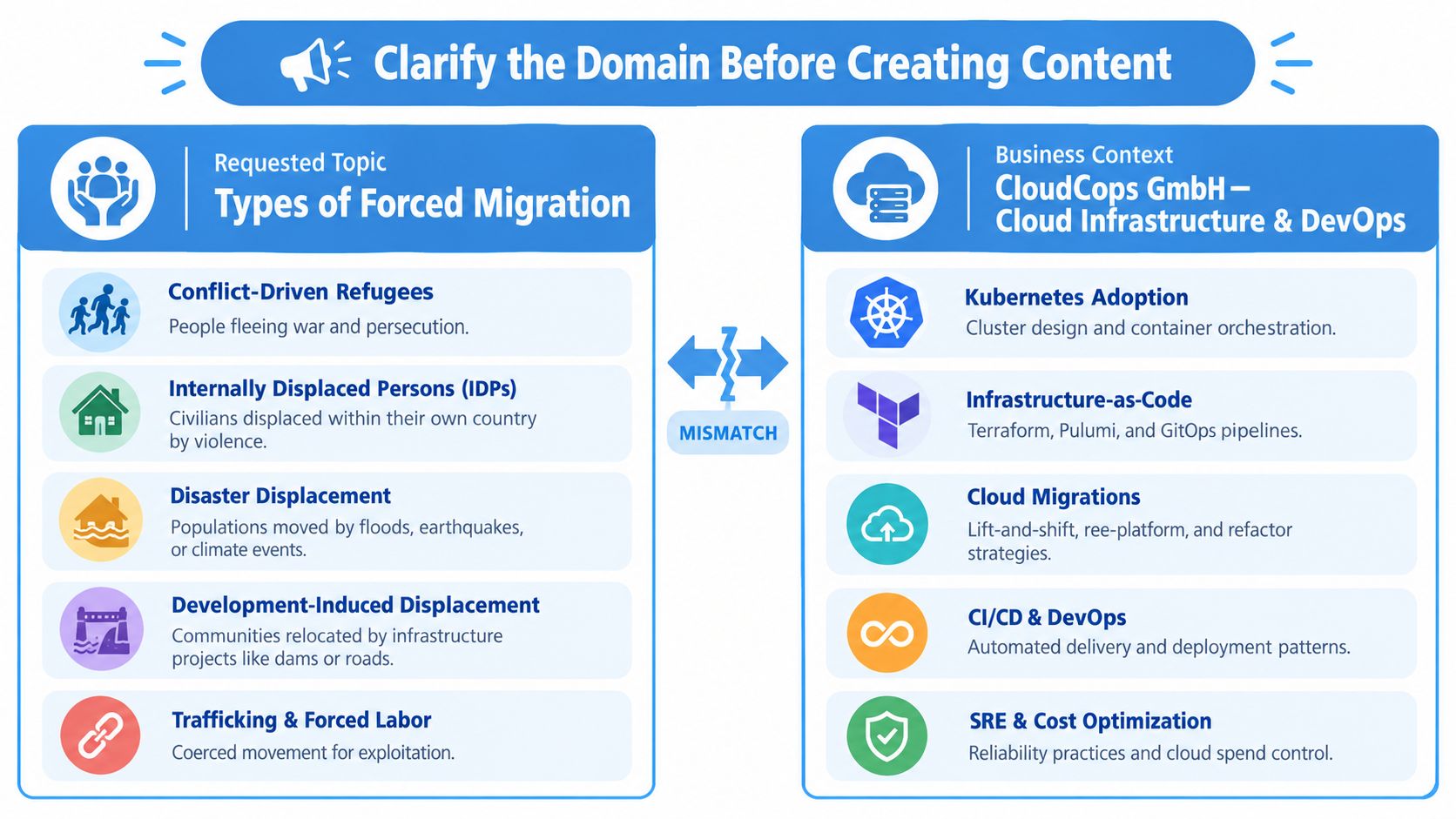
| Issue: Topic–Business Mismatch | Low, primarily coordination/clarification | Minimal time to clarify; avoids wasted effort | Prevents irrelevant deliverables; aligned scope | Intake validation, scoping calls | Ensures content fits audience and goals |
| Topic: Types of Forced Migration (Humanitarian) | Moderate, requires subject-matter expertise | Research time, credible data sources (UNHCR/IOM) | Accurate humanitarian framing and classifications | Academic reports, NGO guidance, policy briefs | High domain relevance and credibility for humanitarian audiences |
| Business Context: CloudCops GmbH (Cloud & DevOps) | Low–Moderate, technical tailoring needed | Cloud/DevOps experts, case studies, tooling examples | Actionable platform recommendations and adoption plans | CTO briefings, platform strategy, consulting deliverables | Direct alignment with company offerings and buyer needs |
| Types of Cloud Migration Strategies | Moderate, workload analysis and planning | Assessment tools, TCO models, engineering effort per app | Prioritized migration portfolio and execution roadmap | Cloud migration programs, portfolio planning | Balances speed, risk, and long-term modernization benefits |
| Infrastructure Deployment Patterns | Moderate, requires automation & observability | CI/CD tooling, feature flags, routing/metrics systems | Safer rollouts, faster rollback, measured releases | Continuous delivery, canary/blue–green releases, SRE ops | Reduces deployment risk and improves reliability |
| Kubernetes Adoption Approaches | High, operational complexity and learning curve | Platform engineers, training, managed services option | Containerized workloads, portability, improved scaling | Platform modernization, microservices migration | Long-term scalability, developer velocity, portability |
| Data Center Consolidation Strategies | High, complex dependencies and compliance | Migration teams, network capacity, DR and compliance planning | Reduced facility costs; centralized operations | Data center exits, colocation consolidation, hybrid setups | Lower fixed costs and simplified operations |
| Legacy System Modernization Patterns | Moderate–High, incremental effort and testing | Engineering resources, test automation, API layers | Reduced technical debt; incremental delivery of value | Strangler pattern, API facades, phased refactoring | Low-risk, incremental modernization that preserves service continuity |
From Labels to Protection and Action
The most useful lesson in studying types of forced migration is that movement, cause, and legal status aren't the same thing. People move for many coercive reasons. Some cross borders. Some don't. Some fall under refugee law. Others need domestic protection, anti-trafficking intervention, disaster response, documentation support, or safeguards during return and relocation.
A practical comparison starts with five questions.
- Did the person cross an international border: If yes, refugee or asylum pathways may matter. If no, look first at internal displacement or domestic relocation frameworks.
- What was the immediate driver: Conflict, persecution, disaster, exploitation, deportation, or a development project point to different systems and risks.
- Was coercion or exploitation involved: This helps distinguish trafficking, forced labor situations, and deceptive recruitment from other migration pathways.
- What protection need exists right now: Shelter, legal status, trauma support, family tracing, documentation, education access, or protection from return may all be central.
- Which response mechanism fits best: Asylum adjudication, domestic humanitarian response, criminal accountability, restitution, planned resettlement, or long-term inclusion may each be appropriate depending on the case.
This approach prevents a common mistake. People affected by forced migration aren't legally interchangeable. A refugee isn't the same as an IDP. An asylum-seeker isn't a refugee with a different label. A stateless person may not have moved at all, yet may face some of the hardest barriers in any displacement setting. A deportee may have a different legal story from a trafficking survivor, even if both experienced coercive movement across borders.
Precise terminology improves more than academic accuracy. It helps lawyers choose the right claims, aid workers design the right services, journalists avoid misleading language, and policymakers match response tools to actual needs. It also helps readers resist oversimplified narratives that reduce every crisis to border crossing alone.
Use the label that matches the facts. Start with the cause of movement, then the border question, then the legal status, then the available response. And because rules, recognition practices, and humanitarian conditions change, verify current details through authoritative humanitarian, legal, and policy sources before drawing conclusions.
CloudCops GmbH works on a very different kind of migration problem: cloud migration, platform engineering, and DevOps delivery for organizations moving systems rather than people. If you came here while researching migration terminology in a technical context, visit CloudCops GmbH for cloud-native architecture, Kubernetes, GitOps, and infrastructure modernization support.
Ready to scale your cloud infrastructure?
Let's discuss how CloudCops can help you build secure, scalable, and modern DevOps workflows. Schedule a free discovery call today.
Continue Reading
Infrastructure as Code Azure: A Practitioner's Guide
Infrastructure as Code Azure. Master infrastructure as code on Azure with Bicep, ARM, Terraform, and GitOps. Practical guidance

What Is Platform Engineering and Why It Matters Now
Learn what is platform engineering, how it differs from DevOps and SRE, the core principles and components, and a maturity roadmap to get started.
Terraform Policy as Code: The Cloud Native Security Guide
Master terraform policy as code. Learn how to enforce governance with Sentinel, OPA, and Terraform Cloud across your infrastructure lifecycle.